Rebuilding After Life Disruptions: Dan Deppen on Career Transitions, Family, and Freedom
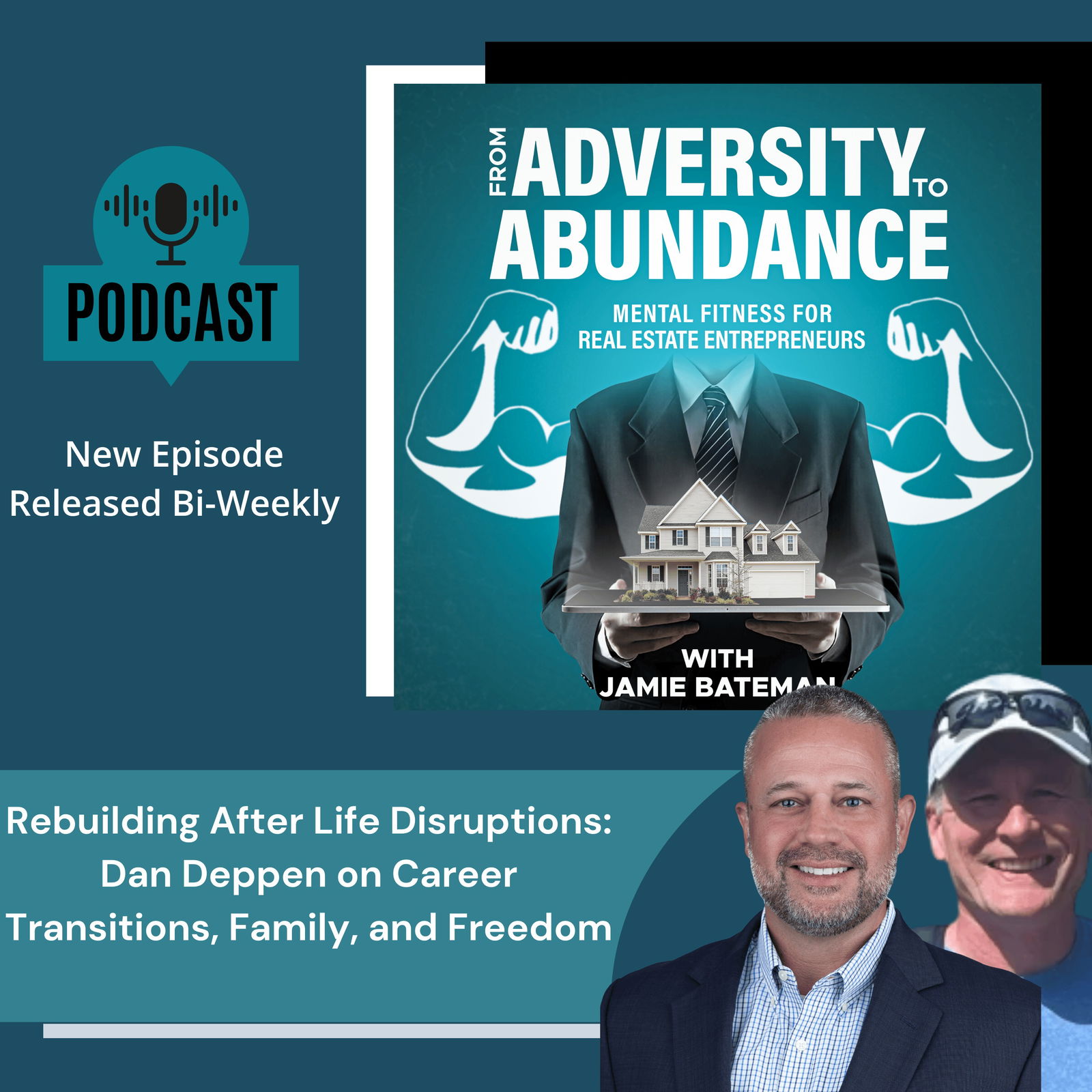


In this episode of From Adversity to Abundance, host Jamie Bateman sits down with Dan Deppen, owner of Call the Underwriter, a company that works closely with seller-finance and owner-finance real estate investors to help create loans for owner-occupied borrowers. But this conversation goes well beyond underwriting and real estate mechanics.
Dan opens up about a season of personal and professional transition that many listeners will find deeply relatable. He shares his experience navigating a recent divorce while simultaneously moving between life as a W-2 employee and entrepreneurship—more than once. Rather than framing these shifts as failures, Dan reflects on how each transition shaped his perspective on work, stability, and what real abundance actually looks like.
Today, Dan is building Call the Underwriter with intention, balancing the demands of scaling a business with the priorities of family, flexibility, and freedom of choice. This episode explores the emotional and mental side of entrepreneurship, the realities of starting over, and how abundance isn’t always about doing less—but about having alignment, options, and purpose. Listeners can expect practical wisdom, grounded insights, and an honest look at what it means to redefine success on your own terms.
Guest Introduction:
Dan Deppen is the owner of Call the Underwriter, a company that supports seller-finance and owner-finance real estate investors by helping structure loans for owner-occupied borrowers. With experience moving between W-2 employment and entrepreneurship, Dan brings a grounded, real-world perspective to business ownership, personal resilience, and redefining abundance through family, freedom, and flexibility.
Episode Highlights:
- Dan’s journey through divorce and major life transitions
- Moving from W-2 employment to entrepreneurship—and back again
- Lessons learned from rebuilding professionally and personally
- What “abundance” looks like beyond money and business growth
- Scaling Call the Underwriter while prioritizing family and flexibility
- Finding stability, purpose, and clarity through change
Key Takeaways:
- Career paths are rarely linear, and transitions don’t equal failure
- Abundance can be defined by freedom, choice, and alignment—not just income
- Entrepreneurship comes with seasons of rebuilding and recalibration
- Personal challenges often shape stronger, more intentional businesses
- True success is about designing a life that supports what matters most
Learn More about Stephen Predmore:
Website:
https://www.linkedin.com/in/dandeppen/
Podcast:
https://podcasts.apple.com/us/podcast/the-note-investor-podcast/id1480182717
Learn More about Labrador Lending:
Integrity Income Fund:
https://labradorlending.com/investors/passive-investors/
Labrador Mentorship:
labradorlending.com/investors/active-investors/
—
Haven Financial Services:
Learn more: jamie.myfinancialhaven.com/
—
Purchase Jamie’s Book: www.amazon.com/dp/B0CGTWJY1D?ref_=pe_3052080_397514860
—
Leave us a REVIEW: podcasts.apple.com/us/podcast/from-adversity-to-abundance/id1618672867?mt=2&ls=1
www.adversity2abundance.com/reviews/new/
Connect with us
Website: www.adversity2abundance.com
Facebook: https://www.facebook.com/labradorlending/
Instagram: https://www.instagram.com/labradorlendingllc/
LinkedIn https://www.linkedin.com/company/labrador-lending/?viewAsMember=true
Youtube: https://www.youtube.com/channel/UChYrpCUlqFYLy4HngRrmU9Q
Connect with Jamie
LinkedIn: www.linkedin.com/in/jamie-bateman-5359a811/
Twitter: twitter.com/batemanjames
Speaker 0
In this episode, we get the chance to hear from Dan Deppin. Dan is the owner of Call the Underwriter. Call the Underwriter works with seller finance and owner finance investors, real estate investors creating loans to owner occupied, borrowers or borrowers, who live in owner occupied properties. But, we we walked through Dan's backstory, and he's been through some things that I think a lot of people can relate to. He's been through a recent divorce. He's also gone from, being a w two employee to being an entrepreneur, back to being a w two employee, back to being an entrepreneur, and we talk about those transitions. And we talk about the abundance that he's living in now, which has a lot to do with family and freedom and choices and flexibility. Not that he's not busy and and working to scale and and improve, call the underwriter. He definitely is. So, you know, I think you're gonna really find some real practical wisdom and nuggets in this one. I hope you enjoy it.
Speaker 1
From adversity to abundance, hosted by entrepreneur and seasoned real estate investor, various niches and a background as a combat veteran, former army officer, and multimillion dollar mortgage note company owner, Jamie brings a wealth of knowledge and inspiring stories to each episode. Through weekly episodes featuring insightful interviews with industry leaders and solo explorations of mindset and strategy, listeners will uncover actionable advice and tips to overcome challenges and build lasting financial success. Whether you're a seasoned investor or just starting, from adversity to abundance is your road map to turning obstacles into opportunities and achieving financial freedom.
Speaker 0
Welcome, everybody, to another episode of the From Adversity to Abundance podcast. I'm your host, Jamie Bateman. And today, we have with us Dan Deppen. Dan is the owner of Call the Underwriter. They focus on mortgage loan origination, and, we're I'm excited to dive into how Dan got involved in Call the Underwriter and and purchased that business. But before we get there, Dan, tell us kind of what you're up to today and and focus a little bit on some of the abundance that you're living in right now.
Speaker 2
Yeah. Thanks, Jamie, for having me on. So yeah. So today, as you mentioned, I'm the owner of Call the Underwriters. So I acquired that from the previous owner, last year in twenty twenty four. And, you know, so kind of my main focus there is helping real estate investors who are originating seller finance notes do it correctly. So it's interesting. Seller finance is a big business. There's a hundred thousand plus loans that get originated every year depending on what data you look at, but it's a little bit of a a dark art. Mhmm. The regulations are a little nebulous for people.
Speaker 0
Yeah.
Speaker 2
Yeah. If you talk to twenty different people that do it, you'll get twenty different opinions Mhmm. On how to go about it. So what I do is basically help investors standardize that, create really good loans that are gonna create cash flows for them, and then also keep their compliance tight and, you know, give them a lot of flexibility in what they can do with the loan after a loan.
Speaker 0
Now we know that we only yours is the only opinion that matters. Right?
Speaker 2
I don't know about that. Like, it's funny. When I was just as a side, before I acquired Call the Underwriter, I was looking at spinning up a competitor.
Speaker 0
Mhmm.
Speaker 2
And so I really wanted to understand the compliance and the regulations and all of that stuff. Mhmm. And there were cases where I would talk to two different attorneys and get different answers to the same questions. So Yeah. Yeah. So I'm sure you'll there's there's many more opinions than than mine.
Speaker 0
Yeah. I get the same thing with just different, you know, real estate, legal topics and questions, very different answers. So
Speaker 2
Yeah.
Speaker 0
So okay. So and I know you have your own mortgage note portfolio as well. We're not gonna focus on that as much. But before we jump into your backstory a little bit, what is your I know you're busy these days with Call the Underwriter and everything else you have going on. What what is, you know, some of the, abundance look like or maybe freedom look like or financial abundance, as far as what you're living in today?
Speaker 2
Yeah. The big one that jumps out to me, like, right this moment, I would say, is is family. So I got engaged, about a year ago, so we'll be getting remarried
Speaker 0
Congrats.
Speaker 2
Next year. Thanks. Yeah. And I got, two daughters. One of them is a sophomore in college doing really well. Just got through, like, the hardest class, you know, of her program and did well in that. And then, my youngest daughter just, two days ago, got accepted. She's a senior in high school. Got accepted to University of Colorado, which is where she had really wanted
Speaker 0
That's awesome.
Speaker 2
To go. So, yeah, so the family stuff is kinda Yeah. Front and center. Great right now.
Speaker 0
What else what else is more important than that? Right?
Speaker 2
Yeah. Exactly.
Speaker 0
So, I know you and I have been through some similar things, and it helps, put, you know, kind of prioritize what's important. But let's jump in back into your backstory for a little bit, and then then we'll get into more of call the underwriter stuff. What what are you know, where do you wanna start? I know you've been through some adversity. I know just for the to for the listener, you know, for context, we don't act like, you know, life has adversity, and then all of a sudden you overcome that and and it's then you're living in abundance a hundred percent. There's always adversity to face. But that's kind of the point of the show is to help us learn from your story, Dan, and and pull out, you know, principles and lessons that maybe we can apply when we know when we when we do face the adversity we know is coming. Mhmm. So, you know, where would you like to start as for as far as your backstory goes?
Speaker 2
Yeah. So I'll I'll you know, just just a quick tour into, like, the kind of professional history. Right? So I'm kind of on my third career now in real estate. So I started as an engineer in the aerospace industry, so I did that for about ten years. Then I went to business school, did my MBA, went into product management. So I worked for Oracle for six years and some startups and some other things. Right? So and then along the way, as a product manager, I found, mortgage notes and got into, basically, note investing, which is, you know, a form of real estate investing, but actually kinda skipped the traditional real estate stuff and and was doing that stuff Yeah. On the side. And then in two thousand eighteen, went full time into notes. And when I did that, it was fairly premature, which I knew at the time. But my wife at the time was still working in aerospace, and the idea was if I go full time in notes, I can even though it's sort of premature on its own. Mhmm. I can really build that
Speaker 0
Mhmm.
Speaker 2
Up. Yeah. And I'll kinda have the freedom to do that. And Yeah. I would say one common theme for me in just about anything I've ever done is everything always, like, takes longer and is harder than what you expect
Speaker 0
Hundred percent.
Speaker 2
In. So that ramp up was, you know, slower than I wanted, and there was definitely a learning curve there, which is sort of interesting because in a lot of ways, though, when I was buying notes in two thousand eighteen, nineteen, I was, I would say, more aggressive than most in scaling up. Mhmm. But not as aggressive as I could have been because I didn't have a huge amount of experience yet, and, like, you don't know what you don't know. So I was a little paranoid about going too big because I didn't wanna make, like, a systemic
Speaker 0
Yeah.
Speaker 2
Error that I didn't know about and create Sure. A big mess. If I had a due over knowing what I do now, I was buying a lot of land contracts at the time that were available. If I had a due over, I'd have bought them all. Like, because there were a lot of good you know, I would have gone, a little bit hard. But it's easy to say, like, knowing now at the time, I didn't know. There there could have been some other issue I wasn't aware of. But then I would say where when the adversity hit was about two years later, so we get into COVID.
Speaker 0
Yeah.
Speaker 2
And then I get divorced.
Speaker 0
Mhmm.
Speaker 2
And then because the no. It was built pretty decent business, but not quite enough, like, to do everything on its own. Sure. So I had to go find another w two Right. Which was now tricky because we were in the middle of COVID, and the whole world was upside down. Right. And everyone was you know, it was just it it was a weird job market, and I had been self employed for two years. Right. And so all of a sudden, that made finding a job, like Right. A lot more challenging than it had ever been in the past. Like, it was kinda funny. Like, you know, when I was an engineer, you know, out of school, it was easy. From the Colorado, it was easy. After my MBA, it was easy. Yeah. And it was kinda funny to me that I was at this point in my career where I actually had tons of experience, like, felt like I knew what I was doing in a way that I never had. And so it was like, when I was like when I had the most to offer, like, people were the least interested, which was kinda funny because, like, when I came out of school with my engineering degree, I didn't know jack shit. But, like Yeah. It was nineteen ninety eight. The job market was hot. Everybody was wanted. So for me, my career has always been inverse. Like, when I've had the least offer, people have been, like, the most interested, which is
Speaker 0
That's funny.
Speaker 2
Which is kinda funny. So just with the whole weirdness of COVID and Sure. You know?
Speaker 0
Yeah. That's a lot.
Speaker 2
Divorce not fun and then trying to find a job and then Yeah. Kinda, like, continuing to try to do more note deals. There was a good six, nine month window there where things just were
Speaker 0
We're not good.
Speaker 2
Not fun
Speaker 0
Yeah.
Speaker 2
For me.
Speaker 0
Yeah. No. I mean and and, you know, I haven't shared until now on my show that I I also recently got divorced, and it's not a it's definitely not a fun process no matter what. So, and you throw COVID and sounds like essentially unemployment, you know, in there. Mhmm. And I I've had a period of unemployment as well, so a while back, but I can I can relate to to the struggles there? You know, we say, oh, we'll just go get a job. And it's like, well, it's not that easy necessarily. But Well
Speaker 2
and and if COVID hadn't hit, it would have been fine. Right? Right. Right. It was like this perfect storm of, like, everything lining up.
Speaker 0
Yeah. Well and then and then with the divorce, that regardless that that almost never helps financially. Right? So I don't know. Yeah. Puts extra stress just the I mean, just just looking at just the fine forget the emotional and all the all the, you know, probably bigger things going on with the divorce, but just the financial aspect of it.
Speaker 2
Yeah. I mean, you go from one household to two, there's an impact.
Speaker 0
Yeah. For sure. So all of a sudden, you have extra pressure, higher expenses. COVID is happening. Everybody's the world is shut down. I mean, that that is a lot for sure. So, yeah. And and I have talked on on different episodes about, you know, there's no not one path to success, and then, you know, it's not like you you must work a w two for twenty years and then you quit your w two and then you become an entrepreneur. And and, I mean, as you've already alluded to, Dan, entrepreneurship is is not easy. It's not for everyone. We don't try to sell it like it's some amazing, you know you know, heaven on earth type thing. And but I love the fact that the to me, this comes back to life has seasons, different paths, you know, for everyone. There's there's you can you can work you can quit your job and be an entrepreneur and then go back to a w two and maybe that's what you need to do for a period of time or, so okay. So just you worked at w two then for for how long, and then how did things go from there?
Speaker 2
Yeah. So then I I I I did find a job after a couple months, which was great. Mhmm. And then what was funny was I found the job, so I'm like, okay. The things are stabilized. I still had the notes business.
Speaker 0
Mhmm. Mhmm.
Speaker 2
And then what was funny was I started the job, and then over the next few months, I had a handful of nonperforming note deals that paid off, like, in a big way. Like, I had these big winners. So
Speaker 0
That's awesome.
Speaker 2
There was just this huge flip where, you know, I got the w two, so kind of the financial pressure was alleviated. Right. The notes business was still making money, and then I had a couple of my best deals ever pay off in the subsequent months. So it just, like, completely wheeled around, like, from one way to Yeah.
Speaker 0
And another. Yeah. And just briefly for those unfamiliar with nonperforming notes and just, you know, especially with nonperforming notes, if you bought them as as nonperformers that you're gonna you would have bought them at a a greater discount, a lower price. So anytime you can get a payoff on non per a note that you bought as a nonperformer if you didn't overpay, that's awesome.
Speaker 2
Yeah. And what was funny was, like so, like, you know, we're in the, like, early twenty twenty one now. Everything wheels around, but what's funny was all of those, you know, deal payoffs were actually the result of things I had done, like, a couple years
Speaker 0
Mhmm.
Speaker 2
Yeah. Previous. Right. Right? So it's not like I did something in those months that paid off. It was actually it was just that that was when the results of what I had done previously happened to show up because you can't schedule payoffs on No. Nonperforming notes as as as you know.
Speaker 0
Yeah.
Speaker 2
And then, like, so so the company I started working with then was kind of a little more than a start up, seven hundred people. They've actually gone public since then. Okay. But then I landed a product manager job at AWS. So for Amazon, which is really hard to get into. Right? Like, that's one of the, you know, the fan companies, Facebook at yeah. Very sought after.
Speaker 0
Mhmm.
Speaker 2
So it was kinda funny after during COVID struggling to, like, find a job at all, I land That one, which doubled what I was making at my previous w two and was, like, almost like when I got the offers, almost like not.
Speaker 0
Is this real?
Speaker 2
Believable. Yeah. So now I'm really, like, smoking. Right? Like, things are going
Speaker 0
good. Before before we move on, I mean, what would you say to somebody who's in the looking back because now you, you know and not that you're not gonna face more adversity, but Mhmm. You you just said you were experiencing a lot of financial abundance that you hadn't been experiencing two years prior. What would you say to someone, you know, from a mental aspect or emotional aspect who's going through something like a divorce or, you know, hopefully, COVID never happens again, but some kind of trial that they're in the middle of, you know, now that you have sort of results to the answers, if you will, you you you you have I mean, sorry. You have access to the results, I should say. You now see so what would you say to somebody who hasn't experienced that abundance that you did experience two years later if they're in the middle of some adversity?
Speaker 2
Yeah. I mean, I I I think the key is you're just always building your skill set and building your value over time. And no matter where you are and, like, let's call it, like, the life cycle of up or down, you you always build that, like, relentlessly, like, whether that means going to school and getting degrees or getting professional experience or getting entrepreneur like like, you're always, like, building that backlog of Yeah. Skills and and resume. And as long as you're, like, always doing that, like, the world can get weird and you can have setbacks or you know? Mhmm. Things can get strange.
Speaker 0
Yeah.
Speaker 2
That stuff will, like, eventually pay off. And so when you do find one of those dips, you know, you just have to kinda it's kinda trite, but, you know, just sort of keep going and trust that that stuff will Right. You know, eventually Yeah. Pay off. You know?
Speaker 0
And and then yeah. And we're not acting like it's not a difficult thing to go through those trials and stuff. Yeah. But at the same time, they really don't last forever, and it it's just hard to see that in in the moment. So I I love that advice of just you don't know how it's gonna turn out for sure, but you're you're always just adding to your skill set and to your, just adding a tool, you know, to your tool belt, if you will, and and, those eventually are gonna pay off. So okay. And then, so I think you were looking at just because I I know you, outside of the show a little bit, you were you were anticipating scaling down your note business and really going all in on calls
Speaker 2
and tracking. Is that right? So along the way, right, so then in what was this? Early twenty three? I actually left the other w two, and so my my real estate stuff was in, like, a at a better position by then because, like, I was continuing to work on that
Speaker 0
Mhmm.
Speaker 2
Along the way, and went back to, you know, full time entrepreneur.
Speaker 0
And what what was your thought process there? I I I know part of it was that the note business was going well. But Mhmm. What else did you consider, you know, when you quit your w two at that point?
Speaker 2
I mean, at that point, it was you you know, every w two job I've had, there were things going on that I didn't like. And what I really like about doing my own thing is I can at least make the strategic decisions.
Speaker 0
Mhmm.
Speaker 2
Right. I I was always annoyed as and I was kinda puzzled at how certain people get into certain leadership positions when they do things that are straight retarded sometimes. You know? You're not supposed to say that, but that that was like, some of it was just Yeah. Absurd. You know? And and so, I kinda like having the the control. So I went and I went back to doing that. I was giving up a lot. Right? So, like, income wise goes down initially. Sure. But it also gives me the opportunity to build things and have
Speaker 0
Right. Because you have a lot more time and focus available.
Speaker 2
Focused and have more control, I would say. If there's a blessing and a curse
Speaker 0
Mhmm.
Speaker 2
For me, but I've always just enjoyed doing Mhmm. A lot of stuff, and I've been able to have different irons in the fire. Right? Like, do a w two and do real estate, take care of kids and blah blah blah. Right. But it's always better if you can focus. Yeah. For sure. That's Right. You know, one of the things it's like I'm like the you know, I say that really, like, I'm saying that to myself. Like, I need to do that.
Speaker 0
No. I got it. I totally get it. I'm bleeding. I think all anyone who has a little bit of an entrepreneurial, you know, whatever, bent, I guess, is a good word, but, is, kinda struggle with that, you know, shiny object syndrome or doing managing too many things. And I can certainly relate to that. So and I've I've mentioned this on other episodes just quickly. You know, people I remember I used to listen to, like, the Bigger Pockets podcast all the time, and they would say, oh, you you just build up your side hustle income so that it matches your w two income. And then when you quit, you have your w two income. And it's like, okay. Well, but you just lost your w two income. You had both, actually. And and number one, that's really hard to do at the same time. Right? Let's just be honest.
Speaker 2
I've done it, and it's and it's hard.
Speaker 0
Yeah. But then you yeah. And you but you are giving up a massive amount of income. Well, substantial. I don't know. It doesn't matter how much, but you're giving up your w two income so that your income is going to drop at that point. You know? And so it's not easy to just walk away from a w two. But like you said, then you do have more time and and energy to focus on what you wanna do. So how did things develop from you for you in twenty twenty three up through today?
Speaker 2
Yeah. So so along the way, you know, I was pretty active in buying notes. And, you know, having done a lot of nonperforming notes, we ended up with REOs.
Speaker 0
Mhmm.
Speaker 2
There have been six or seven that I sold on owner finance. And so I had used company called Call the Underwriter to help with the origination of that. Mhmm. And I had just kinda noticed that in, call it, seller finance, creative finance, sub two, etcetera, the vendor infrastructure in that space, in my opinion, is just very rickety. It's not developed. Yeah. It's just not it's just not there. And so, you know, there was big opportunity to help investors originate loans correctly. So I spent a few months working on setting up a competitor to call the underwriter and doing a lot of digging in, you know, because it's a highly regulated space. And Mhmm. You know, it was very frustrating because you talk to different people, they'll tell you different things, even attorneys. And if you talk to investors, that's the worst because
Speaker 0
Yeah.
Speaker 2
You know, spending a year and a half going down the rabbit hole, I understand this stuff in-depth. But what happens is people understand pieces and then misapply. So a lot of times, there's the rules, but then you have to be very specific about the situation you're talking about Mhmm. And what rules apply. And then it gets trickier because a lot of the rules are very gray. They're not Sure. Like hard lines. And then you can even take it a notch further, and there are things that are technically rules that nobody does that's never been enforced. That's never been enforced. Right. You know? Yeah. Complicates it further. So, anyhow, I was doing that, but then I had caught wind that the the, you know, the previous owner of Call the Underwriter Mhmm. Might be interested in selling.
Speaker 0
Mhmm.
Speaker 2
And so I knew him because I had I was a client. Like, I had originated six or seven loans through them.
Speaker 0
Yeah.
Speaker 2
And so, fortunately, we were able to work something out, which was really nice because I started with some name recognition Yeah. An existing book of clients and business. So instead of starting, like, completely from zero Yeah. You know, you're kinda starting from from a better spot.
Speaker 0
And you showed them your slide deck of the competitor you're about to start and called,
Speaker 2
I I actually actually didn't do that. No. I didn't It was
Speaker 0
it was called don't call the underwriter. No. I'm just kidding.
Speaker 2
That would have been funny. Yeah. That that that would have been, a little more of a gangster negotiating strategy. This is my price that goes down, and I'm gonna do this. So yeah. That's right. I I I didn't I didn't go there. Yeah. I didn't.
Speaker 0
Okay. So then how did that go? You know, obviously, not gonna get into the details of it, but just I've never purchased a business. So how was that Yeah.
Speaker 2
I had neither. And I've got a bunch of lessons learned of things I would do differently. So I would say one parallel to buying a business, to buying notes. When I started buying notes, I did a lot of homework. Right? So I, like, watched all the YouTubes, did a lot of studying. Mhmm. I got some education and training. And then as I got into it, you know, I would just run into all these things.
Speaker 0
Mhmm.
Speaker 2
Code violations on CFDs or Mhmm. You know, other things sellers would do Yeah. That I didn't anticipate and never came up. And then you talk to people in the business, like, oh, yeah. That happens all the time. And I'm like, why why
Speaker 0
Why why didn't you tell me?
Speaker 2
Nowhere along the line, this this came up. Like, nobody said anything. And so I would say, I had a few of those things as well on on the business Mhmm. You know, buying side. So without getting into too much detail on it, but I would say, like, one of one of the opportunities of buying the business was the previous owners did things in a way that was very manual. Right? Like, they basically ran that. They had the loan origination software
Speaker 0
Mhmm.
Speaker 2
A spreadsheet, and an Outlook inbox. And, like, that was about it. And everything was manual. It was like a monkey with a typewriter, you know, doing everything. So And so I'm like, oh, this is cool because I because I can clean that up Right. And make this, Yeah. And come
Speaker 0
up with it from your from your background in software and engineering. And I I know you're big in automation. And
Speaker 2
Yeah. Because, like, if you look at some of the things I had done, right, like, at Oracle, I was the product manager for this thing called storage archive manager that moves data around and archives big files for people. And then at, Ibotta, which is a coupon app, I did this big integration with Walmart where we were automating bringing in their receipt data and matching it, doing all this. And then, you know, AWS with supply chain, we were connecting all these supply chain. You know? So Mhmm. I I was pretty teed up.
Speaker 0
Yeah.
Speaker 2
To to do that. And one of the things I've always liked about loans is while everyone has its own special butterfly, they kinda follow a template. And so to me, the world of mortgage, like, kinda lends itself to that. Pun intended. Yeah. Yeah. I did. That's right. It wasn't actually. Yeah. But but, you know, one of the things I got into, though, that was challenging was I had to get my arms around the business. Mhmm. And it was tricky because everything was manual. The day to day level of the keeping up with stuff was kind of intense. Mhmm. So it was this juggling act of keeping up with files that are coming in.
Speaker 0
Right.
Speaker 2
Learning more of the the whys behind how we do things because you can't really build the ultimate system until you really, really understand it. Sure. So the owners that I bought it from bought it from the guy that started it. Right. And what they did was the guy that started it Yeah. Real really good dude. I still
Speaker 0
Yeah.
Speaker 2
Know him. He trained them, and he Russ. Yeah. Russ O'Donnell. And he's like, here's how you do it. Do this, do this, do that, do that. And what they had kinda done was, like, followed a script that they were given a few years ago. But
Speaker 0
Yeah.
Speaker 2
That script was not optimal.
Speaker 0
Mhmm.
Speaker 2
There were some leaks in that, and so it took a while to figure that out and to change the overall processes. Is. Right. And then, you know, it was just all this manual stuff of
Speaker 0
Yeah.
Speaker 2
Someone submits a term sheet. You have to send them an invoice. You have to do that. And it's all just, like, manual and kept tracking. Right. So a lot of so what I ended up doing was building out a lot of workflow automation on Zoho. Okay. So I've got, like, Zoho forms and CRM. And Zoho is kinda nice because it's got, like, hundred different apps Okay. And they will kind of tie together. So now I've got it where someone submits a deal through a form. It creates the deal and the turn and and the CRM. It populates the data. It creates the invoices. It emails the invoices. It creates custom links Nice. For the borrower to submit their application and credit off. And then when they fill the and it emails it to them. And then when they fill it out with those links, it also populates in the same CRM deal, which we can then push over to the loan origination software. But, you know, you're talking and and there's still a lot to do, but you're talking, like, a year in Right. To get to where I thought I would have been maybe, like, two months.
Speaker 0
Right. Right. Well and but so yeah. You but you had to not only work on the business, but work in the business at at the same time. You you know? So you're kind of building it and optimizing it, improving it while you're executing on, you know Right.
Speaker 2
Yeah. So it's it's kinda tricky. Right? Like, it's a big chicken and the egg problem. You can't automate you can't build the workflow automation Mhmm. Until you understand the business better, and you've gotta have time to do that.
Speaker 1
Right.
Speaker 2
You can't really hire people until you get it a little more under control and have built SOPs. But now where we sit, you know, a little over a year after the acquisition is you got a pretty decent workflow automation and, you know, pipeline management system. So I've got two employees. So, you know, Shante Duffy, you've had on my podcast before, now Bianca more recently. And so it's in a way more stable spot to where now as we get into twenty twenty six, the goal is really gonna be marketing.
Speaker 0
Okay.
Speaker 2
Because before, I almost, like I I've done remarkably little marketing even though I consider myself kind of a marketing guy. Because if I had done a lot of marketing out the gate and pushed clients in, stuff would have fallen on the floor. Now I'm at the point where we can put more in the front end of the pipe and
Speaker 0
Mhmm.
Speaker 2
Scale things up. So that'll be kind of the, hopefully, the next level of abundance.
Speaker 0
Yeah. There you go. I mean and and I just I think the best, and this is from years of not not always doing it correctly, but, you know, the best marketing or sales strategy is to deliver good results. Mhmm. You know? And and it's like, if you're not delivering value through your business, why are you marketing? I know a lot of people might disagree with that, but, you know
Speaker 2
Well, no. You're right. Right? And, like, a lot of the the clients come in through word-of-mouth. Like, you know, real estate investors talk to one another, and so it's grown a lot over
Speaker 0
Yeah. You know,
Speaker 2
if you look at just, like, the last five years
Speaker 0
Mhmm.
Speaker 2
You know, purely, basically, through word-of-mouth Right. For the most part. So
Speaker 0
Sure. And that's just yeah. You wouldn't have that if you weren't delivering value to your clients. So, okay. So now where do you see before we get into some rapid fire questions, where do you see call the underwriter headed in the next, say, two years?
Speaker 2
Yeah. I think in the next two years, you're gonna see more employees and basically more volume and then more of, like, a planned out marketing strategy now that you can kinda put stuff in
Speaker 0
Mhmm.
Speaker 2
The front end without, you know, having to worry about stuff breaking. And then and then continuing to work on the internal process, I call it, like, taking bites of the elephant. I've got a big
Speaker 0
Mhmm.
Speaker 2
Backlog and Trello of things to do, and I'm just, like, just almost daily making little improvements here and there that that add up over time.
Speaker 0
And so just to be super clear on, you know, your client avatar, who is it you know, I know you've you've already kind of said, but, who is it you're you're that you're serving?
Speaker 2
So these are real estate investors who are creating seller finance notes.
Speaker 0
Mhmm.
Speaker 2
So of those, there's a handful of basic models. Sometimes just somebody wants to unload a property, and they wanna preserve cash flow. Sometimes people are converting rental properties
Speaker 0
Mhmm.
Speaker 2
To notes. Like, if they're a retired landlord or they're older and wanna step back
Speaker 0
Yeah.
Speaker 2
That's kinda nice because you can preserve cash flow. It's a little better than selling the property tax wise because now it's an installment sale.
Speaker 0
Mhmm.
Speaker 2
There's a lot of people who are, like, home investors, franchisees. Like, they'll acquire you know, they'll be cash buyers. They'll acquire properties for cheap. Mhmm. And sometimes we'll just flip them with seller finance, either fix and flipping them or just flipping them. Mhmm. And then there's a lot of, just I have a lot of clients, like, in the sub two communities doing those, so creating wrap loans and things. So there's probably four or five basic strategies, but at the end of the day, it's real estate investors who create liens. Yeah.
Speaker 0
And it's but it's more, seller finance, owner finance, for owner occupied.
Speaker 2
Yeah. And so these are owner occupied borrowers for the most part. Now we do have clients who will do investment properties.
Speaker 0
Okay.
Speaker 2
But it's different than, like, the hard money
Speaker 0
Right. Right. World.
Speaker 2
It's a different rule book. Right? It's it's more of a longer term loan with a different set of rules because you have a consumer versus Yeah. And, yeah, a lot of times, people come to me from the hard money lending world where it's like
Speaker 0
Mhmm.
Speaker 2
You know, anything goes investor on investor action where they wanna Right. You know? And that's not how it works when someone's got a primary residence, and if they can't pay, they're good. Somebody's losing their primary. Right. You
Speaker 0
know, with the Yeah. The CFPB and Dodd Frank and all that came out of the two thousand eight crash, That's one big reason for all these, rules. You know, and and a lot of it does make sense to protect borrowers.
Speaker 2
Yeah. To me, like, I would say after a good, like, year and a half, two years of nerding out on the rules. At the end of the day, like, my sort of takeaway is Dodd Frank, Safac, all that stuff, Trid
Speaker 0
Yeah.
Speaker 2
Doesn't tell me to do anything that that I don't already wanna do because it's in my best interests. Right? Right. Right. I wanna know that my borrower can afford to make payments.
Speaker 0
Yeah.
Speaker 2
I wanna disclose everything ahead of time and make sure we're all on the same page and everybody's read the fine print so we don't you know, because whether it's, you know, a loan or some business agreement, right, where you get into disputes or when parties had different ideas of what was gonna happen Mhmm. Going in. Right? So so all that stuff kinda
Speaker 0
It makes sense.
Speaker 2
Make sense. Yeah. Do you work do you really are you gonna have a balloon payment in eighteen months on a owner occupied person who can't get a different loan? Like, really? Like, what are you trying to accomplish with that?
Speaker 0
Have the money right now, why are they gonna have it in a year and a half to to pay it off? Right?
Speaker 2
I mean Yeah. Exactly. Right.
Speaker 0
Yeah. Yeah. Makes sense. Yeah. And that's a big thing, and we'll move forward. But, it's obviously, you you've talked about compliance a lot, but and a lot and one big piece of that is is not proving the borrower's ability to repay, but but, you know, trying to I don't know what the right word is, but trying to estimate and and predict their ability to repay the loan. That's a big part of what you do. Right?
Speaker 2
Exactly. Yeah. And so for me as the lender, right, like, if I'm creating a loan, I wanna understand the risk level of my loan. So I wanna know Sure. How much income does the borrower have? Can the borrower afford to pay me? What other debts do they have? Mhmm. Can they still afford to pay me after they've paid their car payment and whatever else they have?
Speaker 0
Yeah.
Speaker 2
And then what's their willingness to pay or their credit worthiness? Have they paid their bills Sure. In the past? Right? I I I I care about that more than actually, the Dodd Frank bar honestly is
Speaker 0
Pretty low.
Speaker 2
Pretty low. Right? So if something meets Dodd Frank for me as a lender, if I'm making the loan, I'm not necessarily okay with it if it just meets.
Speaker 0
Gotcha. The other thing I'll point out, is that, you know, some of these, investors who are creating these loans, they don't always think, you know, what makes a good I know you've put out content about this, and we've talked about this too. But what makes a good, note for sale? Right? What makes, a note marketable to sell to a note buyer or somebody else? Right? And that's they don't always think about that. And I can say that if I see I was just doing a due a mentorship for someone yesterday, actually, on a call, and we were going through the due diligence because he's buying his first note. And I think and it had it was originated through call the underwriter, and it probably it was probably done, you know, before you bought the business. But Well,
Speaker 2
let me know offline. I probably got all the data
Speaker 0
on it.
Speaker 2
So if you want more info on it, I can help. Yeah. I can And
Speaker 0
but but it I can tell you that it, you know, it it did help me as a mentor feel a little bit better about, you know, just the fact that this was, you know, originated in in a in a an above board way. Doesn't mean it's definitely a hundred percent compliant or or or it's gonna never or it's never gonna miss a payment or something like that, but it's got that extra sort of seal of approval versus somebody just writing a new loan on the back of a napkin.
Speaker 2
Well and the other thing it lets you do. Right? Because you were saying, like like, a lot of investors don't know how to create a sellable loan.
Speaker 0
Mhmm.
Speaker 2
A lot of people who are creating notes. Right? And one of the things I've learned that I didn't understand, I didn't know a year ago, was that a lot of the investors who create notes, it's an entirely different pool of investors than the ones who buy notes. Mhmm. And they don't really talk, and they don't know each other. So I've talked to more than one person creating notes who had no idea that you could even sell the notes, that there was, like, a market for them.
Speaker 0
Right?
Speaker 2
So they don't even know that there's that game. Right. Right. And and for me, the biggest benefit of doing the compliance is even beyond vetting the borrower, which I wanna do anyways. And, you know Yeah. It it's you know, if you create one loan and you do it wrong, it's pretty unlikely you're gonna get a call because of the compliance unless you did something really horrifically bad. But what it does is if you the people who do care about the compliance when they buy a loan are banks.
Speaker 0
Mhmm.
Speaker 2
And there are a number of smaller banks that will buy high quality seller finance paper. And the nice thing is if you can sell to a bank, they will pay more than anyone else. They'll tend to be easier to work with because they have kinda defined processes. Right. And so the biggest benefit, like, of our service is to tee you up to either sell it to an institution, sell it partial to an institution. And then there's a lot of people who can borrow from banks against their loans. That's another one that people don't even think you can do. Like like, I'll go out on the market and buy existing loans and borrow from investors against them. Yeah. All the time.
Speaker 0
Hypothecation. Right?
Speaker 2
Hypothecation. But if I can hypothecate with a bank, that that's gonna be a way lower interest rate than to a private investor. So doing them right has, like, all kinds of crazy benefits for the
Speaker 0
Mhmm.
Speaker 2
You know, for the real estate investor who's creating them. Right.
Speaker 0
Right. Got it. Awesome. Well, we've got some rapid fire questions. Are you ready, Dan?
Speaker 2
I'm ready.
Speaker 0
This one does trip people up a little bit. What's one thing that people misunderstand about you personally?
Speaker 2
They misunderstand about me that I I I think sometimes, like like, when I've met people at conferences, like, they'll hear me on podcasts or hear me talk, I think they make this assumption that everything runs perfectly day to day. Like, I'll say that I've I I screw stuff up Mhmm. Commonly. Like like, I've had a few files that have just, like, despite the systems, like, lost track of and not gotten back to people. Or
Speaker 0
Yeah.
Speaker 2
You know, we've had things that, you know Mhmm. For for all of my emphasis on workflow automation and process Right. The process is not perfect Yeah. Yet. Well, I appreciate that because we we
Speaker 0
like to keep it real on the show, and it's we're not a yeah. I I know you've dealt with some gurus in the past who like to sell things like
Speaker 2
Oh god. Yeah. My buddy. Yeah.
Speaker 0
We won't go there. But, what's one of your biggest failures, Dan, and what did you learn from that experience?
Speaker 2
I think one of the biggest failures was one of my early nonperforming notes where I kind of ignored some warning signs on the outside of the house. So I didn't have enough like, I kinda knew, but I Mhmm. Didn't have enough experience. And then we got into it, eventually got the property back and found out it was a full fledged hoarder house with literally three feet deep of trash throughout it. Wow. It was an eighteen hundred square foot house, and I had to get four forty yard dumpsters. And so I got buried on that one. Mhmm. That was not good. The only saving grace to that one was I didn't use investor money because it was kind of a new thing for me at the time. Right. So, like, when I do something for the first time, I kind of Yeah. Intentionally don't use Right. Investor money in case something like that happens. But, yeah, that was a bad one.
Speaker 0
Would you do differently on that? Just,
Speaker 2
So that one, I wouldn't have bought the note. Okay. Because there were one one of the things I've learned with notes is so when you buy a note, you can't see the inside of the property. You can see the outside.
Speaker 0
Mhmm.
Speaker 2
And what I've kinda learned is whatever you see on the outside, any blemishes, problems, junk, that's gonna be multiplied by ten on the inside.
Speaker 0
That's good advice. Yeah.
Speaker 2
Yeah.
Speaker 0
Speaking of advice, if you could go back and give your eighteen year old self some advice, what would that be? Oh.
Speaker 2
That was nineteen ninety four. I would have bought more Microsoft stock and held it.
Speaker 0
There you go.
Speaker 2
I would've I would've done that Nice. For sure. Yeah.
Speaker 0
That's good. Yeah. If, speaking of of money, what if you were given eighteen or sorry. Ten million dollars tomorrow, no strings attached, what would you do with it?
Speaker 2
Well, I'd go to Scotland and play golf with my fiance because that's something I've been wanting to do
Speaker 0
Nice.
Speaker 2
For a while. I would definitely do that. I would pay off all my investors and just retire any debt, and then I'd go out and put a couple of million in of that into some high quality notes and just kinda create a cash flow that I'm gonna have, like
Speaker 0
Mhmm.
Speaker 2
Forever. But then the rest of it, I'd figure it out.
Speaker 0
Nice. What's a challenge that you're facing in your business right now?
Speaker 2
I think right now, my my biggest challenge is just it's like prioritization and this combination of taking advantage of new opportunities while kinda, like, improving the day to day way that it Sure. Runs. Yeah. It's kinda back to where I said earlier where I tend to, like, try to take on
Speaker 0
Too much.
Speaker 2
A lot because there's a lot of things I can do to make the business run better day to day. There's marketing things I can do to grow it, and then there's a lot of other Yeah. Brand new opportunities that I haven't scratched the surface on.
Speaker 0
Well, and it doesn't
Speaker 2
always picking between those. Yeah.
Speaker 0
Right. Right. It doesn't always mean that the new opportunity is bad or wrong. Right? And and it's like but, you know and, I mean, oftentimes, it is best to focus on the day to day operations and but then you're never finished with that. So you could use that as a crutch to never go into a new venture. Right? So it's Yeah.
Speaker 2
It's like trying to find the balance Yeah.
Speaker 0
Right.
Speaker 2
Of that. Yeah.
Speaker 0
What's one thing that's controversial that you see in the real estate industry these days?
Speaker 2
One of the things that's controversial is, just the whole world of subject two Mhmm. And sub two. So it it's funny. Like, you'll get wildly different opinions on whether that should be done. Mhmm. Or not.
Speaker 0
Where you buy a property subject to the existing mortgage. So the existing mortgage stays on the property. Right?
Speaker 2
Yeah. So and and there's many there there's different flavors of it. But Mhmm. Like, when I say sub two, what I mean is, like, the higher heck. Kind of a high wire act where people will go out. They'll buy a property
Speaker 0
Mhmm.
Speaker 2
Subject to the existing mortgage, so they'll leave that in place. So let's say somebody's trying to sell the property. They can't. Mhmm. The listing expired, but they've got this three percent loan. So you say, okay. I'll buy your property.
Speaker 0
We'll keep the mortgage But I'm
Speaker 2
gonna keep your three percent loan, and then I wheel around, and I sell it to someone else on owner finance for more money.
Speaker 0
Sell the property.
Speaker 2
Yeah. Sell the property. Yeah. And I create a loan for them that's maybe paying me seven or eight percent. So now I'm collecting seven or eight percent. I'm paying maybe three or four percent.
Speaker 0
Mhmm.
Speaker 2
And, also, I've structured this so that I collected a down payment. I also got some cash out of it. It's great.
Speaker 0
Yeah.
Speaker 2
It it it gets you know, some people will say, like, you should never do that because people create messes, blah blah blah. It's one of those things where, my my view on that is, like, done correct. And it's hard mode. Right? There's a lot going on in that. You're Yeah. Creating notes. You're buying property. You're assuming notes. There's things you gotta do to mitigate due on sale. Like, there's a lot happening. If you do it correctly across all the t's, you dot all the i's, and you're in a position where if that underlying loan gets called in, you can deal with it. Mhmm. It's it's an outstanding strategy.
Speaker 0
Mhmm.
Speaker 2
There are a lot of people who do it all wrong and without money in your pocket, and then it's like Mhmm. Playing with fire. It's like it's like the difference between driving down the road at with your hands at ten and two and the seat belt on versus, like, drinking a bottle of liquor and then, you know, doing it. It's like Right. Right. Some people will say, well, driving's bad. Well, no. Driving is fine if you do it Right. Directly. Like, that'll help you if you don't. Yeah.
Speaker 0
Analogy. Yeah. And I I do see some posts in, you know, some of those large Facebook groups about people getting in a lot of trouble, you know, may maybe because they set them the subject two deals up improperly. But I like what you're saying. Don't throw the baby out with the bathwater. Don't just say all subject to is bad.
Speaker 2
Right. Yeah. Done incorrectly, it's bad. I mean, just about anything done wrong is That's true. Bad. But Yeah. True. Yeah.
Speaker 0
Alright. Real real quickly, what's how has financial abundance made your life better?
Speaker 2
For me, it reduces well, it reduces stress
Speaker 0
Mhmm.
Speaker 2
When, you know, you you know, you've got, like, your net worth kind of at a certain point where you've got runway. Right? Mhmm. To me, the benefit of having wealth is it gives me runway and flexibility to do Yeah. Different things. Right? Like, even, like, during that period I talked about earlier, right, where you're, like, looking for a job and doing stuff. Right.
Speaker 0
And if
Speaker 2
you're, like, paycheck to paycheck, man, that is
Speaker 0
It's super stressful.
Speaker 2
Scary as hell. Like, anything can you're you're you're gonna get caught out
Speaker 0
Yeah.
Speaker 2
At some point. To me, it's more flexibility, peace of mind.
Speaker 0
Sure. What is a book or two that you could recommend?
Speaker 2
The, oh, shoot. What's it called? Where I should have it here. Hold on a minute. Bear with me.
Speaker 0
All good.
Speaker 2
Might have it there. I guess I don't have it handy, and I'm drawing a blank on the title, but it's it's basically about the Amazon leadership principles Okay. Written by two guys who were early on at Amazon. So Okay. I would encourage people to just read up on those and take them to heart. It talks about basically being customer focused. So every any company I've ever worked for, right, they're like, we care about our customers. They're number one, blah blah blah. Mhmm. Amazon's the only other company only company I work for that actually takes that stuff seriously. So I I would encourage people to kinda understand those, or you could read some of the old, Jeff Bezos annual letters. There's, like, a real a lot of really good nuggets in there. Like, they they did things very different than other people, had a very long term focus, and an actual, like, legit customer focus, which is part of why that company is where it is. Yeah. Yeah.
Speaker 0
Gotcha. What's one question that you'd you wish I had asked, but I haven't asked you?
Speaker 2
Oh, gosh. I don't know. I think he kinda asked all the big stuff. Yeah. Yeah. Okay.
Speaker 0
Dan Depin, call the underwriter. Where can our listeners find you online?
Speaker 2
Yes. You can find me at call the underwriter dot com. Also on LinkedIn quite a bit, posting there. So yeah.
Speaker 0
Sounds great. Well, Dan, thank you so much. I appreciate you diving into some of the personal adversity that that you went through, and, you know, it does help our listeners realize that, you know, it's it's we all go through adversity of different flavors, and, and you've come out on the other side. Doesn't mean you're gonna never experience adversity again, but, you're experience experiencing abundance now with family life and and doing your own thing, not having to work a w two. Those are too big. I mean, those are fantastic. So congrats to you, and thank you for joining us. I really appreciate it.
Speaker 2
No. Thanks for having me on. It was fun.
Speaker 0
Awesome. And to the listener, thank you for joining us and spending your most valuable resource with us, and that is your time. Thanks, everyone. Take care.
Speaker 1
Thank you for joining us on From Adversity to Abundance. We hope today's episode has equipped you with valuable insights and practical advice to elevate your real estate journey. For more inspiring stories and resources, visit us at w w w dot adversity to abundance dot com. If this episode has inspired you, please share it with a friend who could also benefit from our conversation. Together, let's turn adversity into abundance. Until next time, keep building your mental fitness and your real estate empire.