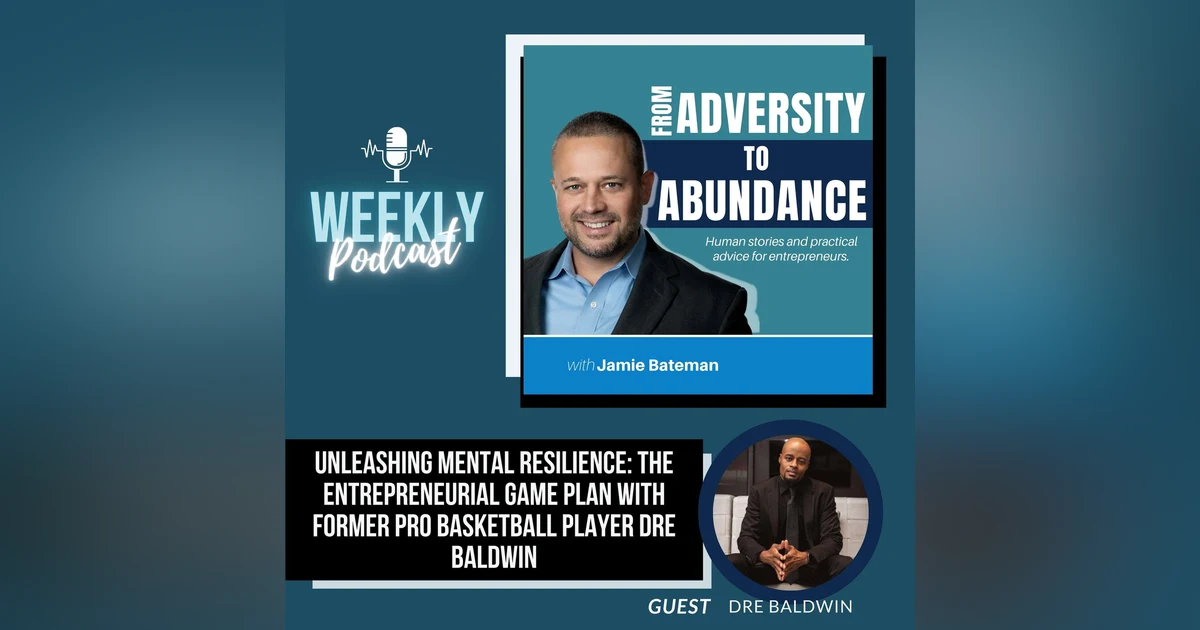
Unleashing Mental Resilience: The Entrepreneurial Game Plan with Former Pro Basketball Player Dre Baldwin


 Apple Podcasts

 Spotify

 Amazon Music

 iHeartRadio

 RSS Feed
Former professional basketball player turned entrepreneur, Dre Baldwin, shares his inspiring journey to success. From selling merchandise online to establishing his brand and coaching business, Dre's story is a testament to the power of self-belief and taking action. But just when everything seems to be going smoothly, a challenge arises that threatens to derail his path. Will Dre be able to overcome this obstacle and continue his journey to success?
In the early years of the new millennium, a young Dre Baldwin found himself wandering through the aisles of bookstores, drawn to the sports and human psychology sections. Little did he know that these seemingly unrelated interests would shape his journey to success. It was during his college years that Dre stumbled upon a network marketing meeting, where he was exposed to a whole new way of thinking about entrepreneurship and money. Intrigued, he dove headfirst into the world of personal development, devouring books by renowned authors like Napoleon Hill and Robert Kiyosaki. These books opened his eyes to the power of mindset and challenged his preconceived notions about wealth and success. Inspired by these groundbreaking ideas, Dre began to carve his own path, combining his passion for basketball with his newfound knowledge of personal development. He started creating content online, sharing his skills and mindset with a growing audience. As his career as a professional basketball player took off, Dre also found himself becoming an entrepreneur, creating products specifically tailored to his dedicated followers. Today, Dre Baldwin is not just a former professional athlete, but a highly sought-after business coach and speaker, helping others tap into their potential and achieve their goals. His journey from adversity to abundance serves as a testament to the transformative power of mindset and the importance of embracing new ideas.
Connect with Dre Baldwin:
WEBSITE: https://workonyourgame.com
https://www.workonyourgameuniversity.com/
LINKEDIN: https://www. linkedin.com/in/dreallday
FACEBOOK: https://www.facebook.com/WorkOnYourGameUniversity
INSTAGRAM: https://www.instagram.com/drebaldwin
TWITTER: https://twitter.com/DreAllDay
YOUTUBE: https://www.youtube.com/@DreB
TIKTOK: https://www.tiktok.com/@workonyourgame
Haven Financial:
https://www.myfinancialhaven.com/jamiebateman/
ATTENTION:
Unlock the secrets to a transformative life with “From Adversity to Abundance: Inspiring stories of Mental, Physical and Financial Transformation”. Buy your copy now and embark on a journey from challenges to triumphs!
AMAZON: https://www.amazon.com/dp/B0CGTWJY1D?ref_=pe_3052080_397514860
Connect with us
WEBSITE: https://www.adversity2abundance.com
Leave us a rating or review: https://www.adversity2abundance.com/reviews/new/ or here
Got comments, feedback or suggestions? We’d love to hear it! https://www.adversity2abundance.com/contact/
Follow From Adversity to Abundance Podcast
FACEBOOK: https://www.facebook.com/profile.php?id=100089126144055
INSTAGRAM: https://www.instagram.com/adversitytoabundancepodcast/
LINKEDIN: https://www.linkedin.com/company/89949391/admin/feed/posts/
YOUTUBE: https://www.youtube.com/@FromAdversity2AbundancePodcast
Connect with Jamie
BOOK: From Adversity to Abundance: Inspiring Stories of Mental, Physical, and Financial Transformation
LINKEDIN: https://www.linkedin.com/in/jamie-bateman-5359a811/
TWITTER: https://twitter.com/batemanjames
0:00 Speaker 0: I really enjoyed this episode. Speaker 0: We get the chance to chat with Drey Baldwin. Speaker 0: Drey is a former professional basketball player Speaker 0: an author. Speaker 0: He's published thirty three books. Speaker 0: He's a business coach. Speaker 0: It this is a very fun and lively Speaker 0: and informative conversation. Speaker 0: We walk through his story. Speaker 0: We don't really focus specifically on one type of adversity Speaker 0: necessarily. Speaker 0: It's a very practical episode that I think you're gonna be able to relate Speaker 0: to. Speaker 0: Lots of ups and downs, Speaker 0: a lot about team sports and also kind of pivoting and listening Speaker 0: to your customer and giving people what they want.
0:46 Speaker 0: He was Speaker 0: an international basketball player used some of the downtime when Speaker 0: his career slow slowed down a little bit to Speaker 0: put out content. Speaker 0: He's been way ahead in the content, game. Speaker 0: He's been putting out content for probably almost twenty years now. Speaker 0: So definitely cutting edge in that space. Speaker 0: Drey has a a big YouTube following, Speaker 0: if you look up work on your game, he's got a big Instagram following. Speaker 0: He's been a public speaker, author, business coach. Speaker 0: He's done a lot of things. Speaker 0: Talks a lot about mindset, a lot about, discipline, Speaker 0: teamwork, Speaker 0: consistency showing up early, doing the right thing, Speaker 0: and and just, you know, a lot of keys to success in this one.
1:36 Speaker 0: Real I really enjoyed this one, and I know you're gonna get a lot Speaker 0: out of it. Speaker 1: Welcome to the from adversity to abundance podcast. Speaker 1: Are you an entrepreneur or aspiring entrepreneur renewer, then this show Speaker 1: is for you. Speaker 1: Each week, we bring you impactful stories of real people who Speaker 1: have overcome painful human adversity to create a life of Speaker 1: abundance. Speaker 1: A life of abundance. Speaker 1: You are not alone in your struggle. Speaker 1: Join us and you will experience the power of true stories and Speaker 1: gained practical knowledge from founders who have turned poverty into Speaker 1: prosperity and weakness into wealth. Speaker 1: This podcast will encourage you through your health, relationship, and financial Speaker 1: challenges so you can become the hero in your quest for Speaker 1: freedom.
2:25 Speaker 1: Take ownership of the life you are destined to live. Speaker 1: Turn your adversity into abundance. Speaker 0: Welcome everybody to another episode of the from adversity to abundance podcast. Speaker 0: I am your host, Jamie Bateman, and I'm thrilled today to have with us Speaker 0: Dray Baldwin of work on your game. Speaker 0: Dray is a business coach and an entrepreneur, and I'm I'm we're gonna we're Speaker 0: gonna have a lot of fun today, former professional athlete as well. Speaker 0: Drake, how are you doing today? Speaker 2: I'm doing excellent, Jamie. Speaker 2: I'm excited for this conversation. Speaker 2: How are you? Speaker 0: Oh, I'm doing great as well. Speaker 0: I also excited. Speaker 0: This is gonna be fun. Speaker 0: We were briefly chatting beforehand about team sports, and I'm, Speaker 0: maybe I'll get to, you know, live some of the relive some of the Speaker 0: glory days in this conversation, but it's not about me though, Drey.
3:12 Speaker 0: It's it's about you and the listener. Speaker 0: So for the listener, tell us who who you are today and what you're Speaker 0: up to today? Speaker 2: Sure. Speaker 2: So, Drake Baldwin, come from the city of Philadelphia. Speaker 2: Now based in Miami, Florida, background in sports played. Speaker 2: As you said, play sports, basketball was my sport. Speaker 2: One year high school ball, walk down and play d three college ball, Nobody Speaker 2: was recruiting me to play pro. Speaker 2: So I'm, basically, hustled and marketed and sold my way into playing pro Speaker 2: basketball. Speaker 2: We've had to a nine year career. Speaker 2: Excuse me. Speaker 2: It wasn't a perfect career because there were times where, no, I wasn't sure Speaker 2: when the phone was gonna ring again. Speaker 2: And in those gaps, I started putting content on the internet. Speaker 2: Doing what I'm gonna do that anyway, but I put constant on internet before Speaker 2: we were calling the content before there was a a cool thing to do.
3:56 Speaker 2: Start to build an audience through, putting basketball videos on YouTube There Speaker 2: was a point about halfway through my career where the phone wasn't ringing. Speaker 2: I started creating, products to sell online, then that's how Speaker 2: I became an entrepreneur because I started creating products specifically from my basketball, Speaker 2: crazed audience. Speaker 2: He just wanted more programs that could teach them how to do the stuff Speaker 2: that I was doing in the videos that I was putting on social media Speaker 2: that we were now calling at social media. Speaker 2: And, that's how it became an entrepreneur. Speaker 2: Kept playing ball for the another five years after that started. Speaker 2: But at that time, players started asking questions about mindset because they just saw Speaker 2: my approach was a little bit different than what they were used to. Speaker 2: This guy puts videos out every day when, again, this was before it was Speaker 2: cool or normal to put content on the internet every day.
4:38 Speaker 2: Now it was normal. Speaker 2: But back then, I was not normal. Speaker 2: So they just want to know why I did it, or how do you Speaker 2: get the confidence to perform in a game the way you're doing practice, or Speaker 2: how do you get the the mindset to keep trying when you face all Speaker 2: these setbacks or you come from this very humble background, as I just explained Speaker 2: to you here, Jamie. Speaker 2: Why'd you even keep the mind that you can make it as a pro Speaker 2: athlete? Speaker 2: You kept having all these, you know, reality telling you that you weren't gonna Speaker 2: make it. Speaker 2: And then Well, how do you get started even doing any of this stuff? Speaker 2: If you wanna play ball overseas or you wanna be an entrepreneur, you wanna Speaker 2: get known on the internet. Speaker 2: These are all things that now people were seeing that, hey, there's a way Speaker 2: that I could we do this, how do I do it? Speaker 2: So they just wanna know how to get started. Speaker 2: So I started, basically in answering those questions, I created the framework Speaker 2: that became work on your game, which I'm sure we'll talk about a lot Speaker 2: here in this conversation.
5:22 Speaker 2: And Yeah. Speaker 2: Kept playing ball till twenty fifteen. Speaker 2: And by that point, I'd already been as I already said, creating a bunch Speaker 2: of stuff online. Speaker 2: I had a nice little name online just from putting up basketball stuff. Speaker 2: Then I was talking about mindset. Speaker 2: I'd already started writing books I was creating courses. Speaker 2: So I already had that stuff kind of going by the time I stopped Speaker 2: playing. Speaker 2: So the normal athlete, you know, when they stopped playing, it's Yeah. Speaker 2: They stopped cold turkey and it's starting to zero. Speaker 0: Absolutely. Speaker 2: Yeah. Speaker 2: So by the time I stopped, I was already doing all the stuff that Speaker 2: I still do now. Speaker 2: So it was a little bit smoother transition for me because of that, and Speaker 2: that's how we got it. Speaker 2: Sure. Speaker 0: That's ex absolutely. Speaker 0: That's the one thing I've that that jumped out to me was obviously, Speaker 0: you know, you want your phone to ring.
6:03 Speaker 0: You wanna get that next that next job. Speaker 0: You're not happy that you're sitting around waiting for the phone to ring, but Speaker 0: sounds like in hindsight, and and we'll we'll drill into this more later. Speaker 0: But sounds like that adversity that you went through actually propelled Speaker 0: you to be more ready for your post Speaker 0: basketball career, which is which is awesome. Speaker 0: And I know we have had professional athletes on the show, Speaker 0: who have done that cold turkey transition, Speaker 0: and it can be it can be earth shattering. Speaker 0: I mean, it can be that's, you know, if your entire identity is wrapped Speaker 0: up in in the sport, which I get. Speaker 0: I mean, I I mean, it's it's very easy to do. Speaker 0: But then all of a sudden, that's not who you are anymore.
6:45 Speaker 0: Man. Speaker 0: Who are you? Speaker 0: Right? Speaker 0: So sounds like you were I could tell you are a hustler and it Speaker 0: sounds like you had You were setting yourself up for success Speaker 0: no matter what. Speaker 0: So that's awesome. Speaker 0: I can't wait to to drill into that, especially the mindset piece. Speaker 0: So let's jump back though and further into your backstory, Drey. Speaker 0: And again, this is where I kind of leave it up to the guest Speaker 0: as far as you know, where you wanna start in your in your story Speaker 0: because what we wanna do is kinda walk through from a younger age Speaker 0: and walk back up through today and pull out and and focus on some Speaker 0: of the the real adversity that you've been through and how you were able Speaker 0: to overcome that adversity, how you were able to get through that adversity and Speaker 0: get to quote, unquote, abundance.
7:29 Speaker 0: And and the the goal here is for the listener, the entrepreneur out there Speaker 0: to learn from your story, take lessons that, you know, Speaker 0: that you've learned and, used in your own life. Speaker 0: And maybe be able to skip some of the pain that that you've had Speaker 0: to go through. Speaker 0: But but still learn from your story and apply that in in their life. Speaker 0: So let's jump back where do you wanna start, Ray? Speaker 2: We'll always go to probably around the turn of the century. Speaker 2: So this is around, two ninety nine, two thousand. Speaker 2: Okay. Speaker 2: And that's around that time, this is, graduate high school in the year two Speaker 2: thousand. Speaker 2: So forty more years of age today, graduate high school in two thousand. Speaker 2: And that was where I used to always go to the bookstores, and my Speaker 2: mom is a big, she's in education.
8:12 Speaker 2: So she always been into reading, and she would always go to the bookstore, Speaker 2: and this is before you buy books online. Speaker 2: So you had to go to the store that if you wanted books. Speaker 2: And I would always whenever I was with her, I would just wander to Speaker 2: the sections that I like. Speaker 2: So I'll go to the sports section and also the time they called a Speaker 2: human psychology, now they called personal development, but didn't have a personal development section Speaker 2: back then. Speaker 2: And that's when I stumbled across my favorite book, which is forty eight volts Speaker 2: powered by Robert Green. Speaker 2: And that's really where I start to get into, that personal development even more Speaker 2: because I was Speaker 2: always into the psychology stuff, like, how does the brain work and how does Speaker 2: it affect our actions, but I didn't know there was a whole genre for Speaker 2: it. Speaker 2: And then the way that I really got introduced to it was a couple Speaker 2: years later.
8:53 Speaker 2: It's about two thousand one, two thousand two. Speaker 2: I'm on my college campus. Speaker 2: I'm with Penn State University Altuna campus is where I I went for basketball Speaker 2: specifically. Speaker 2: And there was this, bulletin board posting And for those who don't know what Speaker 2: that is, this people had the the one ten out something you had to Speaker 2: put on a board. Speaker 2: It wasn't digital. Speaker 2: You had to actually put it up on a board. Speaker 2: People walk past on campus, and they said, make extra money in the in Speaker 2: the summer and all of that. Speaker 2: And this is before college athletes can make money off their name, image, and Speaker 2: likeness. Speaker 2: So you really couldn't make any money when you're a college athlete. Speaker 2: As you go into school and play in the sport, you have no time. Speaker 2: So I responded to this bulletin board posting, and this guy was in network Speaker 2: marketing. Speaker 2: And I didn't know what network marketing was, but he briefly explained the concept. Speaker 2: And when I went back to Philly where I'm from that summer, I went Speaker 2: to a couple hotel meetings for this network marketing company.
9:39 Speaker 2: And the reason why this matters is because in that meeting, two things happen. Speaker 2: Number one, the man speaking from the stage was speaking about Speaker 2: entrepreneurship and money and business in ways that I had never heard explained. Speaker 2: And at this point, I'm twenty one, twenty two years of age. Speaker 2: And I'm in I'm majored in business. Speaker 2: I have a business degree. Speaker 2: And things that this guy was talking about in this hotel meeting, they did Speaker 2: not teach at the college campus that I went to. Speaker 2: And I'm like, the way these people are talking about money is completely different. Speaker 2: Nobody's ever talked about it like this before, and I thought I was pretty Speaker 2: smart. Speaker 2: Right? Speaker 2: That was number one. Speaker 2: And number two, and what he was doing. Speaker 2: A lot of what he was doing was just breaking your false beliefs about Speaker 2: how you think money works and how you think business works and how you Speaker 2: think are your options for making money.
10:20 Speaker 2: Not just what you think they are. Speaker 2: There's a lot of different ways to make money besides what you think you Speaker 2: know. Speaker 2: And that's what he was doing for half the people in the room. Speaker 2: The other half the people in the room were already in the business. Speaker 2: So they already heard for there's just no nine minutes. Speaker 2: And then the other half of it, the other thing that I got from Speaker 2: that meeting was at the end of it. Speaker 2: He said, when you all leave, there's a table outside with some nice lady Speaker 2: sitting at the table. Speaker 2: They're selling personal development books. Speaker 2: Make sure you buy those books because in order to build your business, you Speaker 2: gotta build yourself as a person. Speaker 2: I've never heard anybody say that before. Speaker 2: And, again, in that meeting, I it was just these groundbreaking ideas that as Speaker 2: soon as I heard them, they made perfect sense to me. Speaker 2: And That's how I knew there was a thing called personal development, because he Speaker 2: was mentioning these authors, Jim Rome, Brian Tracy, Tony Robbins, Speaker 2: zig zigler, Napoleon Hill.
11:02 Speaker 2: I never heard of these people. Speaker 2: And but he kept saying their names. Speaker 2: And I did not buy the books when I left the meeting because I Speaker 2: was a broke college kid. Speaker 0: I had no money Speaker 2: to get home from the media. Speaker 2: But I went on eBay. Speaker 2: And this is before Amazon was the place to buy stuff. Speaker 2: I went on eBay. Speaker 2: And I bought a couple of, prided copies of a couple of books. Speaker 2: Okay. Speaker 2: So I bought two. Speaker 2: I bought, they were ninety nine cents a piece. Speaker 2: It was, they can go risk by Napoleon Hill. Speaker 0: Mhmm. Speaker 2: And it was rich dad poor dad by Robert Kiyosaki. Speaker 2: And I bought both of those books, and all I got was a word Speaker 2: document from the person who sold it to me. Speaker 2: And I I read both of those books and what Napoleon Speaker 2: Hills book taught me was that there's a way that you could consciously and Speaker 2: intentionally also thoughts of your mind that will lead to alteration and the results Speaker 2: of your life.
11:48 Speaker 2: And again, new idea to me. Speaker 2: Secondly, and that became pretty much what I do for And secondly, it Speaker 2: was Robert Kiyosaki. Speaker 2: He took it even further than what I heard in that hotel meeting when Speaker 2: it came to business and making money. Speaker 2: I mean, and reached that port at the first two or three chapters of Speaker 2: that book. Speaker 2: He's taking everything that most people think they know about how money gets made Speaker 2: and he's stepping around the window. Speaker 2: Yeah. Speaker 2: Breaking it into pieces and saying, okay. Speaker 2: You know, there are people who make money in a way different way than Speaker 2: this. Speaker 2: Right? Speaker 2: And when I read that book, I said, okay. Speaker 2: When I got out of college, I knew I wanted to play basketball first. Speaker 2: I said, I'm gonna play ball. Speaker 2: But after basketball, new basketball would not last forever, especially since I was coming Speaker 2: from a d three school, who knows how long I'm even gonna get to Speaker 2: put. Speaker 2: Sure. Speaker 2: But after basketball, What this guy's talking about, this is the direction that I'm Speaker 2: going.
12:32 Speaker 2: I'm not gonna go and do the normal, get a job, work nine to Speaker 2: five, live happily ever after. Speaker 2: I'm not gonna do that. Speaker 2: I'm gonna do what this guy's talking about. Speaker 2: I didn't quite understand it then, but I knew that's what I was gonna Speaker 2: do. Speaker 2: So those two stories Yeah. Speaker 2: That's really what set me on the path for where I'm at today. Speaker 0: No. Speaker 0: That's that's fantastic. Speaker 0: And you're absolutely right. Speaker 0: I mean, it's I mean, you know, I'm familiar with those concepts now. Speaker 0: You know, so so But at the time, when I was twenty one, twenty Speaker 0: two, I had no idea. Speaker 0: I I had no I yeah. Speaker 0: That that would have been all far foreign to me as well. Speaker 0: I mean, there's, you know, think you said your mom was in education. Speaker 0: My my mother Yes. Speaker 0: Was as well. Speaker 0: And so this is not a slam on public school teachers or anything like Speaker 0: that.
13:14 Speaker 0: The public school system, private school system, anything. Speaker 0: But they do in general, it does not prepare you for Speaker 0: making money as an entrepreneur or invest or thinking outside the box in Speaker 0: any way, shape, or form. Speaker 0: So, yeah, I love that. Speaker 0: I mean, I do remember Rich Dad, being a a mindset shift for Speaker 0: me as well. Speaker 0: It it's not so much to the how to, like you said. Speaker 0: I mean, it's not really in the nuts and bolts of know, how to Speaker 0: make money on investment property or something like that. Speaker 0: Right. Speaker 0: Cash flow quadrant and some of his other books get a little more detailed, Speaker 0: but But it's that mindset shift of the paradigm shift. Speaker 0: And I love the fact that at a pretty early age, you were Speaker 0: you realize the value of investing in yourself.
13:58 Speaker 0: I mean, that's awesome. Speaker 0: And you also were taking the long term view. Speaker 0: Because you you like you said, you knew basketball wasn't gonna wasn't gonna last Speaker 0: forever. Speaker 0: So okay. Speaker 0: So so Alright. Speaker 0: You get this mindset shift, but you still decide. Speaker 0: Okay. Speaker 0: This this is what I'm gonna work on kind of in the background. Speaker 0: It sounds like, but I'm gonna pursue basketball. Speaker 0: So let's so how did that how did your basketball career go at that Speaker 0: point? Speaker 2: Yeah. Speaker 2: So, one thing you said that Jamie is that you won't sign the education Speaker 2: system. Speaker 2: I will slam the educational system now. Speaker 2: My mom is my mom is in the system. Speaker 2: My sister is a professor as well. Speaker 2: I'm a slam the people in the system. Speaker 2: I'm slamming the system. Speaker 0: That's that's fair. Speaker 0: I and honestly, I don't think my mom listens to this anyway.
14:40 Speaker 0: So she should, though. Speaker 2: But but she didn't create the system. Speaker 2: She she supports it. Speaker 2: Absolutely. Speaker 2: Not on her. Speaker 0: It's the same Speaker 2: way as not a mom. Speaker 2: Right. Speaker 2: So Absolutely. Speaker 2: Yeah. Speaker 2: So, the moving forward, then I kept that in the back of my mind Speaker 2: with Kiyosaki. Speaker 2: So I get out of school two thousand four. Speaker 2: I didn't have a didn't get an offer to play pro immediately. Speaker 2: I worked a couple of regular jobs from that first year graduating and worked Speaker 2: at FootLocker as an assistant manager. Speaker 2: I worked at a gym called Valley total fitness selling memberships. Speaker 2: Mhmm. Speaker 2: Yeah. Speaker 2: Valley's out of business now. Speaker 2: No. Speaker 2: Not because of me. Speaker 2: I sold a lot of memberships. Speaker 2: Alright. Speaker 2: So I I I got pretty good commission So in the summer of two Speaker 2: thousand five, so I've been out of school for a year. Speaker 2: I, saved up my money, went to this event called an exposure camp. Speaker 2: You familiar with those, Jamie?
15:21 Speaker 0: I I've heard of the concept, but but, fill me in. Speaker 2: Okay. Speaker 2: Suppose account's like a job fair, but it's for athletes. Speaker 0: K. Speaker 2: Got it. Speaker 2: So any athlete who thinks they're good enough at the next level, whatever that Speaker 2: may be. Speaker 2: Because nowadays, I see. Speaker 2: For, like, eighth graders. Speaker 2: But, like, it was relatively new. Speaker 2: It was usually for people want to play pro. Speaker 2: So these are destination events where you pay money. Speaker 2: It's not free. Speaker 2: You pay to attend this event. Speaker 2: And then a bunch of athletes who think they're good enough to play at, Speaker 2: program or whatever sport we all come, we all pay, and we all basically Speaker 2: play with it against each other for a couple of days to try to Speaker 2: prove that we're good enough. Speaker 0: Sure. Speaker 0: We we had we had just real quickly in La Cross. Speaker 0: It wasn't for to GoPro, but, you know, coming in in high school, we Speaker 0: had a couple camps. Speaker 0: You could go to top two zero five top star.
16:04 Speaker 0: That the goal was not to get better. Speaker 0: The goal was to show that Speaker 2: you're good. Speaker 2: Exactly. Speaker 2: Right. Speaker 2: So what's the where's your profile? Speaker 2: Yep. Speaker 2: Absolutely. Speaker 2: The same way they have AAU in high school. Speaker 2: It's like that, but for pro and you had to pay for these. Speaker 2: So the audience at these events are not just random people. Speaker 2: They're some random, but mostly it's, agents, coaches, managers, scouts, team owners from Speaker 2: all over the world. Speaker 2: They come to these places on purpose looking for their next employees, basically. Speaker 2: So I saved up two hundred fifty dollars in cash as someone who calls Speaker 2: to go to the event. Speaker 2: I had to save this money up just to give it via a a Speaker 2: idea where I was at at this point. Speaker 2: I'm still living in my parent's house, and I had to call the event Speaker 2: ahead of time and ask them, can I pay you cash at the door? Speaker 2: Because I didn't have a credit card or a bank account at this point.
16:47 Speaker 2: Twenty three years of age. Speaker 2: And they said, yeah, we'll take you can pay us in cash. Speaker 2: They wouldn't take anybody's money. Speaker 2: I later found out. Speaker 2: They they said I'll take no money. Speaker 2: And I had to negotiate with my boss to get three days off. Speaker 2: I need it off Friday, Saturday, Sunday. Speaker 2: And you guys have worked in any kind of retail. Speaker 2: Nobody gets the weekend off. Speaker 2: Right. Speaker 2: So I had negotiated to get the weekend off. Speaker 2: We rented a car in Philly. Speaker 2: The event was in Orlando. Speaker 2: That's about a fifteen to nineteen hour drive. Speaker 2: I don't remember the exact amount, but it's a long drive. Speaker 2: We hopped out of the car, nine AM Saturday morning was happened to be Speaker 2: the exact start time of the the camp. Speaker 2: And tell people I could get away with that at Ace twenty three. Speaker 2: He couldn't do it now, but we did it. Speaker 0: Yeah. Speaker 0: No no warm up. Speaker 2: Yeah. Speaker 2: Exactly. Speaker 2: Jump right out the car and start playing. Speaker 2: That was completely fine. Speaker 2: And I played pretty well at the event. Speaker 2: Got a good scouting report, which is basically that was important because now I Speaker 2: had a third party saying that this guy is he can play.
17:33 Speaker 2: And I got the footage from that event. Speaker 2: Now I did not get signed to a contract on the spot even though Speaker 2: I played well. Speaker 2: I had to be back at work Monday morning at Valley Total Fitness. Speaker 2: So we hop right back in that car. Speaker 2: Drove right back to Philly. Speaker 2: I had to be back at work. Speaker 2: And here's what I started doing, Jamie. Speaker 2: I knew that for me to play pro, I knew I was probably not Speaker 2: gonna play for the Knicks or the Lakers immediately. Speaker 2: I was probably gonna go overseas, but I never even been overseas, let alone Speaker 2: that I know anybody. Speaker 2: So how am I gonna make that happen? Speaker 2: The internet did exist at the time. Speaker 2: It wasn't what it is now, but it existed. Speaker 2: I'm on Google, and I started googling basketball agents. Speaker 2: So anywhere that I saw a basketball agent, many of them had websites at Speaker 2: this point. Speaker 2: If they had a phone number, I called them.
18:14 Speaker 2: I was cold calling basketball agents in the summer of two thousand five. Speaker 2: And I was just telling him, hey, here's who I am, here's what I Speaker 2: have, because at this point, some people may be wondering, why don't you do Speaker 2: this bash year when you graduated? Speaker 2: Well, now it has some collateral. Speaker 2: It has some proof. Speaker 2: Now I'm calling them and saying, hey, I got the scouting report. Speaker 2: I can send you the link to the scouting report. Speaker 2: I got this footage. Speaker 2: I called sixty basketball agents out of that sixty twenty of them said, okay. Speaker 2: Let me see what you got. Speaker 2: Now mind you, the footage that I was sending them was not a link. Speaker 2: The footage was on this thing called a VHS tape. Speaker 2: You remember VHS? Speaker 0: Sure do. Speaker 2: Okay. Speaker 2: So you're gonna be able to listen to this ask a parent in Google Speaker 2: with. Speaker 2: Yes. Speaker 2: I had a VHS state, and I had a double decker BCR at home Speaker 2: again. Speaker 2: And those of you who know that is Google with And I would make Speaker 2: copies of my my that Master VHS statement.
18:56 Speaker 2: That was the footage. Speaker 2: I couldn't give out the main the Master footage. Speaker 2: I made copies of the tape. Speaker 2: And I would mail those out to the agents who asked to see it. Speaker 2: So twenty agents asked to see the footage. Speaker 2: I mailed those out on my own dime. Speaker 2: Mind you, I just had to save up two hundred fifty dollars. Speaker 2: So I'm mailing out these these tapes and bubble mailers to agents Speaker 2: all over the world. Speaker 2: Out of those twenty who I mailed it out to, one agent hit me Speaker 2: back and said, alright, I'll represent you. Speaker 2: He became my agent and in August two thousand five, he called Speaker 2: me and said, hey, I got a teammate with Wayne. Speaker 2: They're gonna do the deal. Speaker 2: And it took about three days. Speaker 2: It was done. Speaker 2: And then I was on a plane. Speaker 2: I was in Conness, Lithuania, and that's how I got my pro basketball career Speaker 2: started. Speaker 0: Wow. Speaker 0: That's awesome. Speaker 0: And, yeah, you're definitely yeah.
19:37 Speaker 0: I mean, you can tell you hit an obstacle and you figure out a Speaker 0: way around it or way over it, that can I can tell that already Speaker 0: for sure, which I think goes back to the the mindset investing in yourself, Speaker 0: investing in that Speaker 0: positive mindset and and, self development? Speaker 0: Okay. Speaker 0: So you go to Lithuania. Speaker 0: You don't know anybody there. Speaker 0: I mean, that's I mean, I'm sure it's exciting, but it's probably pretty scary Speaker 0: too at the at the same time. Speaker 0: What's going through your mind at that at that point? Speaker 2: No. Speaker 2: I was excited. Speaker 2: I wasn't nervous at all because Gotcha. Speaker 2: You gotta you gotta remember, Jamie. Speaker 2: This is two thousand five. Speaker 2: So we don't have the internet that we have now didn't exist we didn't Speaker 2: have social media. Speaker 2: So I had to I was looking up with Wayne, and I was like Speaker 2: Google Earthfing, like, with Wayne, whereas that all you don't know anything about Speaker 2: what's going on in other parts of the world.
20:25 Speaker 2: So I wasn't nervous at all. Speaker 2: I was excited because I'm finally getting to do what I wanna do. Speaker 2: And you gotta remember what what was I doing before this? Speaker 2: I'm working at Valley total for this living in my parents. Speaker 2: I I'm trying to get out of it. Speaker 2: Right? Speaker 2: And so I just that right there represented, like, all this Speaker 2: stuff that I've been doing, it's it's working. Speaker 2: Alright. Speaker 2: This is this is success Sure. Speaker 2: To get out of there. Speaker 2: So this will was excited more than anything. Speaker 2: Just wanted to go over there and play. Speaker 2: And Awesome. Speaker 2: That's how I that's how I started. Speaker 2: And, again, this is a fall two thousand and five. Speaker 2: And what was your question? Speaker 0: Yeah. Speaker 0: Just what's going through your mind at that point, and and, I mean, it Speaker 0: sounds like you're just you're just excited to because it's for the new adventure Speaker 0: and the new opportunity.
21:07 Speaker 0: Right. Speaker 0: And like you said, maybe well, you didn't say this, but ignorance is bliss. Speaker 0: You don't know any of the downsides of this Rainier where where you you Speaker 0: know, where you're headed and and, it sounds like it's it's all hope and Speaker 0: excitement at that point. Speaker 0: But, so how does how do things progress career wise from there? Speaker 2: Well, that was, you know, it was the first place that I played. Speaker 2: And then I I was back from there, then I played for a a Speaker 2: traveling team in the USA, Then I was in after that, went to Mexico. Speaker 2: From there, it was if I'm keeping this in chronological order, then I was Speaker 2: in Montenegro, then Germany, we're just going years and years here. Speaker 2: So then after Germany, that's when I found myself, my Speaker 2: career was stalled out.
21:47 Speaker 2: That was the period where I told you I start creating the products. Speaker 2: There's about two thousand between two thousand nine and two thousand eleven. Speaker 2: That's when all the things that became who I am today Gotcha. Speaker 2: Lotion because Speaker 0: I see. Speaker 2: There were period where my phone wasn't ringing and I asked myself, okay. Speaker 2: By this point in my mid to late twenties, so I'm like, okay, this Speaker 2: isn't this is cute when you're at twenty three is not cute when you're Speaker 2: at twenty eight. Speaker 2: Right? Speaker 2: So now what do you you gotta actually do something. Speaker 2: And that's when I started creating what became this whole work on your game Speaker 2: brand because now I can make money. Speaker 2: I can monetize I was doing on the internet, which again was a relatively Speaker 2: new thing for the average person. Speaker 2: Now there are some experts out there who've been doing it for decades, but Speaker 2: I was a pretty average person when it came to internet knowledge.
22:28 Speaker 2: I was a I've always been a big computer geek, but I didn't know Speaker 2: ins and outs of selling stuff online, but I picked it up pretty quickly. Speaker 2: I was early adopter. Speaker 2: And during that period, that's when the selling products happened. Speaker 2: That's when I started using the phrase work on your game. Speaker 2: That's when I started talking more mindset. Speaker 2: That's when I started creating I started writing books. Speaker 2: So all four of those things happen at the same time, and all four Speaker 2: of those things are a big part of what I do today. Speaker 0: It's awesome. Speaker 0: And you've written how many books at this point? Speaker 2: Officially thirty three. Speaker 0: Wow. Speaker 0: So I I put one out. Speaker 0: And quite honestly, it was based on the podcast content, Speaker 0: it still was a good bit of work. Speaker 0: But, man, that's, Speaker 0: one book is is hard enough to get out That's awesome.
23:09 Speaker 0: But so when you're just curious when you're at that Speaker 0: point when your basketball career was kind of like Speaker 0: you know, on hold, if you will, or just, you know, drying up. Speaker 0: I don't yeah. Speaker 2: Stalled. Speaker 2: There you go. Speaker 0: Was that, were you dealing with injuries or was it more just, hey, Speaker 0: you're getting a lot you're getting a little bit older losing a step or Speaker 0: what what was the reasoning for that? Speaker 2: None of the above is just nobody was calling. Speaker 2: It was just I was in my I was you would say these are Speaker 2: this is like a prime year. Speaker 2: So two thousand and nine, I was twenty seven years of age. Speaker 2: Sure. Speaker 0: Yeah. Speaker 0: Yeah. Speaker 2: This should be in my prime. Speaker 2: So, yeah, I'm like, yeah, I should be this should be the year everybody's Speaker 2: calling, but nobody's calling.
23:49 Speaker 2: Yeah. Speaker 2: Sometimes in the athletic world is kinda like the, like, the entertainment world. Speaker 2: Like, you're in between, acting gigs and your phone's not ringing. Speaker 2: So you're working at Starbucks. Speaker 0: Yeah. Speaker 0: Absolutely. Speaker 0: And, I mean, you can't control everything. Speaker 0: And and and to be clear, I mean, we're talking I remember playing Speaker 0: at Gettysburg playing some pickup basketball with the guys you know, who played on Speaker 0: the team at Gettysburg. Speaker 0: And, you know, the the team was average, you know, average Speaker 0: d three team. Speaker 0: I think they were pretty good, you know, but But when I played them, Speaker 0: it was just like they were amazing. Speaker 0: Like, so it's all relative. Speaker 0: Like, this is we're talking you're playing at an elite level at that point. Speaker 0: Like, so it's easy for us to say, like, oh, you you weren't getting Speaker 0: picked up.
24:31 Speaker 0: I mean, it's like, yeah. Speaker 0: Right. Speaker 0: You're still an excellent basketball player, but Okay. Speaker 0: So how so it sounds like you did do you had another stint in Speaker 0: basketball after that period when you okay. Speaker 0: How did that go? Speaker 2: So that was so there was a period for about a year where nothing Speaker 2: happened basketball was. Speaker 2: And I wasn't well, obviously, playing basketball, but I wasn't signed to a contract. Speaker 2: And the thing is I started to get more known is at this point, Speaker 2: we're talking two thousand and nine, two thousand ten. Speaker 2: So at this point now, the average person is now going to the internet Speaker 2: for things instead of turning on the TV. Speaker 2: That's when this period started to happen. Speaker 2: This is when this this whole cultural shift began. Speaker 2: This is when we start using phrases like content, social media, and these were Speaker 2: brand new terms.
25:14 Speaker 2: And I was pretty known in these places because I've been putting content now Speaker 2: since two thousand and five. Speaker 2: So when people came on the internet, if you looked up basketball in two Speaker 2: thousand ten on the internet, you know my name. Speaker 2: Like, everybody knew my name because I had more content out than everybody put Speaker 2: together. Speaker 2: So at this point, the fact that I had videos on YouTube was Speaker 2: more relevant. Speaker 2: It was more important for my name than the fact that I've been a Speaker 2: professional athlete the YouTube videos. Speaker 2: So that's what started happening at this time. Speaker 2: So now I started monetizing it. Speaker 2: Now YouTube allows you to make money of ad revenue based on how many Speaker 2: people watch your video. Speaker 2: Now I had products that I was selling. Speaker 2: All I did was put a video on YouTube. Speaker 2: I would do a drill. Speaker 2: Like, here's to dribble between your legs. Speaker 2: If you want a whole program on how to dribble between your legs, go Speaker 2: to distantly right here.
25:57 Speaker 2: And I'm selling these programs. Speaker 2: So at this point, Jamie, I'm like, okay. Speaker 2: My phone never rings. Speaker 2: I never get another call to play overseas. Speaker 2: I'm fine. Speaker 2: I'll just do this. Speaker 2: I'll just sell this stuff on there. Speaker 2: Awesome. Speaker 2: Then I remember telling someone at that time that what I'm doing here online Speaker 2: is gonna be bigger than what I'm doing as a professional athlete. Speaker 2: I could see that in two thousand nine. Speaker 2: I knew that that was gonna be the case. Speaker 2: And nowadays, you got athletes who come up playing college, don't even try Speaker 2: to play pro, and they just become famous on social media. Speaker 2: And they made more money doing that than they ever would have made playing Speaker 2: overseas. Speaker 2: Yeah. Speaker 2: Because they wouldn't have they wouldn't have been the same. Speaker 2: They wouldn't have had the stature overseas, but on online, they're the guy. Speaker 2: Right? Speaker 2: So that happens now. Speaker 2: That's a big thing now. Speaker 2: So that's what I was doing in two thousand ten.
26:39 Speaker 2: And then self publishing was a thing. Speaker 2: That's another thing. Speaker 2: You can publish your own books. Speaker 2: You didn't have to sign with a publisher because I've always been a writer. Speaker 2: I was writing before I was on YouTube. Speaker 2: So I was blogging. Speaker 2: That was the first thing I did on the internet. Speaker 2: So I've always been a big writer because I'm a big reader. Speaker 2: And then when I saw self publishing was a thing, like, I could just Speaker 2: write a book and I don't have to go do a publisher to get Speaker 2: the deal. Speaker 2: Okay. Speaker 2: I'm gonna write books. Speaker 2: So I wrote my first book. Speaker 2: Only one of my books is a a narrative. Speaker 2: My first book was a narrative. Speaker 2: Just telling my story when I first started playing up through college, all the Speaker 2: rest of my books are more of, like, professional development stuff. Speaker 2: So that happened as well. Speaker 2: And then, the phone did ring again. Speaker 2: So I was in I went to Croatia, went to Slovakia, And there's one Speaker 2: other place that I'm not, remembering there over the next few years.
27:20 Speaker 2: Then I started doing a whole lot of, brand deals with, companies, Speaker 2: Gatorade, Wendy's, Nike, Jordan brand. Speaker 2: So I started doing all these brand deals and things, and I'm like, I Speaker 2: don't need to pay overseas. Speaker 2: I don't need to go back overseas. Speaker 2: This I could just do this. Speaker 2: I can make a whole career out of this. Speaker 2: The unfortunate part for me was all this stuff started popping off. Speaker 2: When I was now, I'm getting, like, thirty and up. Speaker 2: So, man, I wish this happened when I was twenty two. Speaker 2: I I could've milked this for a whole decade, but it it came kinda Speaker 2: on a tail end, the back and back half of my career, Speaker 2: but the good news is because I started one more thing I do have Speaker 2: to mention is two thousand ten. Speaker 2: This is when the players are asking me a lot of questions about mindset Speaker 2: just because they gotta start to get a feel for who I was.
28:03 Speaker 2: Alright. Speaker 2: One year high school, d three ball, you're, oversee pro basketball player, but Speaker 2: right now, you're in Miami working out in the empty gym, but you keep Speaker 2: practicing because you're waiting for the phone to ring. Speaker 2: He's the one to understand it. Speaker 2: And that's when I said, alright. Speaker 2: These players keep asking me about mindset. Speaker 2: Why don't I just make some videos that are just about mindset? Speaker 2: So I made this video, I remember two thousand ten. Speaker 2: I said, alright, this is what I'm gonna do guys. Speaker 2: Because at the time, every video I put out was meet on the court, Speaker 2: doing basketball, actual basketball stuff. Speaker 2: And every once in a while, we'll do a a narrative video, like a Speaker 2: talking head video, but mostly it was on court. Speaker 2: I said, alright. Speaker 2: This is what I'll do every Monday. Speaker 2: I'm gonna put out this video. Speaker 2: And I'm a just talk a little bit about mindset because so many of Speaker 2: you keep asking me about it. Speaker 2: And I'm a call this the weekly motivation. Speaker 2: I'll put it out every Monday. Speaker 2: And you all let me know.
28:43 Speaker 2: This is just on YouTube. Speaker 2: Just let me know in the comments if you want me to do more Speaker 2: videos like this. Speaker 2: Because if y'all don't like it, it's cool. Speaker 2: We'll just stick to the I'll show you how to do the the Kobe Speaker 2: move. Speaker 2: But if you want the mindset, then just, tell me you want this. Speaker 2: And the response was overwhelming. Speaker 2: They were like, Drey, yes, give us the mindset, the mindset, the mindset, because Speaker 2: I think they could see I guess they want to know how to do Speaker 2: the stuff, but they could tell just from the the little bit that they Speaker 2: would when I would talk, because every once Speaker 0: in a Speaker 2: while, I'll make a video just explaining, here's what happened when I tried out Speaker 2: for the high school team because I had a lot of my I knew Speaker 2: exactly who my demographic was, thirteen to twenty four year old males who were Speaker 2: aspiring basketball, but I knew exactly who they were. Speaker 2: Many of them are trying out for high school, not making it. Speaker 2: Trying out for college not getting on the team. Speaker 2: Their parents are telling them, why don't you give up basketball and get serious?
29:26 Speaker 2: So I knew exactly who they were. Speaker 2: So they saw a guy who looked like he probably got the same thing Speaker 2: said to him, but he kept going and he made it. Speaker 2: So they could see themselves in me. Speaker 2: So I knew exactly what they needed. Speaker 2: So when I started talking about the mindset stuff, they said, yeah, we want Speaker 2: it. Speaker 2: They wanted it from me. Speaker 2: It's not that they wanted mindset. Speaker 2: They wanted it from me because of who I was, relative to who they Speaker 2: were. Speaker 2: Right? Speaker 2: And they'd been there. Speaker 0: You'd been there already. Speaker 2: Exactly. Speaker 2: Exactly. Speaker 2: They were they were me. Speaker 2: There was a ten years younger than me, the same person. Speaker 2: And They said, yeah, keep doing it. Speaker 2: So I just start doing this weekly motivation thing every Monday. Speaker 2: Did the weekly motivation, Jamie, every Monday for four hundred Mondays in a Speaker 2: row. Speaker 2: And that became the foundation for who I am today.
30:08 Speaker 2: Many of my books are based off of something that I said in a Speaker 2: weekly motivation video. Speaker 2: My ted talks are based on weekly motivation videos, my speaking, my coaching. Speaker 2: All of this stuff is based off something that I said in one of Speaker 2: those mindset videos, somewhere across that four hundred weeks, which spans about eight years. Speaker 2: And that's how I really started to establish myself as a guy Speaker 2: who really knows the mindset, and this is where this was beneficial for me Speaker 2: was because I'm on YouTube. Speaker 2: Mind you. Speaker 2: YouTube is not just basketball. Speaker 2: It's just people. Speaker 2: It's YouTube's TV. Speaker 2: It's like cable TV. Speaker 2: So now people who didn't play basketball started finding me Speaker 2: because they would see that video every Monday. Speaker 2: They wanna find interesting videos. Speaker 2: Every Monday, that mindset, because there would be something like, how to be disciplined Speaker 2: and then show up every day, how to be confident when it's time to Speaker 2: perform.
30:52 Speaker 2: I wasn't mentioning basketball in in the video. Speaker 2: I was just talking about and set for basketball. Speaker 2: So if you wouldn't play ball, started reaching out to San Dray, but I Speaker 2: follow you because I only play ball. Speaker 2: But that mindset thing, that applies to everybody. Speaker 2: So I said, okay. Speaker 2: When I get done playing ball, all I gotta do is just talk this Speaker 2: mindset. Speaker 2: He said, the ball players can still follow this. Speaker 2: And now all these people who don't play ball, they can follow it. Speaker 2: It's also probably my nature. Speaker 0: Yeah. Speaker 0: That's awesome. Speaker 0: And and I love the fact that you you did start niche down though. Speaker 0: I mean, you you've you had a very small focus. Speaker 0: You you already said who your avatar was, thirteen to twenty four year Speaker 0: old male, I think, something like that. Speaker 0: But Speaker 0: which I think, you know, I hear from a lot of marketing people.
31:33 Speaker 0: You really need to have a very specific avatar, especially when you're starting out. Speaker 0: Because if you're speaking to everyone, you're essentially speaking to no one But you Speaker 0: need that core group. Speaker 0: There's sort of ambassadors initially to say, like, he's talking to me. Speaker 0: He's literally talking to me, and then they go out and tell everybody else Speaker 0: about you. Speaker 0: And then but you're but you're Yes. Speaker 0: The the concepts are applicable across any field. Speaker 0: So then you can just It just scales exponentially. Speaker 0: That's awesome. Speaker 0: So, I mean, what do you think is is your driving force, Speaker 0: like, at that time, like, but and now as well, I guess. Speaker 0: But, you know, what is ultimately what it because clearly you're a Speaker 0: go getter. Speaker 0: Right? Speaker 0: You're I mean, you you you're driven driven guy, successful guy, Speaker 0: you're gonna you're gonna win.
32:16 Speaker 0: You're gonna find a way to win. Speaker 0: Why is that? Speaker 0: What's what's what's driving? Speaker 0: What's the driver behind all this? Speaker 2: It's a great question, Jimmy. Speaker 2: And I think, the big thing for me is just I'm a competitor. Speaker 2: So I was always competing against not even to keep, of course, in sports, Speaker 2: you're competing as people, but I was competing against the circumstance. Speaker 2: Mhmm. Speaker 2: Because circumstance at first was, well, you just started playing ball. Speaker 2: You're fourteen. Speaker 2: That's kinda late. Speaker 2: You're probably not gonna go anywhere. Speaker 2: Sure. Speaker 2: Now it's competing against, can you make the high school team? Speaker 2: Then is, can you play in college? Speaker 2: And then is, you play d three college? Speaker 2: Are you probably not going pro? Speaker 2: Can you can I competing? Speaker 2: Is that? Speaker 2: Alright. Speaker 2: Then I got on pro. Speaker 2: Alright. Speaker 2: Alright. Speaker 2: I got one contract playing pro, but I saw a lot of guys with Speaker 2: one contract who weren't really that good. Speaker 2: So I'm like, I can't be grouped with these guys.
32:56 Speaker 2: So I gotta get a second contract. Speaker 2: Can I get another one? Speaker 2: Can I get another one? Speaker 2: Can I keep this going? Speaker 2: And then the internet became a thing. Speaker 2: Okay. Speaker 2: Can I okay? Speaker 2: Let me take these concepts that Mister Kiyosaki was talking about let me see Speaker 2: if I can plot into the internet and also read Tim Ferris's four hour Speaker 2: work week where he kinda took the the digital approach to similar principles. Speaker 2: And I said, alright, can I apply this? Speaker 2: Because I had again, I'm always saying to myself, I'm not gonna do what Speaker 2: I saw most of my Collins classmates doing. Speaker 2: I knew I wasn't like them. Speaker 2: I knew I was very different from them sitting in those lecture halls. Speaker 2: My last two years in college, because we're all it's the same people you Speaker 2: see in every class because we're all focused on our major. Speaker 2: Mean, I'm not like these people. Speaker 2: I I'm not gonna I don't wanna go work somewhere. Speaker 2: I I don't wanna do it. Speaker 2: So, but I gotta do something.
33:38 Speaker 2: Right? Speaker 2: The bill is still gotta get paid. Speaker 2: So how can I do And again, but my phone's not ringing from basketball? Speaker 2: What can I do to make things happen? Speaker 2: And that's why I I started going to the the internet. Speaker 2: So it was always just competing against the situation and let's see, how Speaker 2: far I can take this working at what's the next thing? Speaker 2: What's the next thing? Speaker 2: What's the next thing? Speaker 2: So that's been the biggest driver for me. Speaker 0: Awesome. Speaker 0: Yeah. Speaker 0: It's it's really cool. Speaker 0: I mean yeah. Speaker 0: So looking back at your sports career, not just professional, but even before that, Speaker 0: I mean, What would you say other than what you've already said? Speaker 0: What are a couple of kind of principles Speaker 0: that you've taken from your athletic career and and that you've applied to the Speaker 0: rest of your life and others can apply as well.
34:19 Speaker 2: Oh, easy. Speaker 2: First one to show up every day through work. Speaker 2: I mean, that one is Awesome. Speaker 2: Yeah. Speaker 2: That's that's that's in stone. Speaker 2: So, no, that's the discipline piece. Speaker 2: And that comes from, people often ask me where does the discipline piece come Speaker 2: from? Speaker 2: Is that mean, I put up, I put out content every single day for Speaker 2: almost two decades, whether it's written audio or video. Speaker 2: And, people ask me where does it come from? Speaker 2: Well, I have I have to give credit to my parents. Speaker 2: Who are not athletes. Speaker 2: I'm six four. Speaker 2: Six feet four inches tall on my parents. Speaker 2: So, like, five seven and five eight. Speaker 2: Alright. Speaker 2: They're not basketball players, didn't play a sport. Speaker 2: My dad's into sports. Speaker 2: Like, he follows sports and has coach youth sports and all that, but he Speaker 2: doesn't play. Speaker 2: He's not player and butts, rather.
34:59 Speaker 2: Jenny, they got up and went to work every day. Speaker 2: Alright? Speaker 2: Even when they didn't have, cars, they would take public transportation. Speaker 2: And jobs that I know, they weren't too needed to go to. Speaker 2: These are jobs, they I have to go to work. Speaker 2: Now I get to go to work. Speaker 2: Like, those kind of jobs. Speaker 2: Yeah. Speaker 2: And, you know, my sister's a year older than me. Speaker 2: It is just two of us two and my two parents. Speaker 2: And I knew that they did it because they knew they had a responsibility Speaker 2: to take care of their kids and put food on table and pay the Speaker 2: bills, and they never preached about it. Speaker 2: Never once spoke about it. Speaker 2: They never said, hey, be disciplined to go to work every day like us. Speaker 2: They never said that. Speaker 2: But, you have kids? Speaker 0: Yeah. Speaker 0: Two kids. Speaker 2: Yeah. Speaker 2: Okay. Speaker 2: So we all know. Speaker 2: Okay. Speaker 2: Great. Speaker 2: So we all know as parents that your kids follow what they Speaker 2: see you doing, not what they hear you saying.
35:41 Speaker 2: Right? Speaker 2: So I got out on that, on that basketball court, I just took Speaker 2: what I what was modeled for me at home when I applied it on Speaker 2: the basketball court, even though I wasn't sure it was gonna work. Speaker 2: Then it worked, and I applied it the next thing, and I applied it Speaker 2: to the next thing. Speaker 2: And that discipline piece has, always been with me. Speaker 2: It wasn't that great of a student. Speaker 2: That was good enough. Speaker 2: But and the things I actually wanted to do, discipline has always been a Speaker 2: number one thing. Speaker 0: Got it. Speaker 0: That's that's really good. Speaker 0: Yeah. Speaker 0: So okay. Speaker 0: So your your basketball career obviously came to an end. Speaker 0: And then, what year was that? Speaker 0: Twenty fifteen. Speaker 0: Twenty fifteen. Speaker 0: Okay. Speaker 0: So in the last eight years, you've really been focused on, Speaker 0: putting out content and and, you mean, correct me if I'm wrong coaching, Speaker 0: your books, and your businesses, Speaker 0: how what's been the the kind of the from twenty fifteen through today?
36:31 Speaker 0: How has how have things progressed? Speaker 2: Twenty fifteen, by this point, I was starting to do because the first thing Speaker 2: I was thinking when I was getting out of when I knew basketball, I Speaker 2: was was gonna stop playing because I didn't get pushed out. Speaker 2: I I stopped playing was I was gonna do a professional speaking. Speaker 2: That's the first thing I wanna professional speaking because I was doing all these Speaker 2: videos on YouTube and people disliked the way that I would articulate and break Speaker 2: stuff now. Speaker 2: Mhmm. Speaker 0: And they Speaker 2: said, well, you sound like you could be a coach or the Collins professor Speaker 2: or something like that. Speaker 2: That are being professional speaking. Speaker 2: So I went to a toastmasters meeting and somebody told me that somebody put Speaker 2: me on to this concept that there are people out there who just go Speaker 2: and stand on stages and talk for an hour and they get paid. Speaker 2: I didn't know that was a thing. Speaker 2: So I said, let me go do that. Speaker 2: So I my first idea was I was gonna get into that space.
37:13 Speaker 2: So I that's where I started doing the TEDTops and things like that. Speaker 2: And I did do a good amount of speaking up until about twenty twenty. Speaker 2: When COVID happened, and then there were no events for a minute, and then Speaker 2: everybody started doing with the woman. Speaker 2: Know, like, I never liked doing events on Zoom. Speaker 2: I liked doing this on Zoom, but I never liked speaking on Zoom. Speaker 2: So that's when I started I started focusing more on the coaching from twenty Speaker 2: twenty till now. Speaker 2: But during that whole period, it was, courses, the books. Speaker 2: There was some coaching. Speaker 2: No. Speaker 2: People would come to me and just ask me, do I any coaching even Speaker 2: when I wasn't even trying to sell coaching just because I was creating so Speaker 2: much content. Speaker 2: So it's always been that, and I was still selling the basketball program. Speaker 2: I did that from twenty fifteen to twenty twenty. Speaker 2: I was speaking courses and selling my products.
37:55 Speaker 2: Those are the main things, and then just add revenue that was getting online. Speaker 2: Then in twenty twenty, I dropped the speaking, didn't really focus on that anymore Speaker 2: and started focusing on coaching. Speaker 2: So I still have the products, still got the books, and now I'm just Speaker 0: Got it. Speaker 0: Now, and and it can tell you, I mean, yeah, you wanna make money. Speaker 0: Yeah. Speaker 0: You wanna be successful yourself. Speaker 0: Absolutely. Speaker 0: I mean, that's you should. Speaker 0: But it but the flip side is you you clearly lead with adding value Speaker 0: first, putting out content, putting, you know, putting a lot of free value out Speaker 0: there free to the the consumer, you know, takes work for you, Speaker 0: consistently. Speaker 0: But all the other thing I wanna point out is clearly you you listen Speaker 0: And you've mentioned that a few times. Speaker 0: You clearly took feedback from others as to what they're interested Speaker 0: in and what they see in you, like, what you are actually good at.
38:44 Speaker 0: You know, so you're not just, like, full steam ahead. Speaker 0: I'm gonna do whatever I wanna do. Speaker 0: You're taking in input and applying that and pivoting and giving Speaker 0: the people what they want, what they need. Speaker 0: And what you've shown, you have been successful applying. Speaker 0: So, yeah, I love I love all that. Speaker 0: So now the coaching in the last few years, what does that what does Speaker 0: that look like? Speaker 2: Well, it depends on who I'm talking to. Speaker 2: It depends on who I'm coaching. Speaker 2: So I've always tried to keep my coaching, bespoke. Speaker 2: So I know there are some coaches out there. Speaker 2: They have a a actually just talking about the yesterday and stuff I was Speaker 2: recording that. Speaker 2: Some coaches have a a straight line method. Speaker 2: Like, okay, you wanna make ten thousand dollars a month selling courses Speaker 2: get in my program, that's exactly what we're gonna teach.
39:26 Speaker 2: We're gonna teach them that. Speaker 2: And then there are other coaches who is more they're more holistic. Speaker 2: They're just a coach if if my style sounds like type person you would Speaker 2: wanna talk to in a regular basis and we get to know each other Speaker 2: more intimately, and I can help you through different things. Speaker 2: And I'll do that as well. Speaker 2: So I actually I like both lanes. Speaker 2: Mhmm. Speaker 2: But I personally prefer working with a high level people who have Speaker 2: complex challenges because I get to get to know them on a more personal Speaker 2: level and I can even coach them personally This is not always in a Speaker 2: group. Speaker 2: So I have group options, but also, like, because people personally where because Speaker 2: in my experience, Jamie, when I'm talking to people who are at the they're Speaker 2: making at least two hundred fifty thousand dollars a year or more.
40:08 Speaker 0: Mhmm. Speaker 0: Mhmm. Speaker 2: They don't just need help with business. Speaker 2: Alright. Speaker 2: This is personal stuff. Speaker 2: It's life stuff. Speaker 2: It's spouse stuff, it's kid stuff, it's Speaker 0: Yeah. Speaker 2: How do I keep my body in shape? Speaker 2: Because I'm at work all the time making all this money. Speaker 2: Alright. Speaker 2: How do I Can can you help me just overall? Speaker 2: I just need somebody to just talk to every couple of weeks to just Speaker 2: hold space for me so I can let this stuff out because everywhere else Speaker 2: in my life, I'm the one today talk to. Speaker 2: And I said, who do I talk to? Speaker 2: Right? Speaker 2: So that's that's a a big thing that I like personally if I had Speaker 2: to pick just one type of client, that's the type of personal I can Speaker 2: prove Yeah. Speaker 0: It makes sense. Speaker 0: I I started working with a a business coach a few months ago, and Speaker 0: he's been fantastic, also former college athlete. Speaker 0: And, And it's, like, I call him my business coach, but he really is Speaker 0: more of a life coach.
40:54 Speaker 0: It's so much more than just, you know, he he just started working Speaker 0: on our businesses. Speaker 0: My business is, it's it's also it's everything. Speaker 0: He's lately, he's been my therapist as well. Speaker 0: So But, it's it's I mean, being an entrepreneur can be, Speaker 0: you know, this is not a this is not a pity party, but it's Speaker 0: it can be a a lonely space because you're If you are in charge Speaker 0: of organizations, you're you're constantly just putting out fires. Speaker 0: You're you're only dealing with problems, you know, and and you're kind of it's Speaker 0: easy to find yourself on an island. Speaker 0: So I think investing in a coach is absolutely paramount Speaker 0: and and also surrounding yourself in, you know, community of other other like minded Speaker 0: people.
41:35 Speaker 0: Got it. Speaker 0: Yeah. Speaker 0: So I I can only imagine you're you're adding a ton of value Speaker 0: to the the people you're coaching. Speaker 0: So You ready for some rapid fire questions? Speaker 2: Yes. Speaker 0: Alright, Dre. Speaker 0: What is one thing that people misunderstand about you? Speaker 2: Spute question. Speaker 2: One thing that people misunderstand about me. Speaker 0: That one usually gets a little bit of a pause. Speaker 0: It's not quite as rapid fire. Speaker 2: I'm not I don't know if people misunderstand anything about me. Speaker 2: I think I'm pretty good at articulating exactly where I stand. Speaker 2: So Sure. Speaker 2: People go in go into what I'm at sharing, then there's no confusion. Speaker 2: So I don't think there's anything any one particular thing. Speaker 0: Sounds good.
42:15 Speaker 0: What would you say is one of your biggest failures, regrets, something you'd Speaker 0: like to have a do over with. Speaker 0: However, you wanna frame it. Speaker 2: As a college athlete, I could have been more Speaker 2: what's the word? Speaker 2: I guess more disciplined when it came to with the within the team framework Speaker 2: as far as practicing hard every day and team practice. Speaker 2: I always did good doing stuff by myself. Speaker 2: But with the team, I didn't always have the best effort which led to Speaker 2: me losing opportunities for playing time, And I could've been a better player Speaker 2: in college because of that. Speaker 2: I think the the light switch turned on when I got to the pros, Speaker 2: but I could've been a better player in college, you know, even though it Speaker 2: would not have affected my pro specs, I don't think. Speaker 2: I could've been a better player than college had.
42:56 Speaker 2: I just had more discipline for what the team needed. Speaker 0: Got it. Speaker 0: That's interesting. Speaker 0: I can I can identify with that? Speaker 0: If you could go back and give your eighteen year old Speaker 2: self some advice, what would that be? Speaker 2: Again to personal development as quickly as possible, find out what it is, get Speaker 2: into it as quickly as possible, get around the right other Speaker 2: people who are positive and going somewhere and Speaker 2: learn to tap into the brains of other people. Speaker 2: When you're looking to create success, you don't do everything on your own. Speaker 2: And, just investing yourself, investing in yourself, use your money to buy Speaker 2: time. Speaker 0: Love that. Speaker 0: So that's I'm gonna have to play that one again for myself.
43:38 Speaker 0: If you could have coffee with any historical figure, who would it be? Speaker 2: I don't drink coffee, but Okay. Speaker 2: Tea water. Speaker 0: Alright. Speaker 0: Perfect. Speaker 2: Any historical figure, just one person, Speaker 0: It doesn't have to be your favorite person ever. Speaker 0: It's just somebody you'd like to spend have a conversation with. Speaker 0: They could be still alive today or or not. Speaker 2: One person I have a conversation, but, man, if I'd only pick one, Speaker 2: I would go with maybe Robert Green, my favorite author. Speaker 0: Okay. Speaker 0: Yeah. Speaker 0: Great. Speaker 0: If you were given ten million dollars tomorrow, Dre, what would you do with Speaker 0: it? Speaker 2: Ten million dollars tomorrow. Speaker 2: I would, probably hold a good amount of it. Speaker 2: I'll take a million dollars and pay for any things that I need to Speaker 2: pay for I have more than a million dollars and, things need to be Speaker 2: paid for.
44:25 Speaker 2: So I would probably try to hold a good amount of it, invest a Speaker 2: good amount of it, And, yeah, just make sure everything's paid off. Speaker 2: Everything should say zero. Speaker 2: Every balance should be at zero. Speaker 2: And, yeah, then I would just try to hold it. Speaker 2: I think I would just sit I think somebody said if you ever get Speaker 2: a big windfall of money, the one of the best things you could do Speaker 2: is just sit and just experience the feeling of having it and not doing Speaker 2: anything with it. Speaker 2: So that's probably what I would do for maybe a couple months if I Speaker 2: can control myself. Speaker 2: I'll take a million dollars and play with it, but then the rest Speaker 0: of the year. Speaker 0: Hold hold nine back. Speaker 0: Got it. Speaker 0: What's the challenge that you're facing in your your career right now, your Speaker 2: business? Speaker 2: Qualify league. Speaker 2: At the same times every entrepreneur has. Speaker 2: So I'm always trying to I'm always looking for people who are good at Speaker 2: I but I'll tell you this.
45:09 Speaker 2: Have you read, Benjamin Hardy Dan Sullivan ten x is using a two x? Speaker 0: I have read other books of his. Speaker 0: I have not Speaker 2: read Okay. Speaker 2: That one. Speaker 2: Okay. Speaker 2: So that's his damn book. Speaker 0: Dan Sullivan. Speaker 0: Yes. Speaker 0: I've read I've read a couple of their books. Speaker 2: Yeah. Speaker 2: Someone has like thirty. Speaker 2: He's got a bunch of books. Speaker 2: Yeah. Speaker 2: But the two of them together, they've done a couple. Speaker 0: Who, not, how, is one I've read? Speaker 2: I've not read the one. Speaker 2: Yeah. Speaker 0: The gap in the game is another one. Speaker 0: I've not read that, but anyway. Speaker 2: Yeah. Speaker 2: So in this ten x is easier than two x. Speaker 2: One of the things that they're talking about is how you can, you know, Speaker 2: ten extra results instead of making incremental progress, make big progress, and it's about Speaker 2: getting cleared on. Speaker 2: And this is something I've been telling my audience even before I knew about Speaker 2: their book. Speaker 2: But they put it into they articulate in a way that I would not Speaker 2: have thought of saying it.
45:54 Speaker 2: Mhmm. Speaker 2: And Hardy does most of the writing for the book is It's a lot Speaker 2: of it is about what you gotta drop, but you gotta get rid of. Speaker 2: Because if you're gonna make a big jump in your life, you gotta drop Speaker 2: things. Speaker 2: I'm I'm saying all that to say this. Speaker 2: I know what things I should be doing and what things I shouldn't be Speaker 2: doing. Speaker 0: So Mhmm. Speaker 2: Three things that I should be doing is conversations like this one, where I'm Speaker 2: talking to one person, but we're talking to an audience. Speaker 2: Talking to an audience or like a coaching call or a sales call or, Speaker 2: writing or making content. Speaker 2: Those are being talking to an audience, talking to one person or writing. Speaker 2: Those are my three million dollar skills. Speaker 2: Everything else I should not be doing. Speaker 2: I should be passing off to someone else. Speaker 2: So I hate actually, I don't I am good at building sales fun. Speaker 2: I can do it better than most people, but I don't want to build Speaker 2: another sales funnel because I'm not a behind the scenes guy.
46:38 Speaker 2: I'm a Sure. Speaker 2: I'm a front front facing guy. Speaker 2: Yeah. Speaker 2: I don't want to, run ad campaigns. Speaker 2: I hate setting up ad campaigns. Speaker 2: So I am always looking. Speaker 2: So your question was, what am I missing? Speaker 2: Lead generation. Speaker 2: So I'm always looking for people who are good at generating leads for people Speaker 2: who sell stuff that is, like, you know, high ticket, like coaching and consulting. Speaker 2: So I go to marketing conferences and every other person I meet, they do Speaker 2: that. Speaker 2: So it's really just about vetting and finding people. Speaker 2: Go ahead and them test out, see who's good at it. Speaker 2: And I got a few, people that I got, pending Speaker 2: right now that are gonna generate leads for me. Speaker 2: And if they can do what they say they can do, then Epsol is Speaker 2: that problem. Speaker 0: Yeah. Speaker 0: No. Speaker 0: And it's a I think every entrepreneur has has a has that issue where Speaker 0: it's it not even shiny object necessarily.
47:24 Speaker 0: It's just you might be good at a lot of things. Speaker 0: And so it's hard to say no, and it's hard to even if you Speaker 0: might do the marketing piece, the funnel piece better than somebody else, What are Speaker 0: you not doing? Speaker 0: What are you not focused on instead of opportunity cost? Speaker 0: That's really big. Speaker 0: So, Speaker 0: yeah, it's in every every business has challenges. Speaker 0: So that's that's I appreciate you sharing that. Speaker 0: So Speaker 0: In your opinion, what's one of the most important personality traits that somebody needs Speaker 0: to be successful in in business? Speaker 0: Something you haven't mentioned yet. Speaker 0: You've already dropped so much knowledge. Speaker 2: Mental softness. Speaker 2: If someone's gonna be successful in anything, business or anything else is mental softness.
48:04 Speaker 2: Are you familiar with this, essay called carrier letter to Garcia. Speaker 2: Have you ever heard of it? Speaker 0: No. Speaker 0: I have not heard that. Speaker 2: So it was written by Albert Hubbard back in, I believe, eighteen ninety nine. Speaker 2: And I didn't know about either. Speaker 2: But this is a guy named Dan Kennedy. Speaker 2: Are you familiar with Dan Kennedy? Speaker 2: Yes. Speaker 2: Yes. Speaker 2: Okay. Speaker 2: So I have a Dan Kennedy book of because his thing is he's not Speaker 2: on the internet. Speaker 2: He doesn't have a cell phone He's not an online guy. Speaker 2: He wrote. Speaker 2: He was sent faxes to people in his his, mastermind. Speaker 2: And he took all his faxes from, like, ten years straight. Speaker 2: You put them into a book, and I'm reading the faxes. Speaker 2: So in one of these faxes, he's talking about He said this. Speaker 2: He says, hey, I need type of people who can carry a message through Speaker 2: Garcia, and then he puts the parenthesis, look it up if you don't know Speaker 2: what that means.
48:48 Speaker 2: I looked it up and I read it. Speaker 2: It's only three pays as well. Speaker 2: And in that message, it that message is all about finding Speaker 2: the type of people who you can just tell them to go get something Speaker 2: done and they get it done. Speaker 2: They don't have to ask you fifteen questions. Speaker 2: They need you to hold their hand. Speaker 2: You don't need you to lay out the whole plan of what to do. Speaker 2: Just say, get this done, they get it done. Speaker 2: Alright. Speaker 2: Done. Speaker 2: And it'll be done. Speaker 2: And you don't even need to know how they got it done. Speaker 2: So mental toughness is about, do you have the mentality? Speaker 2: If you do you have that type of mentality? Speaker 2: If you're gonna be an entrepreneur, you must have that type of mentality because Speaker 2: there's often no blueprint doing what you're trying to do. Speaker 0: So true. Speaker 0: And Speaker 2: if you're gonna have people working for you, if you don't have that mentality, Speaker 2: then you cannot demand it of them. Speaker 2: And if you I sent I read the letter just yesterday from when we're Speaker 2: recording this, Jamie, and I sent the link to my assistant.
49:33 Speaker 2: And I said, read this, and tomorrow, we're gonna discuss it. Speaker 2: And Awesome. Speaker 2: We discussed it this morning. Speaker 2: And she said, you know, it's funny, Jerry, when I read that article, it Speaker 2: kinda reminded me of you. Speaker 2: If what she was so it was a compliment that she was given to Speaker 2: me. Speaker 2: But and I told her, listen, this is this is kind of what I'll Speaker 2: need you to be. Speaker 2: I need you to be the second person there. Speaker 2: I didn't hire you to be a robot because, listen, this AI software that Speaker 2: can replace you if all you know, get your robot. Speaker 2: And I told her that. Speaker 2: I told her it was AI software that can copy paste. Speaker 2: I don't need to copy paste. Speaker 2: I need to be human and go get things done, but I need to Speaker 2: get them done. Speaker 2: So that's my instant mental service. Speaker 0: Yeah. Speaker 0: That's great. Speaker 0: And I'm glad you didn't have to send her the VHS tape. Speaker 0: Center link. Speaker 0: But, no, I said the same thing. Speaker 0: I I've a a virtual assistant who does, some marketing and and, Speaker 0: I told her the other last week.
50:19 Speaker 0: And she said, well, I I said, why did we pick this clip? Speaker 0: It it doesn't look very good, to be honest. Speaker 0: Like, you know, and she said, well, that's the one that the software chose. Speaker 0: And I said, the software works for us. Speaker 0: We we, you know, we're we're in charge here. Speaker 0: So Speaker 0: but, yes. Speaker 0: So so you've already rattled off a a bunch of books. Speaker 0: So talk about a couple of yours, like, what what are one or two Speaker 0: of your favorite books that you've written? Speaker 2: My favorite probably would be my favorite would be my first ones. Speaker 2: So I'll buy a game, and that was just me telling my story of Speaker 2: basketball when I first came up. Speaker 2: But to your audience, what I would suggest is my book the third day, Speaker 2: which is right here. Speaker 2: Are we on video? Speaker 2: Yes. Speaker 2: Yep. Speaker 0: I see it.
50:59 Speaker 2: Third day is this book right here that this isn't to separate the prose Speaker 2: from the amateurs. Speaker 2: This book is all about how do you show up and give your best Speaker 2: effort when you least feel like it. Speaker 2: So it's basically a sub sub topic of discipline showing up and Speaker 2: having a strategy and a structure for giving you best effort on the days Speaker 2: when you don't really feel like being at work or being at the gym Speaker 2: or answering those calls or whatever we had to do as an entrepreneur. Speaker 2: It's always stuff that you don't feel like doing. Speaker 2: Yeah. Speaker 2: And the key to of successful people is even on the days when Speaker 2: they don't feel like going to go. Speaker 2: Right? Speaker 2: I went to the gym this morning. Speaker 2: I would never even think about not going to the gym. Speaker 2: Exactly. Speaker 2: It was never there's never a day I wouldn't go to the gym. Speaker 2: There's never a day I wouldn't no record if I need to record or Speaker 2: write if I need to write.
51:41 Speaker 2: Right? Speaker 2: Because that's what I do. Speaker 2: So this is not a question. Speaker 2: Just a matter of when am I gonna do it? Speaker 2: Not if I'm gonna do it. Speaker 2: And that's what this book is all about. Speaker 2: And I call it the third day because, you know, the first day when Speaker 2: you start something, everybody's all excited and trying to show off. Speaker 2: Everybody's there the first day. Speaker 2: Second day, a little bit less excited, but people still show up and by Speaker 2: that third day metaphorically, you got the regulars. Speaker 2: Alright. Speaker 2: The people who are gonna be serious. Speaker 2: So Yeah. Speaker 2: I don't know when this episode is gonna come out, but we all know Speaker 2: in January. Speaker 2: Anybody who goes to a gym January. Speaker 0: That's kind of Speaker 2: Everybody's there. Speaker 2: About Valentine's days, backs are the same people from last year. Speaker 2: And and that's what the third day is about. Speaker 2: Third days any moment in life when you realize that the thing you signed Speaker 2: up for is not all fun and games. Speaker 2: And the question is the decision that you make, are you gonna keep showing Speaker 2: up or are you not?
52:24 Speaker 2: That's what the third day is. Speaker 2: The decision is not the occurrence because the occurrence happens to everybody. Speaker 2: The decision is not So I give everybody a free copy of this book. Speaker 2: Can I share how they can get it? Speaker 0: Yeah. Speaker 0: Absolutely. Speaker 0: Please do. Speaker 2: Yeah. Speaker 2: Paperback. Speaker 2: Free copy paperback does go to third day book dot com. Speaker 2: All we ask this to cover the shipping, and we'll ship this book physically Speaker 2: to wherever you live anywhere in the United States international as well. Speaker 2: So third day book dot com. Speaker 0: Fantastic. Speaker 2: Yeah. Speaker 0: Great Baldwin, man, this has been this has been fantastic. Speaker 0: What's one question that I have not asked that you wish I had? Speaker 2: It's a good one. Speaker 2: But we didn't talk about all of the the work when you gained philosophy. Speaker 2: So we didn't really talk initiative, personal initiative, but you brought it up many Speaker 2: times when we talk about the Go Getter and, about confidence.
53:10 Speaker 2: We didn't talk about that that much either. Speaker 2: But discipline creates confidence. Speaker 2: So if you can be disciplined, you're gonna be confident and mental toughness, I Speaker 2: consider that to be like the, the bodyguard for your confidence. Speaker 2: It's like your security system. Speaker 2: So we didn't talk about those things, but they kinda fit into what we Speaker 2: talked about already. Speaker 0: Absolutely. Speaker 0: I mean, I've heard, yeah, I mean, I think, you know, Speaker 0: reps, you gotta put in the reps. Speaker 0: And if you don't have discipline, you're not gonna put in the reps and Speaker 0: you put in the reps, and that's what leads to confidence. Speaker 0: Like you said. Speaker 0: Right. Speaker 0: Well, putting the reps, it leads to competence, and then competence leads to confidence. Speaker 0: They all kind of, play together. Speaker 0: That's awesome. Speaker 0: So, Drey, anything else you wanna add before Speaker 0: we we sign off?
53:54 Speaker 2: Just letting everybody know that, no matter what it is you do, we all Speaker 2: have a game. Speaker 2: Whether you're a real estate maintenance man, a librarian, an entrepreneur athlete, Speaker 2: and you need to understand what game you're in, learn the rules of the Speaker 2: game, do the work that you can work on your game, then you prepare, Speaker 2: you get an opportunity, you perform, you produce results, you produce results, you give Speaker 2: rewards. Speaker 2: So that's the process for anybody and anything you do. Speaker 0: Yeah. Speaker 0: I mean, we this has been a very, Speaker 0: very, energy packed and and just refreshing episode Speaker 0: very practical, mindset based, you know, I know that Speaker 0: you've you've personally been through a lot of adversity. Speaker 0: Along the way, a lot of ups and downs. Speaker 0: And I I just think the listeners gonna be able to relate to a Speaker 0: lot of this, whether they were a basketball player or not, like you said Speaker 0: before, it relates to everybody.
54:42 Speaker 0: So, Speaker 0: this this has been great. Speaker 0: Where can our listeners find you online, Ray? Speaker 2: I'm on every social media platform actively. Speaker 2: So we publish everywhere every single day. Speaker 2: I'm probably most active on Instagram. Speaker 2: Actually, Macon, most active on Instagram because I personally will use it. Speaker 2: My system does a lot of the postings, but it's all my content. Speaker 2: So Instagram is just my name at Drake Baldwin. Speaker 2: I'm also pretty active on, x slash Twitter. Speaker 2: My Twitter is just at dre all day. Speaker 2: That's where you can that's where I like to talk about, current events. Speaker 2: So I like to get in the interesting conversations over there on a on Speaker 2: x. Speaker 2: But besides that, I'm on every platform, every single one I'm on there. Speaker 0: Fantastic. Speaker 0: Very Baldwin.
55:22 Speaker 0: Thank you so much, man. Speaker 0: This has been this has been great. Speaker 0: So thanks for spending your your time with us. Speaker 0: We appreciate it. Speaker 2: I appreciate the opportunity, Jamie. Speaker 2: Thank you for sharing your platform. Speaker 0: Absolutely. Speaker 0: And to the listener, thank you for spending your most valuable resource with us, Speaker 0: and that is your time. Speaker 0: Thanks everyone. Speaker 1: Thank you for spending your most valuable resource with us. Speaker 1: Your time. Speaker 1: If you like the show, please share it with your friends and fellow podcast Speaker 1: listeners. Speaker 1: One entrepreneur at a time, we can change the world. Speaker 1: See you next