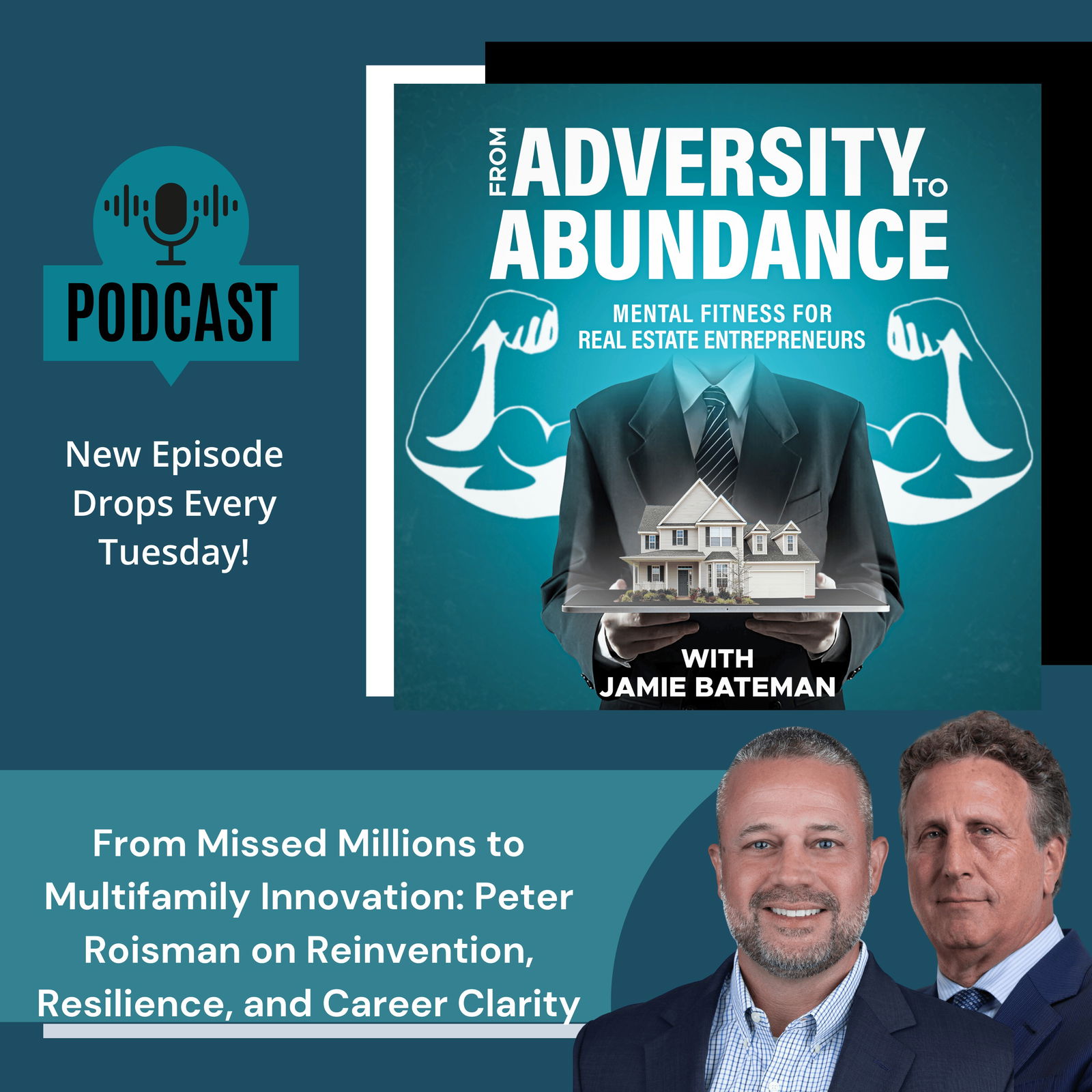
From Missed Millions to Multifamily Innovation: Peter Roisman on Reinvention, Resilience, and Career Clarity

 Apple Podcasts

 Spotify

 Amazon Music

 iHeartRadio

 RSS Feed
In this episode of From Adversity to Abundance , host Jamie Bateman sits down with Peter Roisman, cofounding principal, president, and CEO of Rev—a company reshaping how multifamily leasing is done. With over 30 years of entrepreneurial experience across the sports, medical, and real estate sectors, Peter brings sharp insights and battle-tested wisdom to the table.
Peter opens up about a major inflection point in his journey: a promising business deal that, if successful, could have earned him several million dollars. Instead, the deal fell apart, leaving him not only with a $400,000 loss but also the painful weight of what could have been. Rather than letting that moment define him, Peter used the experience to pivot, rebuild, and ultimately find greater clarity in his entrepreneurial path.
This candid conversation goes beyond real estate. Peter explores how life unfolds in seasons, why timing matters, and how to make intentional choices—whether you're launching a business, investing, or simply figuring out what’s next. He breaks down the Rev model, offers career advice grounded in decades of experience, and shares how to align passion, skill, and market demand in a way that leads to meaningful success.
Guest Introduction: Peter Roisman
Peter Roisman is the cofounding principal, president, and CEO of Rev, an innovative multifamily leasing company. Over the past three decades, he’s launched and led businesses in sports, medicine, and real estate. His story is one of resilience, strategic pivots, and reimagining what success looks like across different seasons of life and work.
Episode Highlights:
- The Deal That Got Away – How Peter missed out on a multimillion-dollar exit and faced a $400K loss instead.
- Redefining Leasing – The origin story of Rev and how it separates leasing from property management.
- Career Crossroads – Insights on choosing between passion, skillset, and what the market will actually pay for.
- Life in Seasons – Why timing and flexibility are essential to long-term success.
- Lessons Across Industries – What Peter took from sports, medicine, and real estate to lead with purpose.
-
Key Takeaways:
- Missing out on a big win can hit harder than a financial loss—but it can also spark a powerful pivot.
- Real estate success isn’t just about deals—it’s about systems, service models, and leadership.
- Your ideal career path often lives at the intersection of passion, talent, and demand.
- Life has seasons—embracing that can help you know when to push forward and when to pivot.
- Failure doesn’t mean the end. It can be the nudge toward your most meaningful work.
Resources:
Connect with Peter:
Website: https://www.rev-leasing.com/
LinkednIn: https://www.linkedin.com/in/peterroisman/
Facebook: https://www.facebook.com/revleasingmanagement
Instagram: https://www.instagram.com/revmultifamilycompany/
Integrity Income Fund:
https://labradorlending.com/investors/passive-investors/
Labrador Mentorship:
labradorlending.com/investors/active-investors/
—
Haven Financial Services:
Learn more: jamie.myfinancialhaven.com/
—
Purchase Jamie’s Book: www.amazon.com/dp/B0CGTWJY1D?ref_=pe_3052080_397514860
—
Leave us a REVIEW: podcasts.apple.com/us/podcast/from-adversity-to-abundance/id1618672867?mt=2&ls=1
www.adversity2abundance.com/reviews/new/
Connect with us:
Website: www.adversity2abundance.com
Facebook: https://www.facebook.com/labradorlending/
Instagram: https://www.instagram.com/labradorlendingllc/
LinkedIn https://www.linkedin.com/company/labrador-lending/?viewAsMember=true
Youtube: https://www.youtube.com/channel/UChYrpCUlqFYLy4HngRrmU9Q
Connect with Jamie:
LinkedIn: www.linkedin.com/in/jamie-bateman-5359a811/
Twitter: twitter.com/batemanjames
0:00 Speaker 0: This conversation today is with Peter Roisman. Speaker 0: Peter is the cofounding principal and president and CEO of Rev, Speaker 0: which is a multifamily leasing company. Speaker 0: Peter has thirty plus years in of entrepreneurial experience and Speaker 0: a track record of launching and leading businesses across different sectors. Speaker 0: He's been in the sports, Speaker 0: agency industry as well as in, Speaker 0: the multifamily real estate industry as well as the medical Speaker 0: industry, and he's done well in all industries. Speaker 0: However, his success has not become without setbacks and adversity.
0:41 Speaker 0: That's for sure. Speaker 0: I mean, anytime you get to hear from someone with this level of experience, Speaker 0: you don't wanna miss it. Speaker 0: Peter drops a lot of knowledge, along the way here. Speaker 0: Just a lot of wisdom, for sure. Speaker 0: With regard to the adversity he's faced, he talks about how there was a Speaker 0: potential exit with one company, that he was Speaker 0: a partner in that would have netted him, I think, two to three million Speaker 0: dollars, and instead, he lost everything that he put into the deal and lost Speaker 0: about four hundred thousand. Speaker 0: So that was quite a bit of adversity there. Speaker 0: But it sounds like over the years with other entrepreneurial ventures, he's Speaker 0: done, he's made up for that and then some.
1:22 Speaker 0: What I love about Rev, the the current company he's leading, Speaker 0: I mean, it's really cool how they've they've really separated leasing Speaker 0: from property management, and he talks a lot about that, for the Speaker 0: the multifamily operator. Speaker 0: He gives a lot of of info, for the investor, the real estate Speaker 0: investor, you know, as to whether to to follow your passion or whether Speaker 0: to follow what you're good at or whether to follow what people will pay Speaker 0: for. Speaker 0: A lot of career, advice here as well as real estate investing advice Speaker 0: along the way. Speaker 0: So I think you're really gonna enjoy this conversation with Peter Roisman. Speaker 1: From adversity to abundance, hosted by entrepreneur and Speaker 1: seasoned real estate investor, Jamie Bateman, is the ultimate guide for Speaker 1: active and passive investors seeking clarity, mental fitness, and the Speaker 1: confidence to make inspired decisions in the world of real estate.
2:16 Speaker 1: With a decade plus of investing experience across various niches and Speaker 1: a background as a combat veteran, former army officer, and Speaker 1: multimillion dollar mortgage note company owner, Jamie brings a wealth Speaker 1: of knowledge and inspiring stories to each episode. Speaker 1: Through weekly episodes featuring insightful interviews with industry leaders Speaker 1: and solo explorations of mindset and strategy, listeners Speaker 1: will uncover actionable advice and tips to overcome challenges Speaker 1: and build lasting financial success. Speaker 1: Whether you're a seasoned investor or just starting, from adversity Speaker 1: to abundance is your road map to turning obstacles into opportunities Speaker 1: and achieving financial freedom.
3:01 Speaker 0: Welcome, everybody, to another episode of the From Adversity to Abundance podcast. Speaker 0: I am your host, Jamie Bateman, and I'm pumped today to have with us Speaker 0: Peter Roisman. Speaker 0: Peter, how are you doing today? Speaker 2: I'm doing great, Jamie. Speaker 2: Thanks for having me on the show. Speaker 0: Absolutely. Speaker 0: This is gonna be a a really fun chat. Speaker 0: I know you've been an active entrepreneur for many years and, Speaker 0: have experienced a lot of ups and downs, and you're in the real Speaker 0: estate commercial real estate multifamily space. Speaker 0: And I know you're gonna bring both a lot of, Speaker 0: practical value as far, as well as inspiration for Speaker 0: our listener. Speaker 0: For the listener who may not be familiar with you, who are you, and Speaker 0: what are you up to today?
3:44 Speaker 2: Oh, I'm, Speaker 2: I would call myself a middle aged guy who thinks young, and, Speaker 2: we we started a new business about six years ago that we shifted four Speaker 2: four like, two years ago from multifamily leasing to Speaker 2: multifamily leasing tools. Speaker 2: We created a couple of property technology tools that we're marketing today. Speaker 2: One is an assessment tool so that any asset manager, owner, property Speaker 2: manager could assess their leasing team's performance. Speaker 2: And the second is a training tool. Speaker 2: We have a curriculum, Rev Leasing University, which is a hundred and thirty Speaker 2: online courses that that train up, leasing teams and get better Speaker 2: performance out of them. Speaker 0: Nice.
4:24 Speaker 0: And, I know before we hit record, you shared with with me where you Speaker 0: were, calling in from. Speaker 0: Do you mind sharing with the listener? Speaker 2: Oh, I don't mind at all. Speaker 2: I I I might make a couple people jealous if if they like warm Speaker 2: weather. Speaker 2: I I live in Puerto Rico. Speaker 2: I moved here, just under twelve years ago, and Okay. Speaker 2: It's been a great experience. Speaker 0: Yeah. Speaker 0: Hopefully, we'll touch on that, that decision later. Speaker 0: Before we jump back into your backstory, though, speak a little bit more about Speaker 0: your personal, quote, unquote, abundance that you're living in. Speaker 0: So our show is From Adversity to Abundance. Speaker 0: We don't pretend that that Peter has no more problems and will never have Speaker 0: any more adversity, but Speaker 0: maybe you've reached some level of financial abundance that you didn't have at age Speaker 0: twenty three when you became an entrepreneur.
5:12 Speaker 0: Speak to some of that abundance that you're experiencing today. Speaker 2: Sure. Speaker 2: So I definitely have experienced both ends of your your show and expect Speaker 2: from adversity to abundance. Speaker 2: I'm not sure we ever you know, if we stay in business, I'm not Speaker 2: sure we ever, avoid the adversity side of this because Yeah. Speaker 2: Every day you have to bring your best. Speaker 2: And, you know, I I Speaker 2: the abundance side, I would say my most successful business, Speaker 2: venture was developing twenty one surgery centers over a seven year period Speaker 2: and then exiting at a at a fairly sizable multiple, ten and a half Speaker 2: multiple on earnings. Speaker 2: And, you know, that that's that's my that's my definition of Speaker 2: abundance.
5:55 Speaker 2: And so, my retirement, again, to be honest, after that, I Speaker 2: I took a year to see if what I wanted to do, and I Speaker 2: became bored out of my mind and and went by the board. Speaker 0: Yeah. Speaker 0: I've heard that from a lot of successful entrepreneurs and and nonentrepreneurs Speaker 0: as well. Speaker 0: I think a lot of us just need something to work toward and and Speaker 0: people to serve and a mission to fulfill, if you will. Speaker 0: So as far as your backstory, you mentioned, well, I mentioned Speaker 0: and you mentioned prior to hitting record, at age twenty three, you started your Speaker 0: first business. Speaker 0: Talk about that if you would. Speaker 2: Sure. Speaker 2: Sure. Speaker 2: At age twenty three, I had been accepted to law school. Speaker 2: And, while in law school, I started a sports agency and started Speaker 2: representing my first clients.
6:39 Speaker 2: And I did that for probably fifteen years and, Speaker 2: built a reasonably successful practice and ended up running, Speaker 2: you know, being absorbed into what's now known as Octagon, which is one of Speaker 2: the top three agencies in the world based in DC, actually. Speaker 2: Okay. Speaker 2: Robins is in New York and all over the world. Speaker 2: But, ran the golf division, was involved in basketball, Speaker 2: was would you know, did did fairly well at that business and realized, Speaker 2: you know, at some point in my late thirties, it was worth it was Speaker 2: time for a change, and and I didn't feel like being on the road Speaker 2: twenty six out of fifty two weeks. Speaker 2: And to see my children and, you know, made a change and and, Speaker 2: was happy I made that change and had three careers since.
7:23 Speaker 0: Okay. Speaker 0: Yeah. Speaker 0: We're gonna at least touch on each one of those three. Speaker 0: So what made you move into that at twenty three? Speaker 0: Why did you wanna start a business, and why did you decide to go Speaker 0: into the sports industry? Speaker 2: So, I was a college golfer. Speaker 2: I achieved some measure of success. Speaker 2: I was all New England and, Speaker 2: you know, but in a small school, in a small setting. Speaker 2: And so spending been about eight months in Florida playing, you Speaker 2: know, open tournaments and other other events just to figure out where I stood Speaker 2: against, you know, the better players in the country and and, Speaker 2: realized I was probably four to six years away from Speaker 2: competing at the very highest level and decided at that point, I wanted Speaker 2: to represent athletes instead of being an athlete.
8:11 Speaker 2: And and and and it wasn't you know, I I I look at it Speaker 2: this way. Speaker 2: I didn't enjoy going to the driving range and the practice facilities every single Speaker 2: day and turning it into work. Speaker 2: So golf for me was always fun. Speaker 2: Yeah. Speaker 2: And getting into a job, I I lost something in the translation. Speaker 2: So that's when I realized I could be on the business side of sport Speaker 2: and not be, you know, the client. Speaker 2: I could represent clients. Speaker 0: Sure. Speaker 0: No. Speaker 0: I like that. Speaker 0: And did you still maintain your your golf hobby and keep it fun? Speaker 2: Yeah. Speaker 2: I'm still, you know, too handicap and, you know, still still playing Speaker 2: at it. Speaker 2: I won a few club championships along the way. Speaker 2: And Nice. Speaker 2: It's it's been and I love golf. Speaker 2: I still get to play a little bit. Speaker 2: Not as much as I like, but a a decent amount.
8:52 Speaker 0: Yeah. Speaker 0: I mean, we that's something we do explore on the show sometimes is, you Speaker 0: know, when to Speaker 0: follow your passion, so to speak, as far as, you know, taking your trying Speaker 0: to monetize your hobby, basically. Speaker 0: And and that can obviously work well for some people. Speaker 0: But then for other people, they end up hating their hobby and not Speaker 0: making as much money maybe as they would have thought. Speaker 0: Or even if they do, it becomes work, like you said. Speaker 0: And if you're not loving it, you know, like, what's the point, and how Speaker 0: successful are you really gonna be? Speaker 0: So speak to the to the listener on that point as far as, you Speaker 0: know, Speaker 0: as far as picking a career or what you know, deciding what direction to Speaker 0: move in, professionally, Speaker 0: how do you follow do you follow what you're good at?
9:38 Speaker 0: Do you follow what people will pay for? Speaker 0: Do you follow what you enjoy doing, such as your your hobby? Speaker 2: Those are three great questions at one end. Speaker 2: Let's say yes to all of them. Speaker 2: It's how you can get someone to pay you for what you're good at Speaker 2: and and what you enjoy. Speaker 2: The those that's the best of all worlds. Speaker 2: Right? Speaker 2: You got all combined. Speaker 2: Yeah. Speaker 2: And and I would I would recommend trying to achieve that. Speaker 2: If if you can't achieve three, maybe you can achieve two of those. Speaker 2: Mhmm. Speaker 2: And still, you know, have real success in business. Speaker 2: Business, you know, you you've been in business a while. Speaker 2: I I've been in business a while. Speaker 2: At the end of the day for me, it means getting up every day Speaker 2: with a passion, wanting wanting to do it.
10:23 Speaker 2: What can we get done today? Speaker 2: Not wasting a day. Speaker 2: Time is our enemy. Speaker 2: It's it's really you know, you wake up one day and you go, where Speaker 2: did those three years go? Speaker 2: Where where this amount of go? Speaker 2: And and so, you know, my partners are all like that too in real Speaker 2: estate. Speaker 2: And so, you know, we push each other and it and it's fun. Speaker 2: And I'm in this in these ventures that I'm in today, I never Speaker 2: did work with the people I grew up with. Speaker 2: This is a chance for me to work with my old friends, which is Speaker 2: just because we've been friends all these years. Speaker 2: We've never been business partners. Speaker 2: And so this is one of the great experiences in life for me. Speaker 0: Sure. Speaker 0: That's really good. Speaker 0: So, Speaker 0: I guess yeah.
11:03 Speaker 0: So so taking at least two of those three, if you can, and maybe Speaker 0: three of those three would be ideal. Speaker 0: But I I think that in many cases, that ends up being pretty rare. Speaker 0: But I think you need at least one or two of those, obviously, to Speaker 0: keep going. Speaker 0: Right? Speaker 0: So in your back to your story, so you did the the sports agency Speaker 0: for fifteen years, and that was, pretty successful. Speaker 0: Talk about you said you made a decision to to leave that. Speaker 0: How did that come about? Speaker 2: You know, I I realized one day I was I was getting a little Speaker 2: stale because I was doing the same thing over and over again without really Speaker 2: a pathway to, Speaker 2: you know, a new challenge, I'll call it. Speaker 2: I I didn't really know what the the next thing should be.
11:45 Speaker 2: And and Mhmm. Speaker 2: Company I was in didn't really need me to grow because they Speaker 2: just needed someone to run this division, if you will. Speaker 2: And and I felt like I was being held back a little bit, not Speaker 2: by them, but but by the role that was needed. Speaker 2: And so I just said, look. Speaker 2: I gotta I'm gonna explore something else. Speaker 2: So, you know, it was a it was I've always had good departures Speaker 2: when I've when I've left places. Speaker 2: I think that's an old point to make here. Speaker 2: Yeah. Speaker 2: Build a nugget for maybe your listeners at the end of the day. Speaker 2: You know, there's no reason to walk away in a in a negative way. Speaker 2: Mhmm. Speaker 2: Experience that you've had wherever you are, I'm sure has has Speaker 2: been, you know, positive for you in some way.
12:28 Speaker 2: And so you you take that. Speaker 2: You you you you you wrap it up, and you and you and I'm Speaker 2: still good friends with the people that hired me at Octagon. Speaker 2: I mean, the guy who's still running Octagon is a good friend of mine. Speaker 2: So he's another Speaker 2: twenty something years. Speaker 2: So, I I I think, you know, I so I walked away, and what Speaker 2: I did was I took some time. Speaker 2: I didn't have the pressure. Speaker 2: My wife was working. Speaker 2: My I didn't have the pressure to immediately find a job. Speaker 2: And so I took a month, two months, and and I looked around. Speaker 2: And and I realized, you know, there was another opportunity out there, which which Speaker 2: I grabbed. Speaker 2: And it was to be the president of a sports ticketing company, and and Speaker 2: and that was that was a really good experience as well.
13:09 Speaker 2: That's one of the ones that didn't end with the financial success even though Speaker 2: we had pieces to sell out at at multiples of what we had Speaker 2: in it. Speaker 2: It was a really great experience. Speaker 2: I I I was tasked with making deals with all of my sports contacts, Speaker 2: the NBA, the NFL, Major League Baseball, the NCAA, Speaker 2: all the bowl games. Speaker 2: I mean so, basically, that I was in a good place. Speaker 2: I could do I could use my contacts and my and my skills Speaker 2: and and was able to do my job pretty well. Speaker 2: Unfortunately, that company, Speaker 2: did we had an exit we had an offer to exit. Speaker 2: We were we were offered, I think, a two x or three x multiple Speaker 2: by CBS and chose not to sell, not not my choice.
13:57 Speaker 2: And the CEO ended up, you know, making, Speaker 2: I think, poor decisions, and and we ended up, the company went belly Speaker 2: up at some point. Speaker 2: And so I went from making several million dollars to losing Speaker 2: several hundred thousand dollars of actually money in the bet money in the deal. Speaker 2: And so, you you know, that's that's adversity. Speaker 2: Right? Speaker 2: If you ever are gonna have adversity, you're losing hard earned money that you Speaker 2: put at work. Speaker 2: Yeah. Speaker 2: You're you're losing four years of your time that you put at work. Speaker 2: Right. Speaker 2: Relationships you put at work. Speaker 2: But you know what? Speaker 2: It's okay. Speaker 2: I I I learned a lot. Speaker 2: I came out of it, and I haven't made those mistakes again. Speaker 2: So I Speaker 0: Got it. Speaker 0: Yeah.
14:37 Speaker 0: So and just to be clear, the several million would have been what you Speaker 0: would have been paid at at that potential exit. Speaker 0: Right? Speaker 2: Would have been somewhere between two and three million dollars, and I had four Speaker 2: thousand in it, and it would have been a nice return. Speaker 0: Yeah. Speaker 0: Absolutely. Speaker 0: And so you did that for four years. Speaker 0: And then before we get to rev in more detail, what was Speaker 0: the third, career that you had? Speaker 2: There was as a development partner for a company known as SurgeCenter Development Speaker 2: where we we became the most prolific and most successful, Speaker 2: surgery center outpatient surgery center developer in the country and still Speaker 2: still are. Speaker 2: If you wanna look up SurgeCenter development online, you'll you'll see Speaker 2: the company's done at well over three hundred independent surgery centers Speaker 2: around probably twenty five states.
15:23 Speaker 2: And I I was responsible for I had a part in twenty one Speaker 2: centers, and I think I was the manager on, you Speaker 2: know, at least a third of those. Speaker 2: And so, I mean, I I ran the whole projects. Speaker 2: I found the doctors to partner with us. Speaker 2: I found the locations. Speaker 2: I, you know, bought all the equipment. Speaker 2: I hired all the people. Speaker 2: I mean, it was it was a, you know, beginning to end running the Speaker 2: project kind of deal, and I got ownership in it. Speaker 2: And and so when when those centers sold, that's when I took Speaker 2: my pause and and thought about what I wanted to do next with the Speaker 2: prerecorded. Speaker 0: Got it. Speaker 0: And I love how you've you've mentioned the pause a couple times because I Speaker 0: think that's if you're able to have that pause or even create Speaker 0: that pause and that space is is just critical for decision making, not being Speaker 0: rushed, not being forced or pressured and just making bad choices.
16:16 Speaker 0: You know, on the surface, the medical industry is pretty different from the sports Speaker 0: industry, pretty different from real estate. Speaker 0: So were you making these decisions to pick a particular industry based on Speaker 0: contacts you had or, you know, just where you saw certain industries Speaker 0: heading, or how were you making those decisions? Speaker 2: Both of those two things. Speaker 2: So I I was fortunate to know one of the two founders Speaker 2: of search center development. Speaker 2: We we played basketball together. Speaker 2: We played poker together. Speaker 2: He was a guy that was from the town I was living in, Great Speaker 2: Falls, Virginia, and, Speaker 2: I approached him. Speaker 2: I I was I was watching his success, and I was you know, I Speaker 2: had just, you know, ended my my sports ticketing Speaker 2: world career.
17:00 Speaker 2: And, Speaker 2: I said, you'd think there's any room in their business for me as a Speaker 2: developer? Speaker 2: And he said, yeah. Speaker 2: But you're gonna have to pay your dues. Speaker 2: You're gonna have to shadow me for several months and and see if this Speaker 2: is a good fit for you, and we'll see if you're a good fit Speaker 2: for it. Speaker 2: And so I was prepared to do that. Speaker 2: And so I did it, and, you know, after about six months of shadowing Speaker 2: and going to meetings, I realized, it looked like a pretty Speaker 2: great potential business. Speaker 2: And, I had asked all the hard questions of all the doctors that were Speaker 2: involved in these surgery centers and the and the and I said, tell me Speaker 2: the worst thing that you heard about Surg Center and the worst thing anyone Speaker 2: ever came up with was, I wish I owned more shares in the surgery Speaker 2: center.
17:41 Speaker 2: So I said, okay. Speaker 2: This sounds like a pretty good deal. Speaker 2: And, first year, I did two centers, and, you know, after seven years, I Speaker 2: had done twenty one surgery centers. Speaker 2: So it was a it was a good fit. Speaker 2: My skill set fit really well. Speaker 2: I have managed the athletes or, you know, you know, you know, strong Speaker 2: ego, strong personality people, are very much like doctors. Speaker 2: So it turns out that was a pretty good skill set I had. Speaker 2: It worked well in in communicating well and and ex exuding Speaker 2: confidence with with people that are very confident. Speaker 2: So Mhmm. Speaker 2: It it's a good match. Speaker 0: Yeah. Speaker 0: So is this like a franchise model or no? Speaker 2: Not really. Speaker 2: It was all internally developed by a search center. Speaker 2: I just became one of one of the development partners and Okay.
18:25 Speaker 0: Got it. Speaker 2: Stuck with it for about seven years. Speaker 2: And after about ten years, all my twenty one centers had been sold. Speaker 0: Wow. Speaker 0: I love that, you know, you were, again, taking your time. Speaker 0: You had to pause, but then even when you were, you know, getting into Speaker 0: it, you sounds like you were very methodical and asking trying to find out Speaker 0: why you shouldn't do this, really, you know, instead of rushing into it. Speaker 0: Any anything to add there? Speaker 2: No. Speaker 2: I think you know, I I I owe a a lot to the partners Speaker 2: I had in that business. Speaker 2: They they took me in. Speaker 2: They they taught me a lot. Speaker 2: I I feel very, appreciative to having having Speaker 2: been part of it, and I think I added something to just to the Speaker 2: company for a while there. Speaker 2: And and then I hit a wall again.
19:06 Speaker 2: It was like literally hit the same wall, which was the question, do I Speaker 2: wanna keep doing the same thing over and over again and keep making walls? Speaker 2: And I realized I didn't. Speaker 2: And and I've had success, and that was, you know, the other side of Speaker 2: your your show. Speaker 2: And Mhmm. Speaker 2: Right. Speaker 2: Luxury of by the way, in the meantime, between Speaker 2: my first center and my twenty first center, I moved to Puerto Rico. Speaker 2: That was that was in in there. Speaker 0: Got it. Speaker 2: Tax purposes, Speaker 2: I I I, was able to keep a lot more of my gains Speaker 2: from centers. Speaker 0: Okay. Speaker 0: And, obviously, you don't have to get too personal, but can you speak to Speaker 0: any of the specific success you had, with the surge Speaker 0: center Yep.
19:50 Speaker 0: That time period? Speaker 2: Yeah. Speaker 2: Each center, was was extremely profitable. Speaker 2: The the doctors, the surgeons themselves that performed, you know, all Speaker 2: of the all of the all the cases, owned typically two thirds Speaker 2: of the center, and search center development owned one third. Speaker 2: We didn't charge management fees. Speaker 2: We didn't charge development fees. Speaker 2: We were literally dollar one dollar for us and two dollars for the Speaker 2: surgeons on the barrel head. Speaker 2: And if we made money in a month, we distributed. Speaker 2: And so they typically were producing, Speaker 2: you know, at one point, it was three or four million dollars a center Speaker 2: a year. Speaker 2: I mean, they were really profitable operations. Speaker 2: They were running really well. Speaker 2: I learned a tremendous amount about how to learn how to run a a Speaker 2: really lean, efficient operation.
20:35 Speaker 2: Mhmm. Speaker 2: It's but but at the same time, I learned that making little mistakes, Speaker 2: really, there's nothing wrong with making mistakes. Speaker 2: It there's something wrong with being afraid to make mistakes. Speaker 2: Making mistake is is is the error. Speaker 2: Make the mistakes, make the corrections, and just keep doing that. Speaker 2: And I've applied new business I'm in with Rev. Speaker 2: You know, I learned, from the the head of search center development. Speaker 2: He said to me, you know, we've made a a hundred corrections along the Speaker 2: way. Speaker 2: And and Mhmm. Speaker 2: There's nothing wrong with that. Speaker 2: You get it's not a path. Speaker 2: You and I talked to Right. Speaker 0: Right. Speaker 0: Exactly. Speaker 2: Success isn't a straight path. Speaker 2: You're gonna bounce off the wall. Speaker 2: You're gonna take a step forward, and maybe it's two steps to the right. Speaker 2: So you bounce off the wall.
21:16 Speaker 2: You you knock yourself back in. Speaker 0: Right. Speaker 0: Yeah. Speaker 0: I love how you you frame that as far as, you know, Speaker 0: basically being afraid to make a mistake is is a mistake. Speaker 0: And there's there's a lot of risk in doing nothing a lot of times, Speaker 0: you know, if you're paralyzed by fear of of making a mistake. Speaker 0: So we've alluded to it. Speaker 0: So you're the cofounding principal and the president and CEO of Rev, which is Speaker 0: a multifamily leasing company. Speaker 0: Dive into, you know, why did you head in that direction? Speaker 0: What, you know, what real estate background did you have, and what were your Speaker 0: your, what was your decision making at that point? Speaker 2: I've personally been an investor in real estate since I was about Speaker 2: twenty two.
21:58 Speaker 2: K? Speaker 0: K. Speaker 2: But I I I wasn't it wasn't my occupation, and and it Speaker 2: you know, until I got into the surgery center development business, which Speaker 2: is already in my, you know, forties at that point. Speaker 2: And so, Speaker 2: my my family is a real estate family. Speaker 2: Like, I'm Okay. Speaker 2: My dad developed hundreds and hundreds of condominiums and office buildings. Speaker 2: And so I I mean, I've been on the sideline watching Yeah. Speaker 2: Learning something. Speaker 2: But but, basically, the reason for Rev, when I got around to Speaker 2: it at some point, because my partners in this business are people I I Speaker 2: grew up with. Speaker 2: Mhmm. Speaker 2: Yeah. Speaker 2: They forty year real estate people, you know, in commercial and Speaker 2: residential and some retail.
22:44 Speaker 2: And, you know, I went to them after search center, and I said, what Speaker 2: are you guys up to? Speaker 2: And basically, you know, said, is there anything we can do together? Speaker 2: And this was the first time my friends and I had actually become business Speaker 2: associates. Speaker 0: Business associates. Speaker 0: That's awesome. Speaker 2: So it's kinda fun. Speaker 2: And I'm actually really enjoying the association with them. Speaker 2: And and it's easy because, you know, we can yell at each other or Speaker 2: we can we can we still love each other. Speaker 2: We but we can we can get through adversity, if you call it that Speaker 2: Right. Speaker 2: Right. Speaker 2: And still keep moving forward. Speaker 2: There there's always adversity in everything. Speaker 2: Even when Rev, Speaker 2: we started this business six years ago, like, twenty nineteen, as Speaker 2: a replacement for the temporary workers that were getting placed in the leasing offices.
23:28 Speaker 0: Okay. Speaker 2: We could easily replace those people because they were warm bodies picking up the Speaker 2: phone without any training. Speaker 2: And so it Speaker 2: training. Speaker 2: And so it low it was a real low barrier Speaker 0: to entry. Speaker 0: For yeah. Speaker 0: Sure. Speaker 2: So we we trained up a bunch of people. Speaker 2: In fact, the first person we trained was a woman that worked in a Speaker 2: restaurant, and we trained her into becoming a leasing person. Speaker 2: And and within three weeks, she was offered a manager's job by the by Speaker 2: our client. Speaker 2: And so we knew that was number one. Speaker 2: We knew Right. Speaker 2: You're on the right track. Speaker 0: Sure. Speaker 2: We ran this out, and we became effectively, you know, one of two Speaker 2: companies that were high profile, Speaker 2: fire drill, save save the save the difficult project Speaker 2: leasing companies.
24:10 Speaker 2: We'd go in within ninety days, we'd turn the whole thing around. Speaker 2: If it was at seventy eight percent occupied, we would turn it around to Speaker 2: ninety three percent occupied in a few months. Speaker 2: And, you you know, that we were good at it, and we were very Speaker 2: good at it. Speaker 2: And we developed a lot of skills and knowledge by doing it. Speaker 2: We took those skills and that knowledge, and we built tools Speaker 2: to give to the marketplace because we realized that, you know, although we had Speaker 2: we and I think the highest employee number we had was, like, seventy nine Speaker 2: or eighty people. Speaker 2: We we weren't gonna grow into this thousand person team that was Speaker 2: gonna go run around the country fixing things. Speaker 0: Mhmm. Speaker 2: But we said to ourselves, well, how do we get people to fix themselves? Speaker 2: Let's let's get the equipment to fix themselves.
24:52 Speaker 2: And we we wrote we we wrote, some AI algorithms, Speaker 2: and and we do some, Speaker 2: some assessments with, you know, people going out and doing tours Speaker 2: and also telephone calls and Internet contacts. Speaker 2: And we we built this what we call the leasing score, rev leasing score. Speaker 0: Okay. Speaker 2: So we assess over a two week period of properties ability to, Speaker 2: perform and and obtain leases. Speaker 2: And so, Speaker 2: we've been doing this for about two years now, and we've got a bunch Speaker 2: of clients that use our assessment, and we have a bunch of clients that Speaker 2: use our training. Speaker 2: So we've on the other side, so once we, you know, it's logical that Speaker 2: if you tell someone, hey.
25:33 Speaker 2: You have a few problems or deficiencies in these Speaker 0: Yeah. Speaker 0: We're gonna give them a solution too. Speaker 2: Help us. Speaker 2: Right? Speaker 2: Right. Speaker 2: Right. Speaker 2: And, well, we say you can help yourselves. Speaker 2: We'll we'll kind of, you know, govern over it, but you're gonna learn, Speaker 2: you know, from our courses and our testing and get better. Speaker 2: And so course of, you know, anywhere from a ten week to, Speaker 2: you know, twenty week period, these people can can train up Speaker 2: and be retested. Speaker 2: And and, you know, it it's effective and it affects the bottom line. Speaker 2: And, ultimately, if you're affecting the income stream, you're affecting the the valuation. Speaker 2: Right. Speaker 0: Right. Speaker 0: Exactly. Speaker 0: And we we I mean, we definitely have a lot of commercial real estate Speaker 0: guests on the show.
26:14 Speaker 0: I'm more of a residential real estate investor, but, but yeah. Speaker 0: So the the occupancy and the the, I mean, that all Speaker 0: ties into NOI and then the value of the property. Speaker 0: Right? Speaker 0: So it's a pretty not just a number on a piece of paper. Speaker 0: It's a pretty important factor in determining how well this the multifamily Speaker 0: project is doing. Speaker 2: I would say it's the factor. Speaker 2: Right? Speaker 2: Yeah. Speaker 0: Yeah. Speaker 2: Asking you know, if you think about it this way, Jamie, the Speaker 2: the the people responsible for all revenues Speaker 2: that mean, it's not it's like maybe there's parking fees and pet fees and Speaker 2: maybe a couple of points, but ninety seven, ninety eight, ninety nine percent of Speaker 2: all revenues have to be generated out of that office.
26:57 Speaker 2: Mhmm. Speaker 2: And Right. Speaker 2: That property can afford to do to promote itself, you know, in Speaker 2: addition to in addition to, you know, realizing returns for their investors. Speaker 2: Mhmm. Speaker 2: You know, you know, you if you're if you're producing better, let's say Speaker 2: you're two, three, four points better in a submarket than your competition. Speaker 2: Mhmm. Speaker 2: You can some of that performance, you know, revenue to stay Speaker 2: far ahead. Speaker 2: There's there's no reason you can't, you know, advertise more Speaker 2: and, you know, add add more, benefits to your property. Speaker 2: Right? Speaker 2: Add more amenities. Speaker 2: I mean Mhmm. Speaker 2: All kinds of things that can be done to keep yourself Speaker 2: far ahead. Speaker 2: So it's not just getting caught up, but staying ahead.
27:40 Speaker 2: You know, those revenues can be used to create a margin between you and Speaker 2: your competition. Speaker 0: Sure. Speaker 0: Which is increasingly important in today's environment. Speaker 0: So as a as a, again, as a residential real estate investor, I've Speaker 0: got some rental properties. Speaker 0: And, you know, one one of the things I noticed over the years about Speaker 0: property management and property managers, Speaker 0: first off, that term can be a little misleading, because it really includes Speaker 0: both property management and tenant management, and that in Speaker 0: in includes leasing. Speaker 0: So, Speaker 0: you know, I know that that was a big part of what you what Speaker 0: you did was decoupling leasing from property management. Speaker 0: So and and from my experience in the residential space, you've got either Speaker 0: essentially, you have property managers who either have a a kind of more of Speaker 0: a realtor background, an agent background, or an actual, like, Speaker 0: construction or, you know, handyman or property management Speaker 0: background, and they're pretty different.
28:40 Speaker 0: But they come to the same place and and become a property manager, but Speaker 0: then they obviously have strengths and weaknesses. Speaker 0: So but they've really there are two majorly different, you know, functions there. Speaker 0: How did you determine to focus on leasing and and not so much Speaker 0: the property management itself? Speaker 2: Yeah. Speaker 2: That's you know, I'm glad you bring that up because Speaker 2: as as as we just a little bit talked about, it's such a critical Speaker 2: function. Speaker 2: The leasing function is so undervalued Speaker 2: in in the multifamily industry today. Speaker 2: Mhmm. Speaker 2: Mhmm. Speaker 2: Literally, if you asked a property manager to give me your twenty Speaker 2: five most important tasks you're doing every day, I would bet you on Speaker 2: some of those lists, it wouldn't exist.
29:23 Speaker 2: Okay? Speaker 2: That's sad, but it's true. Speaker 2: And on on a lot of those lists, it might be below the the Speaker 2: top half. Speaker 2: Mhmm. Speaker 2: If you ask me as a property owner and and and Speaker 2: I'm I'm not a manager, but if I were the manager and you asked Speaker 2: me, leasing would be, if not at the top, very close Speaker 2: to the top. Speaker 2: Mhmm. Speaker 2: Because it pays for everything. Speaker 2: And and if you're not converting on on your opportunities, Speaker 2: on your prospects, Speaker 2: the guy down the street is. Speaker 2: And that's really bad for your property. Speaker 2: Sure. Speaker 2: Yeah. Speaker 0: You Speaker 2: got these concessions, which is really prevalent in the industry right now. Speaker 2: Mhmm. Speaker 2: Yeah. Speaker 2: There isn't give it away.
30:04 Speaker 2: Okay? Speaker 2: The the answer is to get better at what you're doing, not to give Speaker 2: it away, not to increase your advertising, not to use locators to bring Speaker 2: you clients. Speaker 2: You know, just do a better job when you you get the opportunity. Speaker 2: When you it's like at bats. Speaker 2: If you can bat three fifty instead of batting two seventy, you're you're a Speaker 2: hall of famer. Speaker 0: Right. Speaker 0: Right. Speaker 0: Yeah. Speaker 2: Literally, just when you get up to bat, hit get more Speaker 2: hits. Speaker 2: That's what this is. Speaker 2: Yeah. Speaker 0: You don't need more at bats if you have more quality at bats. Speaker 2: Not too often. Speaker 2: I mean, sometimes they don't have enough traffic, but it's really typically not the Speaker 2: problem. Speaker 2: The problem is typically the ability to get the job done. Speaker 0: Sure. Speaker 0: So in the last two years, what have been the biggest challenges you all Speaker 0: have faced?
30:48 Speaker 2: You know, that's a great question. Speaker 2: I'd say, Speaker 2: getting buy in and oversight from our clients, Speaker 2: I think they they genuinely want their people to get better, but Speaker 2: it does involve some oversight. Speaker 2: I mean, we're we're certainly providing oversight on it. Speaker 2: But if the I find that if the manager of a property is not Speaker 2: really bought in and not, Speaker 2: you know, urging that leasing person to complete the coursework Speaker 0: Mhmm. Speaker 2: Then the coursework doesn't get done, the improvement doesn't happen. Speaker 2: So it really literally has to be buy in at the local level. Speaker 2: I mean, we can only do so much, and we need to but we Speaker 2: can only do so much, and we need that buy in.
31:30 Speaker 2: And with that buy in, the success rates are tremendous. Speaker 2: So as long as people try to get better and as long as there's Speaker 2: oversight, helping them realize it's important to take these Speaker 2: courses and get better Mhmm. Speaker 2: But but it breaks down also if there isn't. Speaker 0: Sure. Speaker 0: Understood. Speaker 0: So and just, Speaker 0: before we jump into some rapid fire questions here, who is your ideal client Speaker 0: avatar for Rev? Speaker 2: Yeah. Speaker 2: That that right now is proving to be the mid market. Speaker 2: You know, the people that have, you know, Speaker 2: four thousand units to fifteen thousand units.
32:13 Speaker 0: Okay. Speaker 2: Because they haven't take they typically don't have, Speaker 2: their own leasing their own training and leasing staff. Speaker 0: Mhmm. Speaker 0: They Speaker 2: have they have on-site people, but they don't necessarily have Speaker 2: the Speaker 2: the governance over those tasks. Speaker 2: And so we find that we can plug in as as Speaker 2: almost an outsource for the training of leasing. Speaker 2: And so we we look for that mid market that says we have a Speaker 2: lot of properties, but we haven't invested in a trainer. Speaker 2: We haven't invested in a in a a training department. Speaker 2: And we we still need the function. Speaker 2: We still need this to happen.
32:54 Speaker 2: So, you know, let's step in and do that. Speaker 2: We're we're we're we still need buying on local level. Speaker 2: Right? Speaker 2: We still need buying at the site, but we're able to save them money, Speaker 2: and we're able to, you know, perform and get get their people's performance Speaker 2: better and better. Speaker 0: And, again, before we do the rapid fire questions, because I know that Speaker 0: those are gonna be fun, Speaker 0: what's been really surprising with regard to your rev adventure, Speaker 0: compared to the prior three career seasons you've had. Speaker 0: You know, you've already touched on the relationships you have, and you're you're getting Speaker 0: to work with your friend your friends, but maybe something else has been surprising Speaker 0: to you about this venture.
33:36 Speaker 2: I think I think the success of the multifamily industry, Speaker 2: has bred and I was not in multifamily before this, Speaker 2: so this is exposure to it. Speaker 2: I think it's bred some level of complacency. Speaker 2: And so, you know, we all know complacency in any business isn't isn't Speaker 2: the greatest thing. Speaker 2: Mhmm. Speaker 2: But the biz the business itself, multifamily is a Speaker 2: really successful industry. Speaker 2: Don't get me wrong. Speaker 0: Mhmm. Speaker 2: On the other hand, there's still a lot of room for improvement. Speaker 2: That's the thing that surprised me the most. Speaker 2: We Mhmm. Speaker 2: Got in here, and we found this leasing position being Speaker 2: undervalued, and we realized that no matter you know, Speaker 2: we could we talk about it every single day of our lives in this Speaker 2: business.
34:25 Speaker 2: And yet the industry still is not so much Speaker 2: revenue driven, but cost saving driven. Speaker 2: Mhmm. Speaker 2: And last two or three years, there have been some nice moves cost saving Speaker 2: wise. Speaker 0: Mhmm. Speaker 2: But Speaker 2: the the Speaker 2: the lack of focus on revenue growth Speaker 0: Mhmm. Speaker 2: Which is much easier to grow than it is to save costs Mhmm. Speaker 2: Is shocking to me, actually. Speaker 2: Frankly, it's shocking. Speaker 2: And and and it's right there. Speaker 2: And, look, our our our leasing score has a seven hundred top Speaker 2: cap. Speaker 2: Okay. Speaker 2: Like a credit score, which is eight fifty cap. Speaker 2: Mhmm. Speaker 2: But if if you wanna take a guess, I'd love you to take a Speaker 2: guess what we've we've tested well over three hundred individual properties.
35:09 Speaker 2: If you wanna take a guess and tell me what you think the highest Speaker 2: score, seven hundred being perfect, what you think the highest score Speaker 2: recorded to date is over these two years. Speaker 0: Five fifty. Speaker 2: That's a good guess. Speaker 2: Highest score is four eighty five. Speaker 0: Okay. Speaker 2: So we consider anything over five hundred very good, over six hundred Speaker 2: excellent. Speaker 2: And so even on our scale, no one has quite reached the Speaker 2: very good leasing level, which means there's opportunity. Speaker 2: Right? Speaker 2: So Sure. Speaker 2: We're in a good space. Speaker 2: Right. Speaker 2: We get more and more buy in and people, you know, ready to focus Speaker 2: on, you know, investing in their leasing people.
35:49 Speaker 2: If I I tell you, every dollar invested will produce ten dollars. Speaker 2: And so Mhmm. Speaker 2: It's worth it. Speaker 2: And every ten dollars is probably at some sort of a cap rate of Speaker 2: six or seven, and and you're at, like, fifteen to twenty Speaker 2: times that number as a valuation number. Speaker 0: Mhmm. Speaker 2: Yeah. Speaker 2: I mean, it's worth it. Speaker 2: I'm not suggesting you something for you know, that doesn't have a payback. Speaker 2: This one definitely pays back. Speaker 0: Got it. Speaker 0: Alright. Speaker 0: You ready for these rapid fire questions I've alluded to? Speaker 2: Thanks. Speaker 2: Go for it. Speaker 0: This one does trip people up sometimes. Speaker 0: What do people misunderstand about you, Peter? Speaker 2: About me? Speaker 2: Great question. Speaker 2: No one's ever asked questions.
36:30 Speaker 2: So what do they misunderstand? Speaker 2: I think they see my, competitiveness, and, Speaker 2: they think I'm kind of an an angry guy sometimes, but I'm not. Speaker 2: I'm a I'm a pretty happy guy. Speaker 0: Yeah. Speaker 0: I understand that. Speaker 0: I can relate to that. Speaker 0: What's one of your biggest failures personally? Speaker 0: It could be professionally or not, but, and what did you learn Speaker 0: from that? Speaker 2: Well, my biggest failure professionally was definitely the the ticketing company Speaker 2: I was involved in. Speaker 2: That's that was a win we turned into a loss, and it it it. Speaker 2: And decisions were made that that Speaker 2: could have been avoided and could have been could have been better made. Speaker 2: And so I learned from that.
37:12 Speaker 2: I learned not to give control to someone that shouldn't be trusted Speaker 2: with full control. Speaker 2: Mhmm. Speaker 2: And so I've never done that again. Speaker 2: And and at this point, I'm happy with control by committee. Speaker 2: I like people to have a voice in in their future, and and that's Speaker 2: sort of where we're at. Speaker 0: Got it. Speaker 0: If you could go back and give your eighteen year old self some advice, Speaker 0: what would that be? Speaker 2: Don't waste time. Speaker 2: Take advantage of every single moment. Speaker 2: Time is your enemy. Speaker 2: You you will run out of time one day. Speaker 2: And so just just keep pushing every day. Speaker 2: Don't don't be afraid to make decisions. Speaker 2: Right? Speaker 2: We talked about this a little bit. Speaker 2: Yeah. Speaker 2: Fear is fear is your enemy too in addition to time. Speaker 0: Mhmm. Speaker 2: Be afraid of them.
37:53 Speaker 2: Just jump in. Speaker 2: You know? Speaker 2: Think about it, plan it, and then jump in. Speaker 0: Right. Speaker 0: Right. Speaker 0: If you could have coffee with any historical figure, whom would you choose? Speaker 2: I'm a big Winston Churchill fan. Speaker 0: Okay. Speaker 0: Nice. Speaker 2: He's a guy that wasn't afraid to jump in, and he never took no Speaker 2: as an answer. Speaker 2: I've read about three or four of his biographies, and it's terrific. Speaker 0: If you were given ten million dollars tomorrow, what would you do with it? Speaker 0: No strings attached. Speaker 2: Invest it and donate some of it, probably. Speaker 0: Nice. Speaker 0: What about in your industry? Speaker 0: What controversial techniques or strategies do you see, Speaker 0: that you obviously don't necessarily agree with?
38:41 Speaker 2: I think Speaker 2: in in in multifamily specifically, I would say Speaker 2: I see ownership giving up too much control to management. Speaker 2: Mhmm. Speaker 2: I don't agree with that. Speaker 2: I think, you know, that's what that's what reads this level of complacency Speaker 2: in it because the managers are fine with just going to work every day, Speaker 2: and Speaker 2: they're they don't necessarily have skin in the game. Speaker 2: And so the people that have skin in the game should not Speaker 2: abdicate their power. Speaker 2: They should they should stay on top, And things run better when the people Speaker 2: that have the risk, you know, money at risk and and investment Speaker 2: at risk, and and they pay attention to it.
39:23 Speaker 2: So, I I don't like when that that decision is Speaker 2: is pawned off on someone that doesn't have skin in the game. Speaker 2: Mhmm. Speaker 0: Makes sense. Speaker 0: A lot of our listeners are real estate investors. Speaker 0: Maybe they're on the fence about which, you know, niche to get into, and, Speaker 0: should I be a passive investor or active investor? Speaker 0: There are a lot of lot of questions, in this, you know, in this, Speaker 0: on this topic. Speaker 0: But what advice would you give to someone who's deciding whether Speaker 0: they should be a real estate investor, and if so, how to get into Speaker 0: the space? Speaker 0: Sure. Speaker 2: So I I like I like to be an active investor because Speaker 2: I I had that that experience with giving away, Speaker 2: you know, decision making.
40:06 Speaker 2: Mhmm. Speaker 2: So if you can, if you have the opportunity, you have the time to Speaker 2: be an active investor, be that. Speaker 2: Mhmm. Speaker 2: Let me give you an example. Speaker 2: So we have a scoring system. Speaker 2: The scoring system evaluates how well a leasing team is doing. Speaker 2: So now let's say you're in the market to buy something. Speaker 2: If you're evaluating the the the balance sheet of a of a property, Speaker 2: you don't know whether a leasing team has nailed it, gotten, you know, Speaker 2: hitting seventy five percent of its, you know, at bats to getting the Speaker 2: the leases. Speaker 2: Mhmm. Speaker 2: They're betting one fifty. Speaker 2: And so our leasing score tells you that. Speaker 2: And so if you walk in, I would I and I'm not this is Speaker 2: not a pitch to use us, but it's a pitch to dig deeper into Speaker 2: the numbers than just what you're doing.
40:51 Speaker 2: My my what I would do if I were an investor and I was Speaker 2: buying a multifamily property, I'd wanna know how well the team on-site is performing. Speaker 2: If they're performing at a really high level, there's not a lot of upside Speaker 2: there. Speaker 0: Right. Speaker 0: Right. Speaker 2: There's There's a much opportunity. Speaker 2: There's a tremendous amount of upside. Speaker 2: And so this is just another statistic, another thing another piece of data Speaker 2: to use to evaluate your investment to make sound investments. Speaker 2: And so, you know, the leasing is a factor. Speaker 2: That's the only thing I would want your your listeners to know. Speaker 0: Sure. Speaker 0: What about, any kind of mindset shifts that you think an investor Speaker 0: needs to make along their their, their their path?
41:35 Speaker 2: One, I think, you know, don't look. Speaker 2: There's a couple of ways to look at investing. Speaker 2: You know, if you're in a bad investment, you gotta be able to evaluate Speaker 2: it relatively quickly. Speaker 2: Right? Speaker 2: You gotta figure out if if what you have in there can be moved Speaker 2: to a faster horse and and should stay on this horse. Speaker 2: Mhmm. Speaker 2: So I'm I I was told by the guy who started search center, Speaker 2: look at look at everything every single day with fresh eyes. Speaker 2: Evaluate it new every day, and you want Speaker 0: I like that. Speaker 2: Days. Speaker 2: And so do that with your investments. Speaker 2: Think about them. Speaker 2: If you can if you can be liquid, be liquid.
42:16 Speaker 2: You know? Speaker 2: Don't don't just marry them. Speaker 2: And and and if you can get more information about your investment, sometimes you Speaker 2: if you're a passive investor, you're getting whatever they send you. Speaker 2: Sure. Speaker 2: We could we could actually provide interesting information to passive investors that wanna know Speaker 2: how leasing team's doing on passive. Speaker 2: So Speaker 0: Right. Speaker 2: Data is helpful. Speaker 2: That's that's all I can tell you. Speaker 2: Sure. Speaker 0: Makes a lot of sense. Speaker 0: Back to your your personal situation. Speaker 0: We've already touched on this, but how how has financial abundance made your life Speaker 0: better? Speaker 2: You know, it hasn't changed my life that much, although Speaker 2: it gives me the it's given me the freedom to Speaker 2: remove some fear in terms of getting into deals.
43:01 Speaker 2: Right? Speaker 2: If it's not my last dollar, I feel a little Speaker 2: less fearful of getting into something. Speaker 2: So if you it gives you that comfort of of knowing Speaker 2: you'll still be able to eat, you'll still be able to sleep in a Speaker 2: nice place, you'll travel. Speaker 2: So I I look at abundance as a security Speaker 2: blanket kind of. Speaker 0: Yeah. Speaker 0: Makes a lot of sense. Speaker 0: We end up, talking about the mindset and mental fitness that it Speaker 0: takes to be an entrepreneur or real estate investor. Speaker 0: And oftentimes, I talk about, you know, instead of asking what if, what Speaker 0: if, what if, you change that to even if. Speaker 0: So in your case, even if you lost all the money you put Speaker 0: into a particular deal, you should be okay because you've experienced financial Speaker 0: abundance prior to getting into that deal.
43:49 Speaker 0: So that makes a lot of sense. Speaker 0: What is a book or two that you could recommend for our listener? Speaker 2: You know, I read this book about twenty five years ago, and I and Speaker 2: I love it. Speaker 2: And when someone goes in the hospital, it's a very long book. Speaker 2: It's like eleven hundred. Speaker 2: It's called Pillars of the Earth. Speaker 0: Okay. Speaker 2: Happen to like historical fiction. Speaker 2: I feel like you're getting a story told to you, but you're learning at Speaker 2: the same time. Speaker 0: Sure. Speaker 2: So, it's it's really, really good. Speaker 2: And then I read biographies, like the Churchill biographies that I highly recommend. Speaker 2: Think of a think of a world leader or an economist or just someone Speaker 2: you have some respect for, at least you think you do, and then about Speaker 2: them.
44:30 Speaker 2: Sometimes it it's it's an eye opener and Right. Speaker 2: Lose respect. Speaker 2: But Might have yeah. Speaker 2: Exactly. Speaker 2: I actually gained respect for the man. Speaker 0: Nice. Speaker 0: What's one question that you wish I'd asked, but I I haven't? Speaker 2: I I always ask people, where do you see yourself in five years or Speaker 2: ten years? Speaker 2: Yeah. Speaker 2: Where where? Speaker 2: See, I probably see myself doing something different because Okay. Speaker 2: Frankly, you know, I I tend to change careers about every Speaker 2: ten years plus or minus a few years. Speaker 0: Right. Speaker 0: Right. Speaker 2: I mean, I think I'll work till the very end. Speaker 2: I do enjoy it. Speaker 2: My father till he was eighty six, and he's gonna be eighty eight on Speaker 2: Monday.
45:12 Speaker 2: Uh-huh. Speaker 2: So, it keeps you young. Speaker 2: It keeps you, you know, engaged with people. Speaker 2: You're working with people much younger than you typically. Speaker 2: And and that's because they have all the energy, and they're just looking to Speaker 2: gain some knowledge and insight. Speaker 2: So it's it's great. Speaker 2: It's, you know, where would I be? Speaker 2: I'll be working at something. Speaker 2: I'm not sure what yet. Speaker 0: Yeah. Speaker 0: But I I love the fact too that, you know, it's okay to to Speaker 0: realize that life has seasons. Speaker 0: And even if you do even if you do take that space, make a Speaker 0: logical decision with the information you have and move in a direction and it Speaker 0: doesn't work out like you'd planned, like you'd hoped, you you Speaker 0: can realize, well, this this is just a season anyway, and, there's Speaker 0: gonna be a new season ahead.
45:53 Speaker 0: Or maybe you're enjoying an amazing season and helps you appreciate that Speaker 0: season, because, you know, it it's not gonna last forever. Speaker 0: So, Speaker 0: take some pressure off in my mind as far as, you know, decision making Speaker 0: for for an entrepreneur or anyone with regard to their career. Speaker 0: Peter, this has been fantastic. Speaker 0: Anything else you wanna add before we hop we hop off? Speaker 2: I hope something I said in in our forty five minutes had Speaker 2: some some value for somebody because I I thought your questions were great. Speaker 2: I thought you did a nice job of Thank you. Speaker 2: Affecting the conversation, and, I appreciate you having me on. Speaker 2: I really do. Speaker 0: Thanks, Peter. Speaker 0: Where can our listeners find you online?
46:33 Speaker 2: Rev dash leasing dot com. Speaker 0: Sounds great. Speaker 0: Thanks again for your time, Peter. Speaker 0: This has been great. Speaker 2: Thank you, Jamie. Speaker 2: Enjoyed it a lot. Speaker 0: And to the listener, thank you for your spending your most valuable resource with Speaker 0: us, and that is your time. Speaker 0: Thanks, everyone. Speaker 0: Take care. Speaker 1: Thank you for joining us on From Adversity to Abundance. Speaker 1: We hope today's episode has equipped you with valuable insights and practical advice Speaker 1: to elevate your real estate journey. Speaker 1: For more inspiring stories and resources, visit us at w w w Speaker 1: dot adversity to abundance dot com. Speaker 1: If this episode has inspired you, please share it with a friend who could Speaker 1: also benefit from our conversation.
47:18 Speaker 1: Together, let's turn adversity into abundance. Speaker 1: Until next time, keep building your mental fitness and your real estate empire.