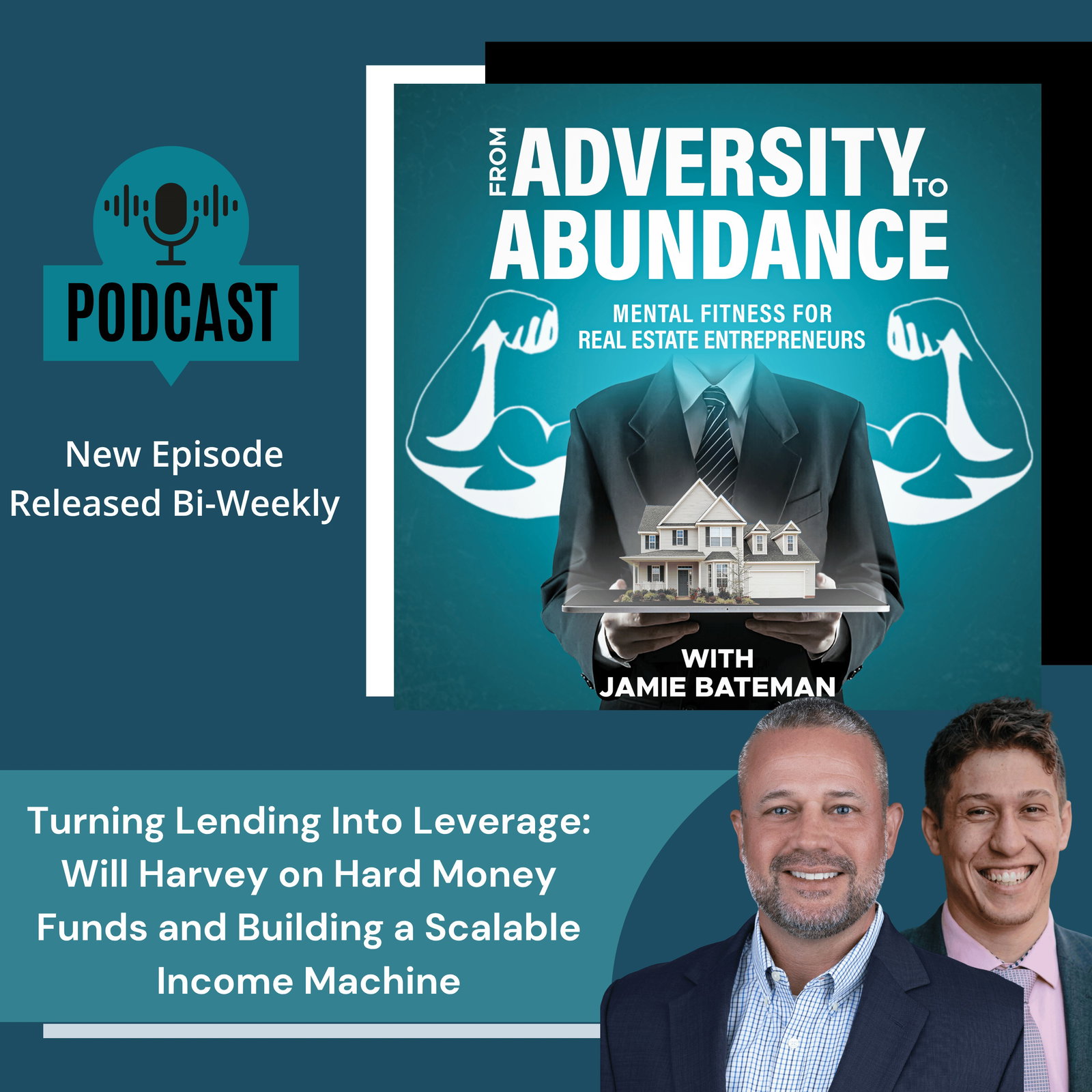
Turning Lending Into Leverage: Will Harvey on Hard Money Funds and Building a Scalable Income Machine

 Apple Podcasts
 Spotify
 Amazon Music
 iHeartRadio
 RSS Feed
 In this episode of From Adversity to Abundance, host Jamie Bateman sits down with Will Harvey of Harvey Capital for a practical, in-depth conversation on private lending, hard money, and what it really takes to run a real estate fund. Will shares his journey from working in the mortgage business to flipping houses—and ultimately finding his niche in private lending and fund management. As he prepares to launch his first 506C fund, Will breaks down how these structures work, why he chose to focus on lending, and how his strategy compares to Jamie’s approach in the note investing space.
But this episode goes beyond strategy. Will opens up about a painful $70,000 loss on a deal that didn’t go as planned, unpacking the critical mistakes and lessons that reshaped how he evaluates risk and opportunity. From discipline in deal selection to building scalable systems and raising capital, this conversation is packed with real-world insights for both active and passive investors looking to navigate the lending and fund space more effectively.
Guest Introduction: Will Harvey
Will Harvey is a real estate investor and founder of Harvey Capital, a hard money lending business based in Virginia. After starting his career in the mortgage industry in 2015, Will transitioned into house flipping and eventually private lending, where he now focuses on running funds and deploying capital through short-term real estate loans. He is currently preparing to launch his first 506C fund, designed to provide passive investment opportunities while scaling his lending operations.
Episode Highlights:
- The Shift to Private Lending – Why Will moved from flipping houses to focusing on hard money lending and fund management.
- Launching a 506C Fund – How Will is structuring his new fund and key differences compared to other lending funds.
- A Costly $70K Mistake – The deal that went wrong and the hard lessons learned about discipline and risk.
- Scaling a Lending Business – Building systems, raising capital, and positioning a fund as a bond alternative.
Key Takeaways:
- Hard money lending can provide consistent opportunities, but success depends on disciplined underwriting and deal selection.
- Fund structures like 506C can offer scalability, but require clarity in strategy and investor communication.
- Losses often come from stepping outside your proven model—staying within your expertise is critical.
- Building a successful fund is as much about operations, systems, and capital raising as it is about finding deals.
Learn More about Will Harvey:
Website: harvey-capital.com
Twitter: x.com/wharvey1993
Learn More about Labrador Lending:
Integrity Income Fund:
labradorlending.com/passive-investors/
Labrador Mentorship:
labradorlending.com/active-investors/
Asset Management Service:
labradorlending.com/hybrid-investors/
—
Purchase Jamie’s Book: www.amazon.com/dp/B0CGTWJY1D?ref_=pe_3052080_397514860
—
Leave us a REVIEW: podcasts.apple.com/us/podcast/from-adversity-to-abundance/id1618672867?mt=2&ls=1
www.adversity2abundance.com/reviews/new/
Connect with us
Website: www.adversity2abundance.com
Facebook: www.facebook.com/labradorlending/
Instagram: www.instagram.com/labradorlendingllc/
LinkedIn www.linkedin.com/company/labrador-lending/?viewAsMember=true
Youtube: www.youtube.com/channel/UChYrpCUlqFYLy4HngRrmU9Q
Connect with Jamie
LinkedIn: www.linkedin.com/in/jamie-bateman-5359a811/
Twitter: twitter.com/batemanjames
Speaker 0
Today, we get the chance to have a detailed conversation with Will Harvey of Harvey Capital. Will is a real estate investor. He's on the finance side of things now, and we talk about that. Is this is a pretty in-depth conversation about private lending, hard money lending, running a running a fund, and also about Will's journey in trying different things. He was a mortgage broker for a while working for a lender, has done a lot of different real estate projects, and is now focused on launching he's run a couple of of funds, and this is this is gonna be his first five zero six c that he's launching, hard money loan fund where you can invest as a passive investor. And we talk about some of the differences between our two funds, my fund and his fund, and also some of the similarities and things that we like about investing in loans. So whether that's originating or buying first lien mortgage notes. We also Will gets, vulnerable about a particular deal where he lost a good bit of money and and talks about a lot of the lessons that he learned there. So, hopefully, you can take those lessons and avoid the pain that he or similar pain from what he experienced. So, this is a very very practical episode for real estate investors, passive investors, and fund managers and operators alike. So I think you're gonna really get a lot of value out of this. Thanks for listening.
Speaker 1
From adversity to abundance, hosted by entrepreneur and seasoned real estate investor, Jamie Bateman, is the ultimate guide for active and passive investors seeking clarity, mental fitness, and the confidence to make inspired decisions in the world of real estate. With a decade plus of investing experience across various niches and a background as a combat veteran, former army officer, and multimillion dollar mortgage note company owner, Jamie brings a wealth of knowledge and inspiring stories to each episode. Through weekly episodes featuring insightful interviews with industry leaders and solo explorations of mind set and strategy, listeners will uncover actionable advice and tips to overcome challenges and build lasting financial success. Whether you're a seasoned investor or just starting, from adversity to abundance is your road map to turning obstacles into opportunities and achieving financial freedom.
Speaker 0
Welcome, everybody, to another episode of the from adversity to abundance podcast. I am your host, Jamie Bateman. And today, we have with us Will Harvey of Harvey Capital. Will is in the Richmond, Virginia area. Will, how are you doing today?
Speaker 2
I'm doing really good, Jamie. Thanks so much for having me. I'm honored to be here.
Speaker 0
Yeah. Thanks for, spending some time with us. I know everybody's time is valuable, including yours. And so, I'm I'm excited to jump in because we have some some similarities in in how we run our our businesses, I think. And so we can compare notes a little bit and, and speak to the listener about some lessons that you've learned along your journey, and, this is this is gonna be cool. So for the listener who may not be familiar with you, who are you, and what are you up to today? And, specifically, what is some of the abundance that you are living in now?
Speaker 2
Yeah. So I can get into my my background and and and all that. So I, I got into the mortgage twenty fifteen after, dropping out of the second college that I dropped out of Nice. With double drop out. Yeah. I was playing football and had double hip surgery, and that was sort of the the end of that. So came home and got into the mortgage business.
Speaker 0
Yeah.
Speaker 2
And that is what got me just into real estate. I just caught the real estate bug, bought my first house long before I could even qualify for one. I had my dad cosign. Okay. And I had, I did a whole house hack. I didn't even know what that term was.
Speaker 0
Yeah. Yeah.
Speaker 2
But I had a couple guys live with me and that, you know, pretty much paid the mortgage and it was it was awesome. So, did did that. And, then I then I started after about a year, I started originating loans as a as a loan officer. The first year, I was just kinda learning the business Yeah. In the back end and just chomping at the bit, ready to get going. And, got out into into production and had a great, you know, had a really fun three year run. Was able to build up some reserves, buy some rental properties. I did realize that I don't like being a landlord. Yeah. But but it was great. And then I got, I got going. This is, end of twenty nineteen. I started a house flipping company with a with a partner, and, and we'd you know, I did that. I was focused on that for a few years. And but all the while, I was just sorta migrating more and more to the finance side of things.
Speaker 0
Yeah.
Speaker 2
It's really what I enjoy. I realized that, you know, I'm not a I'm not a big operator. I don't like Right. Look. We did great flipping houses. We we had, you know, one of them broke even. That was our worst deal. And then we had, you know, some of them that were six figure net profits. And so it it wasn't through,
Speaker 0
through COVID and all that, I I sounds like.
Speaker 2
Yeah. Which actually helped us tremendously. When we first
Speaker 0
you know,
Speaker 2
I I left right at the I left the mortgage business right at the end of twenty nineteen, and, you know, COVID happened right after that, early twenty twenty. And me and my partner were like, man, what what did we just do? We just left our jobs. Yeah.
Speaker 0
Right.
Speaker 2
But then it ended up rebounding, and the real estate market went, you know, just Right.
Speaker 0
And a lot of people were sort of stuck at home with, you know, in some cases, extra cash to spend. And I know, like, you know, at least on owner occupied properties, people were doing additions and things because they couldn't leave their house. So, like, I I want more space. And so I know in that in that particular space, you know, the peep the contractors and operators did well. And as you said, real estate prices kept climbing in general. Exactly. So but now, like, what does your business look like today? And then we're gonna jump back and talk about some of the challenges that you've overcome, some some of the times you've lost money. What do things look like today for you?
Speaker 2
So today, they look like running more of you know, I I run some funds, and I need, to to everything I do is really on the finance side of things now.
Speaker 0
Yeah. I don't
Speaker 2
own aside from my primary residence, I don't own, any any real estate as, you know, like a like a rental property that I own Yeah. Hundred percent of my own. There's a couple properties that I own with partners, a wedding venue, and a boutique hotel. But I'm I'm more of a capital partner on those. And Right. And, you know, I don't I don't have any day to day, responsibilities. So today, I'm focused on I'm I'm mainly focused on a hard money business where in Central Virginia, we're we're focused on, just growing that and and trying to be the the best lender in in that area. So, yeah, that's the that's the main focus. And I have another fund. We've we've sorta I I've done some stuff, some real estate, deals in the in the public markets, actually. Okay. Most people don't know that that exists, but certainly does. And
Speaker 0
Yeah. We can dive into that.
Speaker 2
Yeah. So so Yeah. Well that that answers questions.
Speaker 0
In a in a little bit. The so and I do wanna very soon jump into, you know, maybe comparing our our two funds a little bit, the, your hard money fund and because I it looks like it's yours is structured a little differently than mine, and it's just, from an upper a fund manager standpoint, it's it's fascinating to me how these things can be set up. What is it, you know, what does a typical day or a typical week look like for you?
Speaker 2
Typical day, I wake up some sometime between five and five thirty, and, I read I read the Bible. So I get in the word, read read the Bible, do some prayer, and and really just try to, you know, center myself, get my mind, Yeah. Calm, and and I find that that's a good way to start the day.
Speaker 0
Tone well. Yeah.
Speaker 2
Yeah. Exactly. And, and then I get to work. I work for a few hours, and then, I'm with my family, getting them going for with, breakfast and all that stuff. I have a three year old and a almost one year old.
Speaker 0
So so
Speaker 2
yeah. So I'm busy there. And yeah. And then
Speaker 0
Although you're probably tired at five, five thirty, you probably need that, either, centering and prayer time as you as you I need that. I need
Speaker 2
a three year old. Yes.
Speaker 0
Yeah. For sure.
Speaker 2
Absolutely.
Speaker 0
My kids are a little older, so but I I don't I I don't forget those days.
Speaker 2
I do remember that. No. No. Yeah. And I hear that you just you need it at all ages and all. For sure. The problems The challenges just just evolved. Yeah. Exactly.
Speaker 0
Yeah. And I Yeah. No no one's story is the same, but the the the, problems just yeah. Yeah. As you said, they take on a different form. But, Yeah. Exactly. Less less hour by minute, less hour by hour, but, it's, there's still still pretty big challenges or it can be.
Speaker 2
Yeah. Exactly.
Speaker 0
So So Yeah. Go ahead.
Speaker 2
Yeah. No. So I I get in the word and then, you know, I'm with my my family after I've worked for a few hours. And the morning hours are when I tend to get my best when I tend tend to have my best work done and thinking the clearest, you know, that emails aren't flying at that point. So, you know, that's when I really try to focus on the most important things and not try not to try not to waste time responding to emails and things like that. I I I do that, of course. But, but, you know, I I really wanna focus those hours on really important, you know, high level stuff.
Speaker 0
And Sure.
Speaker 2
And, and then as the day goes on, I I just, you know, I I get what I I do what I need to do, check-in on our pipeline with our, you know, with our processor and team and everything.
Speaker 0
More dated more, like, admin slash maybe reactive a little bit to just the the problem of the hour type thing in the afternoon, maybe.
Speaker 2
Yeah. Ex exactly. You just gotta do whatever you have to do and Yeah. Yeah. So, yeah, that's pretty much my my my day. And then I, stop work usually around five or so and then Okay. Back to family time until they go to bed. Yeah. And then, you know, I'm either reading or trying to think through different things I wanna do and implement. And and then then it's off to bed and Mhmm. Started
Speaker 0
So you, do you like being your own your own boss?
Speaker 2
Yeah. Yeah. There were yeah.
Speaker 0
You hesitated.
Speaker 2
There's no. I I I no. I'm just saying there's no I I I would not do it any other way. Yeah. I mean, even when I was in the mortgage business, the hundred percent commission Mhmm. You know, employees with with with I didn't have set office hours or anything like that. It's really still felt like to
Speaker 0
you. Right.
Speaker 2
Yeah. And I I the job I just remember being like, man, this is there's no way I could do this rest of my life. There's no way I could, you know, just just punch a clock, work forty hours. There's no way.
Speaker 0
No. I think I'd be a terrible employee at this point, to be honest. Yeah. I think there is a bit of a delay here. Hopefully, the the listener can piece it together. But, yeah. So, talk to us about how you launched your private lending fund, why you got into, as you've said a couple times, the more the finance side of things. Just briefly, I, have been in the single family residential space myself as an investor since two thousand ten, and I do still own rental properties. But since twenty eighteen, I've been much more focused on mortgage notes specifically. We don't originate we have originated some loans, but we don't we're not in the hard money, you know, lending business like you are, so that's a little bit different. But people ask, you know, are you in the are you in real estate, or are you in finance? And it's like, well, yes. Because we do take back properties, and and, I do own properties. But, primarily, I I think of it, like you said, more on the finance side of things. And we're not typically lending. We buy already existing debt, and it's typically on it's, you know, owner occupied properties. So I have dabbled some in the private lending slash hard money space a little, when we do have a a fund that buys primarily first lien mortgage notes. So I'm I'm familiar with the space, but yours is a little bit different, the your setup. And I think you're a little more geographically focused, which makes a ton of sense, for some some really solid reasons. And, we're we're spread out geographically, I think, a little bit more. But why did you get into that space? I mean, you were you had experience obviously as a as a lender, you know, as a as a working for a lender, originating loans, making commissions by, having loans originated. And then, you know but what appealed to you about the the finance side of things, and why did you start your fund?
Speaker 2
So I actually never intended to get into hard money. So my original intent with that, I I started a, you know, small friends and family fund
Speaker 0
Yeah.
Speaker 2
A couple or three years ago. And we just had some cash sitting on the sides, and someone called me, an old coworker from when I was in the mortgage business. Yeah. And he was like, hey. I have this I have this borrower that makes makes good money, but he Right. Just can't show any of his income because he's from another country. Mhmm. Yeah. Would you be willing to do a hard money loan? He's putting down seventy five percent, and, you know, he's willing to pay, you know, three points and ten percent. And before he even got done with the question, I was like, yeah. That's a no brainer. Yes. You know, first lien position at, like, twenty five percent LTV. It it wasn't a wasn't a hard decision. No. So I did that loan, and then, and then I just had a few more just just come to me from my network, and we had this fund. And, again, funds are the main focus of it. We were more so at the time looking to do, like, syndicated deals. We were investing in, we we got involved with the mobile home park and, you know, built around multifamily deal, and we've done some, public real estate investing through that. And, but the hard money was a great way to get capital working on a short term basis when we didn't have a home for it. So Right. I did that, through that fund for a while and then just realized that hard money is a really interesting business, and Yeah. We've done well with it. And, you know, I have a lending background and Right. House flipping background. So I feel like that all you know, I know the space. Yeah. I know both sides pretty intimately. And and, so I ended up last year, deciding to start, another friends and family fund for for for that. And, you know, it's dedicated to just hard money. So Okay. And we've done that for a while and feel like we have solid proof of concept. And Right. I have an attorney as we speak drafting the docs for a a five zero six c fund
Speaker 0
Got it.
Speaker 2
Which will allow us a lot more flexibility and be able to really scale this thing.
Speaker 0
Got it. Okay. That's what I, you know, see on your website, harvey dash capital dot com. Yeah. Our fund my fund is a five zero six c as well, and so I can talk all about it. And, you know, I've had the that fund for about about four years now. We've it it actually, from the investor standpoint, looks pretty similar, you know, from the based on a little bit I know about your fund, the returns are pretty similar monthly distributions. And, you know, I but but, again, I think the assets that we're investing in are a little bit different. They're both loans, but you you all are gonna be originating loans. So you're, I think, well, in our case, I noticed on your website, you said you're gonna issue ten ninety nines, And correct me if I'm wrong here, and I know I'm in the weeds a little bit. But in our case, our investors buy a share of the fund, and they are issued a k one, each year, which we just met the deadline a few weeks ago and which is not always the case with with a lot of fund managers. And, you know, we we pay monthly distributions, same range, eight to ten percent depending on the investment amount, And, haven't missed distribution in the four years the fund has been open. But, again, we buy existing debt. Yeah. It's been it's been good. It's it's consistent, reliable. I mean, we're not gonna compete with, you know, crypto returns when they're good or oil and gas or something. We I I'm not trying to compete with those returns, but our our, commitment period
Speaker 2
is Eddie.
Speaker 0
Yeah. Exactly. And it's it's a good diversification play for people that may maybe you already have money in a real estate syndication or the some of the other asset classes you mentioned or maybe you have too much in stocks and bonds and you wanna just do something different. But, you know, so those are both of our funds. The five zero six c's that we're talking about are for accredited investors. Okay. So your that fund is is about to launch, it sounds like. Is that right?
Speaker 2
Yeah. That's right. And I think you were touching on the ten ninety nine versus k one and and just all that. So I I actually got that idea from, it's it's the the person that we we he he founded the company that, it's called Lender, l e n d r. Mhmm. It's the the software that we use for our yeah. It's great. It's it's for our investor and borrower, management. Right. It's it's it's really cool. It's a bit it's a portal that, you know, investors log into, your borrowers log into, you manage all your loans through it, collect payments. It's it's awesome. Anyone that's a hard money lender is checking out.
Speaker 0
But Yeah. I've listened I've been listening to the is it the hard money bankers? Is that right? Or at the
Speaker 2
Oh, yeah. They they push they push. Yeah.
Speaker 0
They're in the Baltimore area and some other areas, but
Speaker 2
That's right.
Speaker 0
I've never used it myself. But yeah. So the Okay. So that so he came up or
Speaker 2
So he gave
Speaker 0
you that idea.
Speaker 2
Yeah. He he, he shared the structure of his, fund with me because he he originally before starting that, he was a hard money lender, and that's how he realized that, you know, it's a very low tech industry. And Oh, for sure. Yeah. There's definitely white space to create a product like that. So he did. Right. It's doing very well. But, but yeah. So he he he just showed me the structure of his, and I was like, oh, man. That's so genius to be able to advertise that, you know, you send ten ninety nines versus k ones. You know, everyone hates k ones Yeah. And having to chase them down. And a lot of times they get extended. I'm in I'm in a bunch of passive deals where, you know, there there's always two or three every year that get delayed and you gotta file your your return late. And,
Speaker 0
you
Speaker 2
know, a lot of people, I'm used to it because I've dealt with it for years at this point. But somebody that's newer to investing in these kinds of privately syndicated deals or funds, they might be a little shocked when you're like, hey. I don't have your k one. You gotta file an extension. Yeah. That that happened to us.
Speaker 0
My my first fund sorry to cut you off. The first fund I did was
Speaker 2
a non more
Speaker 0
of a nonperforming distressed note fund, and, that we did that for three years before my current fund. But, yeah, we had a a couple who had not. This was their first sort of alternative investment, you know, into a fund or anything similar to that, and they we were late that first year on issuing our k ones. Not very late, but they didn't even realize. And we'd we had put this information out, but they hadn't they'd already filed their tax returns, and they were they were upset, you know, because then they got a k one after they'd submitted their returns and you know? Sorry. Yeah. Right. But it does it's very commonplace in the industry to be late on the k ones. You know? So yeah.
Speaker 2
For sure. Ten ninety nine just completely eliminates that. You know? Ten ninety nines have to go out by the end of January. So
Speaker 0
Right.
Speaker 2
You know, somebody that would be on the fence about investing in something that that issues a a k one where they own a piece of the actual business. Right. They the the ten ninety nine is just much simpler and
Speaker 0
Sure.
Speaker 2
Sorta answers that objection.
Speaker 0
Yeah. Absolutely. So, in your case, with that fund, your the the investor is actually purchasing a promissory note issued by the fund. Right?
Speaker 2
Exactly.
Speaker 0
Okay.
Speaker 2
So they don't actually own a piece of the the fund. They just own
Speaker 0
Right.
Speaker 2
A a note to the fund.
Speaker 0
Mhmm. Got it. Yeah. And then, do you intend to stay, you know, geographically focused with your fund in in that in the Virginia area?
Speaker 2
For the time being. Yeah. So I have I've talked about this a lot. So, you know, when I speak to guys that have gone through downturns
Speaker 0
Yeah.
Speaker 2
And have experienced pain in real estate, lending, whatever, A lot of times, a common theme is that they'll say that, you know, the real estate that I owned locally did fine. Right. Because I knew it really well. But it was the real estate that was outside of my market that really struggled and led us to bankruptcy or led us to, just really, really struggle. And I've heard that over and over and over. And I just believe that real estate is so localized and having that local boots on the ground knowledge is super important. Now for buying the notes, like you're doing, it's totally different. You can't focus on one market. There's not enough
Speaker 0
notes. There's not enough inventory.
Speaker 2
Right. For sure. Exactly. So
Speaker 0
Yeah. Yeah. And there is some other I mean, you your business in in you're lending to real estate investors who are managing a a project who and those the that project heavily relies on contractors who are doing the
Speaker 2
actual
Speaker 0
work, the rehab work. We're not doing that. And so, you know, that's there are various reasons why, you know, it's it's difficult to scale your business model from that standpoint more beyond the the local area. But at the same time, you can also, you know, generate a loan, you know, that I can't just generate. So Yeah. There's some key differences there. I mean, I do like the fact that we're diversified geographically, but Yeah. But the the the but the truth is I don't know all of the markets that that the that we're investing in super well. I mean, that's just a fact. I can't be an expert in in all these markets, but that's also why we typically buy, you know, less than seventy five percent.
Speaker 2
I was just gonna say. Yeah.
Speaker 0
But we'll call it investment to value. You're probably you probably deal more with LTV. Yeah. And so, you know, we're not lending for the most part. But but, yeah, makes a lot of sense. I I think people with your business model or similar one either struggle, like you said, when they try to expand geographically or they're very deliberate about opening up a new office in a certain location, and then they they slowly expand their their operations that way. But it it's almost impossible to do it nationally. Would you agree with that?
Speaker 2
I think it's impossible to do it. Oh, I think it's not very wise to do it nationally Right. Unless you you start from one point and just just naturally expand from there. Like, that's that's what my, that's what my, you know, my goal would be Vision.
Speaker 0
Yeah.
Speaker 2
To outgrow the the Richmond market and then expand around there. Not Sure. Not expand, you know, to California or Florida, but just start to, you know, hey, this market is pretty close to us. Let's go there. Let's go to, you know, Charlotte, North Carolina. That's not terribly far. And you know what I mean? Instead of instead of just going, hey, we're gonna open up a satellite office in in Los Angeles. I mean, that just wouldn't make sense in my opinion.
Speaker 0
Yeah. And and just to piggyback on what you're saying about people getting into trouble, you know, and it there are other ways that investors get into trouble, I mean, many ways. But, one, you know, not just geographically, but a lot of times when the markets tighten and deal flow is harder to come by, deals are are just you know, maybe the the yields are compressed or whatever, and that's that creates pressure on the fund operator to, you know, or just the real estate investor to to go out and just do deals outside of their their buy box. You know, I we we that's how, you know, we're buying notes, so it's our buy box. But outside of their wheelhouse, but the the flip side is you do need to get uncomfortable sometimes, and you do need to expand and, you know, you do need to shift a little bit and listen to market conditions. So there's a lot of art and and strategy involved. Not it's not just, oh, I only buy in this buy box, and I'll never change. Well, you do need to pivot it sometimes. You do need to adjust. But if you do that too drastically or too quickly, you can really get, you know, in in some serious trouble. Speaking of that, let's talk
Speaker 2
about percent.
Speaker 0
Our the show is from adversity to abundance. I know you've lost some money on some real estate deals yourself. So, you know, back to kind of your personal story a little bit. Let's talk about, you know, when things haven't gone well for you, what happened there? Was there anything you could have done to prevent that? What were some of the lessons learned? Does does a deal or two come to mind?
Speaker 2
Yeah. Yeah. There's there's one in particular. It was this goofy property that I bought with two partners, in early twenty twenty two. So this was right before the Fed started jacking up interest rates, and everyone was riding riding high on the whole zero interest rate environment that we were in. And Right. We had flipped a a few few properties before then, been very profitable. And I found this, we were this is when I was flipping houses and Mhmm. And, we we we rely relied heavily on Google Ads.
Speaker 0
Okay.
Speaker 2
And we got a lead, got in touch with, the the homeowner and went to see the property. The property was was about we we ended up buying it for eight hundred and sixty thousand, which was well outside of our typical, you know, we tried to buy, this was this was in Northern Virginia. Yeah. So it's an expensive market, but we tried to be, we like to buy around, you know, call it two hundred to four hundred thousand. So this was way outside of that.
Speaker 0
Right.
Speaker 2
And, you know, I just I was the one quarterbacking it. We didn't really have a cohesive plan or a clear plan as far as what we were gonna do. I was sort of thinking, well, if if things go well and we can flip it, then let's flip it. Otherwise, let's run it as an Airbnb. And so it was just kinda we didn't have a a set plan. It was just like, hey. You know, I think we're getting a decent deal on this, and the market's going crazy. So let's just do it. Right. And, it was just a total disaster. We couldn't sell it for what we wanted. And long story short, after fumbling around with it for a year and a half Mhmm. Getting a property manager, just trying all different kinds of variations on how we could, operate it as a short term rental Yeah. We ended up we ended up being in and took a took about a seventy thousand dollar loss on it. So, it was painful, but, we lived to fight another another day. It wasn't it wasn't one that wipe wiped me out or anything, but it was it it stung, and it wasn't fun to go through. But I will say that I learned way more from that Yeah. Than I have on on the deals that have gone well.
Speaker 0
So that was seventy grand, like, that you lost personally, not not across
Speaker 2
No. I was a partner in it. That was the entire higher amount. So Got it. My portion was was less than that.
Speaker 0
And it's all relative. You know, it's it depends, you know, what it's seventy grand to to your group, maybe different to a different group and but but that still stings no matter what. And I, you know, for sure can what you just said resonates with me. I mean, I I had a I've lost money in real estate deals and, even a a a business that I was a partner in. It kinda sorta got well, not not not roped in. I mean, I chose to, but I it wasn't originally my idea to to do this. We started a loan servicing business and, you know, so many less
Speaker 2
bankless business.
Speaker 0
Oh, I don't I don't recommend it. I mean, I have a lot of Oh, I I've I've used probably six or seven loan servicers now, and, I mean, I still get frustrated with them, but I but I have a lot more empathy than I used to. A little
Speaker 2
bit of grace for them.
Speaker 0
Yes. It is not not fun, and it's the margins aren't great. It's so much so much, you know, with the licensing requirements for for the types of loans that we that we buy. There's a lot more red tape than what you guys deal with. There's a lot more, licensing Yeah. Mostly from the states, but requirements. But it didn't go well from a financial standpoint. It didn't go well at all. And but the reality is I learned a ton, and it no. I mean, I'm not trying to learn that that similar lessons the same way again. You know? But, not seeking out adversity per se, but, I learned so many lessons about, you know, leadership and people and, probably one of the biggest well, you know, one was, you know, scaling organically. So we did the whole like, we went out and got twenty five licenses in in twenty five different states, and then it was, like, build it and they will come kinda model. And we should have just started with one or two states and gotten enough revenue with a few small clients and then just added a few states here and there, from a licensing standpoint. You know, that that's one big one. And then the other one was probably I probably should have quit earlier, to be honest, you know, because I tend to be a little stubborn and, you know, you've got people who are working for you who, you know, they need their paycheck, and it's like, well, you know, you don't wanna shut the whole thing down. So it's a I learned a lot through that just
Speaker 2
to your point.
Speaker 0
I mean, that's that's really what the I mean, I learned a ton. So I am grateful in that, you know, from that standpoint. But, what would you say I mean, what would you say you would do differently other than, oh, I wouldn't do the deal. But, you know, how would you if you had a similar deal come across your desk, what would you do differently now?
Speaker 2
I where I was undisciplined was just I think that, like you said, when you when you don't have a ton of deal flow, you can talk yourself into doing a thinner deal. And
Speaker 0
Yeah.
Speaker 2
That was that was a big contributing factor. So I didn't have a ton going on. Right. You know, I I had sold my last Airbnb. I had I had some Airbnb rentals, and, you know, I sold I sold one about six months prior to buying this. And I remember being like, I will never buy an Airbnb as long as I live. And then it wasn't even a year later, and I'm buying this one because you just
Speaker 0
Right.
Speaker 2
You just get bored. And it's like you you forget all the all my wife and I joke about it where people have kids and then they forget how how hard it is when when you're in the baby baby stage and then you have another and you're like, man,
Speaker 0
I I
Speaker 2
don't remember any of this. Like, why did you know, it's just so hard.
Speaker 0
For sure.
Speaker 2
And, that's sort of what happened on on that deal where I I I just was, why did I why did I do this again?
Speaker 0
Right.
Speaker 2
And, but that at least solidified in my mind, like, when I'm when I'm bored, don't do that. You know? Don't just be patient, you know, adopt a Warren Buffett type of mindset and
Speaker 0
Right.
Speaker 2
Just wait for the wait for the fat pitch to be thrown your way and
Speaker 0
Yeah.
Speaker 2
And only swing when you have the perfect pitch. Don't
Speaker 0
Right.
Speaker 2
Don't swing don't swing at everything. You know? You don't need to. You can just wait and wait and wait.
Speaker 0
Yeah.
Speaker 2
So that's
Speaker 0
Very true.
Speaker 2
That's what I would say is is the biggest takeaway from that.
Speaker 0
And I I couple points is one, I mean, for those looking to possibly invest with you, I mean, I do think I personally feel comfortable more comfortable placing my capital with somebody who has made mistakes and who has lost money and who has been through a downturn before versus somebody who just rode the wave and, you know, maybe thinks they're a genius and and, you know, it's like, I don't know. I'd rather put my place my money with someone who has some some battle wounds or some scars. And then secondly, I just want you know, the the space that we're operating in, the the hard money lending slash buying first lien mortgage notes, we do buy seconds as well, but mostly first. You know, it's just you you can lose money for sure, but in general, it's a little bit lower on the, you know, the risk spectrum, if you will. It's a little bit lower risk than some of these other asset classes. So, you know, the the operator matters. The fund manager matters considerably, but I do also think the asset class classes that you and I have chosen to operate in are fairly low risk. There's always risk. But in general, I think it's a
Speaker 2
We'll need to sleep somewhere.
Speaker 0
Yeah. Exactly. And and, you know, the real estate is the collateral. It's, you know, so if you're if you're not lending at at a hundred percent, you know, LTV for based on the ARV. I mean, that's not my my world, but if you're not lending, like, to that threshold, you should be able to get out of most deals, at least get your capital back. Right? So, you know, so I love the space that we are we're operating in. So, where do you see you're you're gonna launch your fund soon. Where do you see things going in the next one to two years for your business?
Speaker 2
I just wanna keep building the right processes and and scaling. I think that, you know, the more that the more that I can do that, the more it'll allow us to really build a a well oiled machine and allow us to scale beyond, you know, just just like, a lot of guys operate locally, and they have a they have a good business, and they make good money as a hard money lender. But Mhmm. They're just they're a one man band and they're not really able to get
Speaker 0
Yeah.
Speaker 2
Get to scale because Right. It's only themselves and that all the knowledge lives in their head. And so I think that I think that, you know, motivating a a team and getting other people involved in this, is is important. So that's really what what I'm focused on now.
Speaker 0
For for sure, it makes a lot of sense. I mean, you have to in order to scale any business, you need to leverage other people's time or or money or both.
Speaker 2
Yep.
Speaker 0
So running a note fund and or or running a hard money fund, hard money syndication offering, whatever, really, really comes down to three legs of the stool. And I didn't come up with this, so I can't take credit for it, but I but I use it all the time. But it's, you know, raising capital, find so finding money to invest. Two is finding deals, you know, to invest the capital into. And then three is is managing those two, managing the capital and managing those deals. Where we end up spending a lot of our time is is asset management, actually, managing the notes because we do also buy distressed debt and those you know, working through foreclosures and bankruptcies and things. It takes a lot of management. But I'm curious on the capital raising side, and I know your other offerings have been, you know, more friends and family. What have you done already to get that ball rolling, and what are your plans to raise capital? How are you gonna reach those those in those passive investors, or or, I guess, lenders technically, but those investors for your for your offering?
Speaker 2
Yeah. It's a great question. So my my plan I have a pretty decent network of people that have invested with me in past deals, not just not just the hard money stuff, but but Yeah. Real estate deals, you know, standalone real estate deals in the past. Mhmm. And, so that's certainly an area. And then the next biggest one that I wanna really focus in on is the wealth advisor route. So positioning this as the bond alternative and just setting it up that way where, where that's how we position ourselves. Mhmm. And and we can, you know, pitch the whole, you know, the fact that we we issue ten ninety nine.
Speaker 0
And
Speaker 2
instead of k ones, they don't have to chase us down. They don't have to get get angry phone calls from their clients wondering where where a k one is and
Speaker 0
Right. Yeah.
Speaker 2
So that's that's really that's really my, my focus is to is to play the long game and and go and lean hard into into that channel. There's a few other ones that I plan to do, but I would say that's that's where a a lot of my focus is gonna go.
Speaker 0
I think it makes a lot of sense. I mean, we certainly post on social media and things, but at the end of the day, our biggest our our most fruitful source of, you know, investment capital has been our current investor base. And Mhmm. Whether whether that investor is
Speaker 2
Relationship business.
Speaker 0
Capital. Yeah. And that, to me, shows that they're happy with the service, the communication, and the returns that they've been provided thus far. So it's it's, you know, additional capital from those existing investors or referrals from those investors. And then as you mentioned, potential referrals from wealth advisors or people who are connected to people with money. You know, again, it's they they already have that social proof of, hey. Will's done a good job for me. He can probably do a good job for you as well. So, makes a lot of sense. What do you, what do you see as a a what's one of the biggest challenges you're facing right now in your business? No challenges? It's all easy?
Speaker 2
No. There's definitely challenges.
Speaker 0
I'm just kidding.
Speaker 2
I would say I would say that for me, what I, what I've really been focused on lately is bringing on, and I'm pretty, you know, I should be pretty close to having this person. I feel pretty good about who whoever re recently offered a job to. And, but I I struggle with with, with documenting our processes and just getting everything going from an operational standpoint. So I need that I need I need that person to help me, you know, do all that, implement things. And, so I I I think that once that is in place, it'll really, you know Yeah. We'll really be able to to get moving.
Speaker 0
That is a big it's always a challenge. And, you know, we we we use Loom a lot and and to record, you know, how to do certain things or whatever, and you can take those transcripts and, use them. You know? But the truth is then we change softwares and that whole, you know, folder that make libraries useless and, like, why do we do that? But but you're but but it is an important effort to undertake for sure, to be able to document your SOPs and your processes because you can't scale otherwise. You can't hire.
Speaker 2
Yeah. Exactly.
Speaker 0
So that makes a lot of sense. Are you ready for some rapid fire questions, Will?
Speaker 2
Yeah. Absolutely.
Speaker 0
Alright. What's one thing that people misunderstand about you?
Speaker 2
Oh, man. What a deep question.
Speaker 0
That one does trip
Speaker 2
people up.
Speaker 0
It's less rapid fire in reality than the others.
Speaker 2
Yeah. I don't know. I've never really I've never really thought about that. Maybe that I would say it it's not necessarily about me, but it took me a while to figure out. I always liked real estate, and I always knew I wanted to be in real estate.
Speaker 0
Mhmm.
Speaker 2
But I, you know, I own rental properties, realized I didn't like being a landlord. I I flipped houses, didn't you know, that wasn't what I wanted to do forever. I've just done a bunch of things. I've I've operated properties as a, you know, as a GP, and and, it's just not it's just not my thing. And so it took me almost a decade to figure out Mhmm. What I wanted to be and what lane I wanted to be in in real estate. And, and that's more on the finance side, and and, I've done some some invest investing in real estate through the through the public markets. And that Yeah.
Speaker 0
We were gonna circle back on that. Talk talk about that. Sorry to cut cut. We'll get back to the rapid fire questions. What does that mean exactly, and how does that work briefly?
Speaker 2
Yeah. So a couple I'll tell you how I started doing it. A couple years ago, I put together a very small fund with myself, my own money, and then two immediate family members. And I was just going out with that and looking looking in the in this in the public markets for interesting opportunities. Okay. Not necessarily real estate related, but just things that I could understand and where I felt like there was a a a significant discount to what it was what it was worth. And and, I ended up stumbling upon this this deal. It was a it was a a liquidating trust that traded over the counter, so it had very little exposure. It had, not a ton of liquidity, but I I found it. And long story short, they owned it was formed in connection with JCPenney's bankruptcy. So JCPenney filed bankruptcy in late twenty twenty. They got purchased by these two big mall operators who then, recapitalized everything. And they they took the operating business and separated from separated it from the underlying real estate that JCPenney owned. And they took the real estate and they spun it into this liquidating trust and had the the had it just trade over the counter. And all the creditors involved in the bankruptcy just got just were given shares in this liquidating trust, and I'm sure that they just dumped them and, just recouped whatever they could. And then you had this liquidating trust that anybody could go out and buy over the counter, through the through your Fidelity account or whatever. And so I came across this, and I don't know how familiar you are with with cap rates. But,
Speaker 0
A little bit. Yeah.
Speaker 2
Okay. So, basically, I could buy this portfolio. I could buy into this portfolio of JCPenney properties at at fifty cents on the dollar. And then they were turning around the liquid the trust. The the manager of the trust was tasked with selling these properties just to, you know, real estate investors, and they were turning around and selling these properties at a dollar. So I bought into them at fifty cents and, and got a twelve percent yield just on the lease income. And then they were turning around and selling properties and basically doubling what would the, you know, the price that I paid. So Yeah. You know, that was a great early win for my that friends and family fund I put together, and we put a good chunk of the fund in it. Okay. And, you know, that I was that was just something that I had real estate knowledge and,
Speaker 0
you
Speaker 2
know, is this this weird quirky deal that flew under the radar. There weren't big fund managers looking at it, and and, we we did very well on it.
Speaker 0
We've never talked about that on the the show in the last four years that we've had the show. So anything like that. So where where does somebody find a deal like that?
Speaker 2
Just if if you look, if you've it's easier if you have some kind of investment screener, and you can you can look up, you know, REITs, you can filter by real estate companies. Yeah. But there's also there's also companies that maybe have there's there's one example that I I didn't invest in this, but people that did ended up doing very well. It was this, company that operated somewhere. I think they were in Illinois outside of some major metro there or Oklahoma somewhere. And they, the company was, was founded, you know, like a hundred years ago or more than a hundred years ago. And at the time the real estate they owned was, was rural and wasn't really worth much.
Speaker 0
And
Speaker 2
what they did was they, they sold cattle. Their business was, it was like an auction platform for people to buy and sell cattle.
Speaker 0
Okay.
Speaker 2
And over time that real estate, they just got more and more value as the more and more valuable as the, you know, the core of the city kept expanding. And they ended up sitting, you know, they they were sitting on this real estate that was now more value valuable than their operating business. And they ended up, deciding to just liquidate everything. And, when they announced that the stock price jumped up, but, you know, had you had you known what they owned Right. And could do some research on it and saw that there was a, you know, imminent catalyst there.
Speaker 0
Right.
Speaker 2
You could have invested in something like that. And, and you know, again, they weren't a real estate company, but they owned valuable real estate and their plan was to liquidate it. And, you know, so there's deals like that out there. There. You just have to look really hard to find them.
Speaker 0
Yeah. Well, my son would be upset if I didn't point out the the pun that I could make, which was catalyst.
Speaker 2
I like
Speaker 0
it. Imminent catalyst. So sorry. I couldn't do that. That's a
Speaker 2
good one.
Speaker 0
Anyway, that was really bad. Alright. Let's let's fly through these rapid fire questions. You you ready? Cool. Alright. I'm ready. If you were given ten million dollars tomorrow, Will, what would you do with it?
Speaker 2
I would I would go out, and I would just keep doing what I'm doing. I would do hard money loans, and I would probably invest in, you know, and I would probably start trying to find more of those, publicly traded companies.
Speaker 0
There you go. If you could have coffee with any historical figure, whom would you choose?
Speaker 2
Warren Buffett.
Speaker 0
Nice. What's some advice that you would give your eighteen year old self?
Speaker 2
Oh, man. Stop doing drugs and alcohol. I got sober very shortly after that. So
Speaker 0
There you go. Hey. That's good advice.
Speaker 2
Always help to do it sooner.
Speaker 0
Yeah. Right. What's a controversial or unconventional strategy that you see in your industry?
Speaker 2
I would say that, you know, for us, we're in we're in the asset we're in the asset based lending space. So a lot of guys focus really, really heavily on the asset. Mhmm. I to do that, of course, we're not gonna land over a certain percentage of what the ARV is, and we we wanna make sure the as is value is is, is there and that we have a good cushion. Mhmm. But I put a ton of emphasis on the borrower, their character. I use I use, you know, I I record meetings that I'm in with with people so that I can analyze what was said and just what and and try to try to pick up on red flags and things that I might have missed while I was in the conversation. So I put a lot on the qualitative, you know, component of who the person is, their experience, their character, and all that.
Speaker 0
Makes sense. Yeah. I mean, in in our space, that's when we're we're running due diligence on a particular asset. It's the three p's is the paper, the property, and the payer. And, they all they all matter quite a bit, especially in especially the the paper matters quite a bit because we're buying notes that may have an assignment chain that's extensive. So I need to make sure what I'm buying actually is an enforceable has an enforceable lien. Yeah. But back to the questions. What is a book or two that you can recommend for our listener?
Speaker 2
I always recommend it's not a book, but it's a collection of letters. They're Warren Buffett's annual letters that he writes to his shareholders, and you can get them going back even before Berkshire Hathaway when he had his early partnership. And, they're just so loaded with with wisdom and, investing philosophy, and I I I highly recommend them to anyone.
Speaker 0
You sent a collection of letters. I was thinking, like, the New Testament or something.
Speaker 2
Well, I recommend that as well.
Speaker 0
They're not all letters, but but,
Speaker 2
Yeah. A lot are.
Speaker 0
Yeah. Will Harvey, what's one question you wish I'd asked that I have not asked?
Speaker 2
I was I was just just for to to, you know, just to talk about something that is an ego boost to me. I wish you would ask me about the the the note that I just, that I bought. I bought it in December. Yeah. It just paid off. I wish you would have asked me about that. It was it's probably, on a percentage basis, the best deal I've ever done.
Speaker 0
Yeah. If you get if you're ever in the mortgage note space and and you get an unexpected payoff, I don't think there's really much better than that from a return standpoint, especially I'm presuming you bought it at a discount. Is that right?
Speaker 2
It was a zero percent note,
Speaker 0
and it
Speaker 2
had a balloon on it. It was not a owner occupied property and, had a balloon. We we bought it at a really low ITV, and I felt that
Speaker 0
Pretty good about it.
Speaker 2
You know, on the wrist was there and
Speaker 0
Yeah.
Speaker 2
Even though it was zeroed. And, bought it at about four, five dollars. And How much was it? Sorry. Paid off and
Speaker 0
What was the discount we bought?
Speaker 2
We bought it for, about twenty seven thousand, and it it just paid off for fifty eight thousand five hundred. So it was a yeah. It was phenomenal.
Speaker 0
Three three less than four months?
Speaker 2
Yeah. Bought it right before Christmas. And, and and yes. Yeah. Just it just paid off, I think, last week.
Speaker 0
Yeah. So about three months. So that's amazing.
Speaker 2
The annualized return was Yeah. Was off the charts. Yeah. I am Probably will never do anything like that again.
Speaker 0
Right. I mean, it's it's the you know, I I for our buy box, we don't typically buy anything that's less it has a coupon rate of less than seven percent, for various reasons because we also do modifications, and I have a little more wiggle room if there's a higher interest rate, you know, but Yeah. Zero percent. But the and the balloon balloons are hard to price because, you know, what's the exit strategy? How are they how are they gonna come up with that money? But, apparently, they did in your case, so congrats. That's awesome.
Speaker 2
Yeah. Well, they were flipping it. It was it was Okay. Yeah. It was it was,
Speaker 0
Well, it's a business. It's a space you know. So Yeah. You know? Awesome. Will, where can our listeners find you online?
Speaker 2
They can just go to my website. It's harvey dash capital dot com, or they can just email me, will at harvey dash capital dot com.
Speaker 0
Awesome. Well, Will, thank you so much for spending your time with us. Really appreciate it. It's been really good. We got into the weeds a good bit, and, also, you were vulnerable and shared some of the the losses that you've experienced, shared some of the information about that. And, thanks for spending your time, and I wish you the best of luck with your new fund.
Speaker 2
Thanks so much, Jamie. I really appreciate, you having me on.
Speaker 0
Absolutely. And to the listener, thank you for spending your most valuable resource with us, and that is your time. Thanks, everyone. Take care.
Speaker 1
Thank you for joining us on From Adversity to Abundance. We hope today's episode has equipped you with valuable insights and practical advice to elevate your real estate journey. For more inspiring stories and resources, visit us at w w w dot adversity to abundance dot com. If this episode has inspired you, please share it with a friend who could also benefit from our conversation. Together, let's turn adversity into abundance. Until next time, keep building your mental fitness and your real estate empire.

CEO - Harvey Capital
Will began his real estate career in 2015 as an award-winning residential loan officer at a national lender. Transitioning to direct investment, he founded his first real estate company in 2019 after building a personal portfolio of houses, rapidly gaining a comprehensive understanding of private syndications as both a limited and general partner.
This diverse, hands-on experience has been instrumental in his current role, where he adeptly manages multiple funds. Will's unwavering commitment to shared success is underscored by his practice of personally investing alongside all partners in every venture.
Will and his wife, Sarah, are based in the Richmond area and have two young boys. Will is a devoted Christ follower and is committed to using the resources he's been blessed with to make Him known throughout the world.