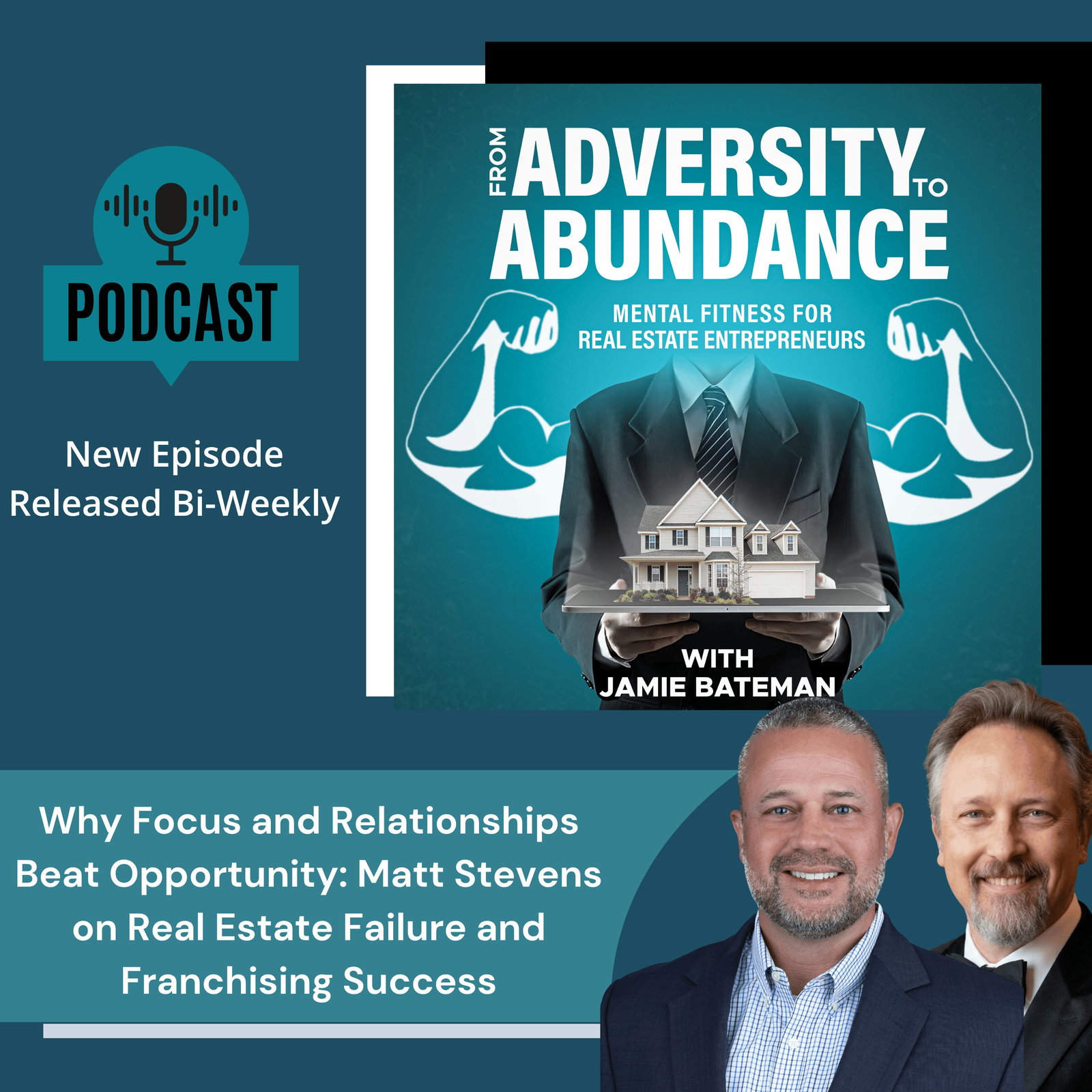
Why Focus and Relationships Beat Opportunity: Matt Stevens on Real Estate Failure and Franchising Success

 Apple Podcasts
 Spotify
 Amazon Music
 iHeartRadio
 RSS Feed
 In this episode of From Adversity to Abundance, host Jamie Bateman sits down with Matt Stevens, known as “the franchise guy,” for a candid conversation about business, real estate, and the realities behind both. Matt shares his early entrepreneurial success—building a painting franchise to 5,000 hours in just three months—before opening up about his much tougher experience in real estate, where fires, insurance issues, and other setbacks led to roughly $50,000 in losses. This episode offers a grounded perspective that challenges the idea of any “perfect” investment strategy.
After stepping away from real estate, Matt refocused on his franchise consulting business, where clarity and focus led to massive growth—ultimately increasing his revenue sixfold. He breaks down his relationship-first approach to helping clients find the right franchise opportunities, along with practical insights on financial requirements, time commitments, and what makes a strong candidate. The conversation also explores industries poised for growth, particularly service-based and healthcare sectors, making this episode both a reality check and a forward-looking guide for investors and entrepreneurs.
Guest Introduction: Matt Stevens
Matt Stevens, known as “the franchise guy,” is a franchise consultant and business strategist who helps individuals identify and invest in franchise opportunities aligned with their goals. With decades of experience across industries, he focuses on relationship-driven guidance, helping clients make informed, strategic decisions about business ownership.
Episode Highlights:
- Real Estate Reality Check – Matt shares how he lost around $50K due to fires, insurance issues, and property challenges
- Early Entrepreneurial Success – Growing a painting franchise to 5,000 hours in just three months
- The Power of Focus – How cutting distractions led to a 6x increase in revenue
- Franchising as a Path – How Matt helps clients find the right business opportunities
- Relationship-Driven Business – Why Matt prioritizes people over transactions
Key Takeaways:
- No investment strategy is foolproof—real estate comes with real risks
- Early success doesn’t guarantee long-term wins without the right systems and protections
- Focus and simplification can dramatically accelerate business growth
- Franchising can be a viable path, but requires alignment with financial and lifestyle goals
- Strong relationships and honest conversations drive better long-term outcomes
Learn More about Matt Stevens:
LinkedIn:https://www.linkedin.com/in/iamthefranchiseguy/
Facebook:https://www.facebook.com/heisthefranchiseguy/
Website:https://heisthefranchiseguy.com/
Learn More about Labrador Lending:
Integrity Income Fund:
labradorlending.com/passive-investors/
Labrador Mentorship:
labradorlending.com/active-investors/
Asset Management Service:
labradorlending.com/hybrid-investors/
—
Purchase Jamie’s Book: www.amazon.com/dp/B0CGTWJY1D?ref_=pe_3052080_397514860
—
Leave us a REVIEW: podcasts.apple.com/us/podcast/from-adversity-to-abundance/id1618672867?mt=2&ls=1
www.adversity2abundance.com/reviews/new/
Connect with us
Website: www.adversity2abundance.com
Facebook: www.facebook.com/labradorlending/
Instagram: www.instagram.com/labradorlendingllc/
LinkedIn www.linkedin.com/company/labrador-lending/?viewAsMember=true
Youtube: www.youtube.com/channel/UChYrpCUlqFYLy4HngRrmU9Q
Connect with Jamie
LinkedIn: www.linkedin.com/in/jamie-bateman-5359a811/
Twitter: twitter.com/batemanjames
Speaker 0
In this episode, we hear from Matt Stevens, the franchise guy. We do dive into real estate investing, and frankly, we talk a lot about the downsides and how Matt had a pretty bad experience with real estate investing overall. You know, we like to keep it real in the show. We don't, provide, guidance that says real estate investing is amazing or mortgage note investing, you know, is is the only perfect is a perfect asset class or strategy. So I love that. And we talk about how, Matt is really focused on people, relationships, quality, and delivering value. And one of the things that I I that really stood out to me was an inflection point in in Matt's career where he really implemented focus. And I think some of the things he cut out were not bad things in and of themselves, but they were taking away from, where he could have been focused. And after he implemented that focus, his, revenue skyrocketed. We talk about how in just a few short years, his revenue increased sixfold. So, listen up, and, I think you're gonna get a lot lot of value out of this. I'm not an ex expert in franchising, so this was really interesting to me. And Matt also has insights into so many different industries. And we also talked toward the end about which industries he sees thriving in the near future and which ones he thinks may suffer. So you're not gonna wanna miss that that, bit of the conversation. Thanks for listening.
Speaker 1
From adversity to abundance, hosted by entrepreneur and seasoned real estate investor, Jamie Bateman, is the ultimate guide for active and passive investors seeking clarity, mental fitness, and the confidence to make inspired decisions in the world of real estate. With a decade plus of investing experience across various niches and a background as a combat veteran, former army officer, and multimillion dollar mortgage note company owner, Jamie brings a wealth of knowledge and inspiring stories to each episode. Through weekly episodes featuring insightful interviews with industry leaders and solo explorations of mindset and strategy, listeners will uncover actionable advice and tips to over come challenges and build lasting financial success. Whether you're a seasoned investor or just starting, from adversity to abundance is your road map to turning obstacles into opportunities and achieving financial freedom.
Speaker 0
Welcome everybody to another episode of the from adversity to abundance podcast. I am your host, Jamie Bateman. And today, we have with us Matt Stevens, the franchise guy. Matt, how are you doing today?
Speaker 2
I'm doing very well, Jamie. Thank you very much, and thanks for having me today.
Speaker 0
Absolutely. This is gonna be a a a fun conversation. I know oftentimes our our discussions on this show are largely centered around real estate, and we're definitely gonna talk about some of the your experience in real estate, some of the challenges that you've faced, and maybe some of the the, you know, not so great, moments you've had in real estate, but also get into, you know, kind of the mindset of seeking opportunities wherever they may be. Quite frankly, neither you nor I know exactly where this conversation is gonna go. So, for the listener who may not be familiar with you, who are you and what are you up to today, and and what is some of the abundance that you're living in right now?
Speaker 2
Yeah. I I am the franchise guy. I've been in franchising since nineteen eighty eight. And, the abundance I'm living in now was really really focus on the freedoms of people, power, purpose, and money. And so, you know, for a number of and by power, I mean control of of of your schedule and your your your focus. So I I've reached a point where I try to take off, a week every two months. It's been successful for years at a time and unsuccessful for years at a time, but I do work to take off every Friday so I can have that time, and the abundances. You know, my youngest daughter now just got accepted to college. We're gonna be able to foot that bill, and I have a plan for the future. So, I think to wake up in the morning and feeling comfort, a little bit of positive stress that you still have to get up and do things. You still gotta work. You still gotta endeavor towards something. But understanding that if you, employ the behaviors you know that generate results, is in your discipline, then you can get the results you want.
Speaker 0
I love it. I was just talking yesterday about how sometimes I think stress gets a bad rap these days, because stress can be a very good thing, and it's it can cause growth and effort and, you know, a little bit of anxiety might be okay. It might mean that you actually care about what you're working on, but that's a that's a separate episode. I completely agree having that that financial abundance gives you a peace of mind and and and, certainly, that just that stability factor. I I love what you what you just touched on. So let's figure out how you how you got there. Not that you've, you know, you I don't think any of us have ever will ever arrive, so to speak, but let's let's talk about how you got to this level of abundance. Let's jump back into your backstory. The show is called From Adversity to Abundance. Obviously, you've been through some adversity, particularly in real estate, so I'll, let you decide where we're gonna start with your backstory. Where would you like to start? Sure.
Speaker 2
I'll just I I think this is I I grew up in a in a small town in New Hampshire, at the end of a dirt road with two propane tanks in the front yard. So, but I was the youngest of four in a very loving family. My parents were married for sixty four years when my father passed away. My siblings are all fantastic and wonderful people, and we all get along marvelously, and we joke it's laughter all the time. So I'm extremely lucky in those things. Kind of the first bench, kind of the first change for me was, when I was nineteen years old. I transferred. I I went to freshman year in school in Florida. I transferred to a school in the Carolinas. Mhmm. And while I was walking those hallways, I saw an ad for summer work.
Speaker 0
Okay.
Speaker 2
And, actually, it wasn't necessarily work. It it was to run your own business. Mhmm. And I was in the mindset that I'm gonna say yes to everything. You Now if there's a school function where you can ride a horse on a farm, I'm gonna do that. If there's a canoe race, I'm gonna do that. You know, I just said yes to everything, and that's exactly how it went. Well Let me guess. Was it this
Speaker 0
painting franchise?
Speaker 2
It was in painting, and it changed my mind.
Speaker 0
I guessed it. Yeah. And, no, I did not have that information upfront.
Speaker 2
Sorry about that.
Speaker 0
No. No. No. No. I just I was curious because I remember seeing a bunch of those painting franchise offers Yeah. Today.
Speaker 2
Yeah. Yeah. When I got into it, there were sixty seven of us, if I remember right, in New England and Canada, just kinda shooting from the hip, but there were some real established, there was some real established processes in place so that someone with my naivety and ignorance could do well. Right. And so they trained us on situational leadership, they trained us on a sales program, they trained us on how to manage others, They trained us on getting our credit lined up with a paint store. They trained us on so many different things Mhmm. And and how to be in the moment and how to make it happen. And I learned terms there like bob and weave. You just make it happen. Right? And and and and look for the duck. The duck is the one who flies the highest. Right?
Speaker 0
Nice.
Speaker 2
And so and these were Canadian terms, I thought, at the time. I think they still might be. But, anyway, that proliferated. And, you know, I I ran a five thousand hour business in my first three months. If we take that industry and translate those hours to today's dollars, that's about a five hundred thousand dollars revenue in three months. And it was just phenomenal and you just had to get things done. I remember falling asleep in a well lit room at three in the morning fully clothed. That's how exhausted I was. Right?
Speaker 0
Right.
Speaker 2
But, yeah, that was the start of it, and, and it just grew from there. So that started nine I mean, I was in training in my twentieth birthday. I'm now fifty eight.
Speaker 0
Okay. Yeah. And so yeah. I mean, you mentioned the naive naivete and, I think ignorance you said. You know, and I that that's a that's a good way to put it. But, also, you had, I'm, assuming a good bit of energy to be able to put in those kind of hours. And there are a lot I guess my point is there are a lot of traits and characteristics that young people bring to the table even though they may not have the experience and the relationships and whatnot, you know, the career establishment built up yet, but they've got a lot of of traits and and positive attributes that they bring to the table. So, and and that's where the the franchise needs that. Right? They need that young talent and energy. Right?
Speaker 2
They do. And we would we would another saying we would use is, you know, hire for attitude, train for skill. Mhmm. You can work with the right attitude. You you can never you know, the wrong one, you need to get rid of them. So I also remember, you know, I I would do things at age twenty that adults wouldn't do. For instance, we didn't have SEO back then. Mhmm. You know? Yeah. Paid for marketing was quite expensive. So we would put signs up, and I would cold call every single weekend until I get ten estimates lined up. And in in rural New Hampshire, houses can be a third of a mile apart easily, just the driveways into the house. Sure. And so it would take me roughly six to twelve hours every weekend of just going on knocking on doors and all these rejections, but I'd get about one estimate scheduled per hour. That was the average. And I'd mark off the streets at a big map of Cheshire County, New Hampshire, and I'd mark off the streets, and I'd say on this street, I was two for twenty one. On this street, I was one for sixty three. And on this one, I was, you know, four for forty nine. And and I kept that. But it paid off. I knew the behavior that would generate the results I needed. Mhmm. And I was rookie of the year that year. I won some other tenacity awards. The next year I came back, I was I was franchisee of the year runner-up. But it just changed everything about my path, and it gave me so many references of what must be done in the mindset you have to be in Yeah. To just get there from here, and and it's worked out wonderfully.
Speaker 0
Yeah. And I do think persistence is so much more powerful in the long run than any any talent or, you know, even skill that that someone can develop. But, let let's, fast forward a little bit into some of the adversity. It sounds like I mean, I know that was challenging for sure as far as working that hard and getting all those rejections and whatnot, but it doesn't sound like you faced a ton of really heavy adversity in the early days, with the franchise. Where would you say things started to take a turn for the worse with, maybe some financial challenges and real estate investing challenges?
Speaker 2
Sure. In my late twenties, I had I was a I'm a late night guy. I always have been, and I I would follow Carlton Sheets and Ron LeGrand and all the others. And and the the the theories and the things they promoted are legit. And at the time, anyway, I don't know if you still can get a a property with the down, but we certainly could then. Oh, yeah.
Speaker 0
You can, but it's, yeah, that's a whole different discussion.
Speaker 2
I I
Speaker 0
wouldn't I wouldn't really advise it in most cases. But
Speaker 2
Okay. I would walk away from the closing with a check-in hand. I mean, I didn't think that was possible until I studied and did that stuff. Well so I had a I had fourteen properties, and and in a period of about eight months or so, two of them burned down. Not burned down to the ground, but burned out. And that created some challenges and, you know, I was part of the Real Estate Investment Association in Central Ohio. I knew this stuff happened and I found that, at least in my case, I felt I mean, I had a friend doing this in Kansas and he went to his insurance agent who said, oh yeah, we'll get that taken care of. He was a friend of the family. You know, he bought the property long ago or a few years ago for like sixty grand and and he ended up getting a hundred grand check, and then he sold it to a rehabber for ten or fifteen grand. I mean, it it wasn't arson, but he made out. He was made whole and then some. Yeah. Right. It wasn't arson on his ball. Yeah.
Speaker 0
Because a lot of times the insurance company, it's it's the premiums or the policy is is, priced for the cost to rebuild or whatever it's called versus the actual as is value of the property prior to it burning down. So that sometimes that's a lot more than what the property was actually worth. So and then he was able to sell it as well. So that's Right. That's that's pretty sweet for him.
Speaker 2
Yeah. It was it was a it was a catalyst for him, frankly, in his life. And and, and this was this was this happened by a Molotov cocktail. It wasn't it wasn't in the best community in the area. Mhmm. But it's still it was a nice duplex, you know, before it burned down. My insurer said, no, that's fraud. We're not gonna do that. So, and the thing is I only owe I only owed, like, forty three grand on it. They could have paid that, and then I could have sold it. A rehabber had given me an offer of ten grand. Well, they said, no. We're gonna rebuild it even if it costs double that. Wow. And so we got into the whole rebuilding thing, and then my builder had some issues. And he left the job. Thirteen months in, he wasn't halfway done. Wow. And the rent payments ran out from the insurance company. The builder took off. I had a half done property, and I just let it go into foreclosure.
Speaker 0
Wow.
Speaker 2
So the insurer lost. They paid a hundred plus thousand. Mhmm. The builder lost because of whatever, all that, and I lost big time. Right. And the rehabber who offered me ten grand for the shell lost because he wanted it. So Sure. Everybody lost because of that, what I thought, very nonsensical effort. Well, here I am now with a with a foreclosure on my record. Mhmm. During that time, another one burned out, and it wasn't a place I visited often, and I didn't get news from it. And it was vacant. And in that one, the insurer decided they weren't gonna pay it all, and we went to court and found out that they were gonna win that argument. Wow. So I was out there as well, and and I knew, alright, this stuff's gonna be on my record for at least seven years. Mhmm. But it just created some real challenges. There are some other things in there too that folks who own these properties may not know. At least where I live, the first ten percent check that comes from the insurer goes to the city, and they hold on to it until that property is done.
Speaker 0
Really? I've never I didn't Yeah. Never heard of that. Interesting.
Speaker 2
So this the city was holding a seventy seven hundred dollar check, which at the time for me wasn't peanuts. Right. And, and I would talk to my attorney, and he said, Matt, I've I've worked with the city, and they said, if you can find a permit that was pulled, we can get that money. And I scoured for an entire weekend, and I found this little slip of white lined paper much much like that. Yeah. And I cut above it and below it, and it had a bunch of digits on it. I had no idea what it went to. And I sent that message to my attorney, and he took it in. He said that was it. So luckily, I I got the seventy seven hundred bucks back. Wow. But, that wasn't a great experience. I ended up selling my final property in twenty seventeen, and, actually for a few thousand less than I paid for it in nineteen ninety eight. Wow. So things had changed there. So in the end, with all my real estate exploits, I ended up negative about fifty grand.
Speaker 0
Okay. This
Speaker 2
is across all the
Speaker 0
all the the properties that you had.
Speaker 2
Across everything. It could have been much worse. It could have been far better.
Speaker 0
Right.
Speaker 2
But I took the lesson, and I wouldn't, I I would I would explore it again in the future. I think there's great advantages there. It would just be in a different way.
Speaker 0
Sure. Yeah. I mean and and I I don't wanna I I say this often on the show, so I don't wanna go into it too much, but I don't think there's any, you know, perfect real estate or perfect asset class or perfect investing strategy or perfect business model that certainly is for you know there's definitely not one size that fits all. Right? And even Agree. Even for one person, I think you have different seasons in your life and one you know, whatever strategy is appropriate at this time may not be appropriate in ten years, for example. And I've certainly lost money in real estate. And and, you know, I I there there's is is the stock market better than real estate just because that's a common, you know, comparison? Well, there's you can it's not yes or no. There's so many variables, and it really depends on your circumstances and and your specific approach within real estate, your specific approach within stock investing, for example. So there's not one size that fits all. It's very personal. And, you know, I I appreciate the fact that you're not you you don't rule out real estate entirely, it sounds like. Is that right?
Speaker 2
Absolutely correct. There's so many ways. I there's so much money out there. There's so many ways to make money in real estate. Absolutely. You just have to find yours. I found that I personally am better like I was in my first painting business. If I can exude behavior every day that goes out and gets results
Speaker 0
Yeah.
Speaker 2
I just I'm that's me. That's my wiring. And in real estate, yes. Yeah. That may or may not be the case with the stock market.
Speaker 0
Yeah.
Speaker 2
So if if I can behave in a way every day that gets results, I'm very comfortable with it.
Speaker 0
Yeah. That makes sense. Yeah. And, I mean, I still have some rental properties, and I still like rental property investing. Mhmm. But there's you know, this is one reason I've largely pivoted over to buying mortgage notes because then we're not we're not dealing with the property directly very often. The property is our collateral. It is a very important factor in in our approach, but it's not our focus. And I'm not managing and with mortgage notes, I'm not managing, as they say, tenants, toilets, and trash. I'm you know? It's, we're we're more like the bank getting cash flow, if it's a performing loan. But that's one reason I I really have focused on mortgage note investing, because the property can be a real real pain. So Right. Fast forward, I mean, I I I guess, you know, overall, you lost fifty k, but, I mean, that's we're glossing over a lot of, I think, pain and struggle that you went through over time as well. How did you pivot from there? What did you learn from there? What was your approach after really of I I guess we could say a a failed or at least difficult experience within in real estate investing?
Speaker 2
Yeah. I just I doubled down on my consultancy, frankly, maybe even tripled down on it. I just said, alright. This is going to be what it hasn't been in the past. And and I placed a lot of people over the years into franchises. And I was running it as a business. But I was also doing I was very distracted, by a number of things on the side. One was real estate, one was board memberships and so forth. And I just said, all right, I'm gonna end all that. I did. Sold my last property, dropped out of each board, and just These were boards,
Speaker 0
sorry to interrupt. Boards? Yeah. Like, for for, what what type of boards?
Speaker 2
These were advisory boards for small businesses. Okay. Some of them were nonprofits.
Speaker 0
Gotcha.
Speaker 2
And, you know, the goal is they just wanted a different perspective, and I was that guy. I wasn't being paid to be on the board. I was simply adding perspective, and and they were sharing the perspective from their businesses with me.
Speaker 0
Yeah. Well, I think that's a really valuable point just to point this out is that just there are many times I think we need to really, as business owners and investors, focus. And it's not that being a board member and correct me if I'm wrong, but it's not that that was a bad thing. It sounds like you were adding value, and you were doing a good thing if you look at it in a vacuum. Right. And real estate investing, you know, we already talked about that. It's not necessarily a bad approach by itself. But in your case, I think it just sounds like they were they were hurting what your results could have been on the the consulting slash franchise side because of opportunity cost. Your energy and your time were spread out and spread too thin. Am I on the right track?
Speaker 2
It really was that. With the properties, I was doing a lot of work for them on the weekends for the boards. It it wasn't every night by far, but it was a night a week.
Speaker 0
Mhmm.
Speaker 2
And and that was taxing. It was a high it was of high reward, but it was also, mentally taxing and physically taxing to spend my time on the weekends on the property. So, you know, my last property that I sold in twenty seventeen, I received it. We had a freezing February in Ohio when I had a a pipe burst in a property. And when I went out there, this is the one that I had owned the longest, actually. And I found long ago before I bought it, someone had replaced a copper pipe with a plastic one.
Speaker 1
Gotcha.
Speaker 2
And we had to tear apart the floor to find that out, and I said, alright. I think I'm I I think I wanna move on to something else.
Speaker 0
Right.
Speaker 2
Yeah. But, yeah, I think the board memberships were were highly valuable. And and, again, I'm not not ruling that out. I'll certainly go back to that, and I've been requested to be on some in the meanwhile. But Mhmm. I just thought I had you know, this was about twenty seventeen. I was gonna put my focus back into my business, and my results in in my business skyrocketed thereafter.
Speaker 0
So from a kind of personal standpoint before we dive into how your business skyrocketed, you know, and you can get as specific as you as you are, feel like and, based on how comfortable you are sharing. But, you know, from an income or asset standpoint or just overall six business success standpoint, what was if you look back, at at, you know, from college to that point where you got rid of the real estate, you got rid of the board memberships, and you doubled down on your consulting business, what was the trajectory of your financial success?
Speaker 2
It was it was retire at sixty five and have a modest Mhmm. Income.
Speaker 0
Yeah. Got it.
Speaker 2
You know? And and it was, you know, it was work you know, it was work four to five days a week, work forty hours a week and and do that. I mean, I haven't left this has all been done out of my home. I haven't left my home in years, I'll say. Right?
Speaker 0
Nice.
Speaker 2
So Yeah. That's another enjoying enjoying part of this. Sure. Another benefit of it. But, it it was it was I had a lot of capacity intellectually to deal with the subject matter of franchising and startup and establishing and setting up a resale and what to learn for expectations and how to manage that And I thought, alright. Well, let's see if I can double or triple the number of people I can at least work with each year and we'll just see what happens. I love helping people. I love being even the smallest part of their story. Mhmm. This is a journey. We we have no idea what's happening tomorrow. We have no idea what that person we just passed on the street is going through.
Speaker 0
Right.
Speaker 2
We're all just out there trying to figure out our path and and do it the best way we can. And I said, what role can I play in other people's lives doing that while enjoying it myself? Yeah. And, so I I I, you know, I I ended up operating a lot more on marketing. I spent a lot more time on the phones, and I was just able to work with a lot more people. And and that's that's when my results changed.
Speaker 0
Okay. So, yeah, how long I mean, what did things look like over the following, say, five years after you kind of instituted that focus?
Speaker 2
Yeah. There was a first period where my results from from one year to the next tripled. Wow. And that maintained, and then that again doubled. And that has maintained. And so we're talking now six x versus what they were in twenty sixteen. Yeah. And and what it means is I I actually had a candidate reach out to me last week. He's golfing with a buddy of his that he's been part of this team for a while, and it just came around to the subject. And it so happens the buddy I worked with two years ago Oh, wow. Small world. And that person's, you know, three states away. Yeah. And he said, Matt, is your outreach is is your is your grasp that large, or is it just that small of a world? And I said, probably a little bit of both.
Speaker 0
Yeah. Right. Right.
Speaker 2
Right. Right. But it's it's allowed me to really it's not a transactional approach anymore. And I think for a while there for me, it kinda was. Okay. It's really getting into the nitty gritty. It's it's having deep, conversations about consequences with people in their world versus their goals. Okay. And it's just and it's a much more enjoyable experience for me.
Speaker 0
Mhmm.
Speaker 2
And I think it is, by the comments I've received, a more enjoyable experience from what the candidates are with as well.
Speaker 0
That's really, you know, in today's environment just with everything being remote and all the AI talk and and AI use and, it's, that's refreshing to hear, and it's in some ways counterintuitive, but in some ways not surprising that you're focused that the focusing on relationships and the quality of conversations and the, you know, depth, and I guess, it sounds like empathy, honestly, is what you're employing because you're putting yourself in the shoes of the client slash potential client and really kind of understanding their journey. And, and it's interesting to hear that it's it's also been more, a a more positive experience for you as well. So by taking this non transactional approach and and going deeper and making it more relationship and people focused. So that's, I I really like that. Yeah.
Speaker 2
It has. There's you know, I tell people there's no subject off limits. We'll just be honest about everything. There's no political correctness in my discussions with people. We deal with, you know, people's decisions have consequences.
Speaker 0
Right.
Speaker 2
So we approach it that way and so I will my my claim to fame for my candidates is that I will force them to think about things no one else has asked them to think about.
Speaker 0
Okay.
Speaker 2
We will have discussions that are uncomfortable, but I've never had anyone say I don't wanna talk about that or I don't wanna answer that or I don't wanna address that. That's never happened.
Speaker 0
Can you give
Speaker 2
an example of three thousand times. What's that?
Speaker 0
Can you give an example of of something that a question you've asked someone that no one else had asked or something that just was a you thought might be an uncomfortable conversation?
Speaker 2
Sure. Actually, without I and I when I say discomfort, what I mean here is things that I I don't want anyone to feel foolish that they hadn't thought of it yet. And and without getting too personal
Speaker 0
Yeah.
Speaker 2
These are inevitably common sense questions that will come out. But, you know, can you be the first one in the state of a business proven multiple times three states over? Or do you need to be or would you rather be the last one in the market where everyone else is doing great Right. But you're taking the last available territory, which says something. Right. Right. No. Do you want comfort, or do you want scalability?
Speaker 0
Right.
Speaker 2
You know, do you wanna work with blue collar or white collar? What days of the week, what hours of the week is this not gonna work for you? How, you know, how how soon how long can you go at zero income from your business? Because it's going to happen. What is the support or lack thereof of your spouse? How is this going to affect your kids at home who you actually told me you wanna see? Right. Right. No. Those are really
Speaker 0
good questions. Yeah.
Speaker 2
Yeah. Can a person I I've even asked them. Can a person who looks like you in the state you're in Mhmm. Go in and generate business on a b to b basis? And this gentleman thought about it for half a minute, and he said no. Interesting. And that was the direction he felt he wanted to go, Frank. Right. And so I was able to to in in his response, use that to have him focus more so on an opportunity that was gonna be far more beneficial to him Right. Rather than just something that he was comfortable with Yeah. While working under the flag of a corporation.
Speaker 0
Yeah. That's interesting. And that's not a we won't go into depth on this either, but I do mentorship for, mortgage note investors, people who wanna learn how to scale their mortgage note investing business from an active investing standpoint. And that's why I don't take the approach of, here's your course or here and and that courses are fine. You need I've taken courses. Training is good. You know? There needs to be some structure, and there are a lot of principles that can apply across the board. But at the end of the day, I need to have that multiple conversations with the person to understand where they're coming from and where they're trying to go. And Right. Because otherwise, I can't I I don't know. I mean, the best way I can help you might be to say you shouldn't be doing you shouldn't be in mortgage note investing or but, and there are many niches within our space that I can kind of help focus and direct them. And that's why we do it that way. It's a one on one approach, and it's because I don't like the one size fits all advice that the gurus put out there and that this is this is what worked for everyone, you know, what works for everyone because this is what allegedly worked for me.
Speaker 2
So I love I love that. Everyone's different. Everyone's body is different. Everyone's mind is different.
Speaker 0
Absolutely. And the your experience, what you bring to the table, and where you're trying to go, it it I don't know what you know, how would I know that?
Speaker 2
Unless we
Speaker 0
get to know each other a little bit. So, so today, I mean, before I I'm gonna ask you about your kind of typical client avatar who you work with. But before we get there, what does your business look like? You know? Again, as comfortable as you are in sharing, but revenue wise or or, you know, what it just what does it look like to you know, this year?
Speaker 2
Yeah. I typically know I I wanna help a hundred people a year.
Speaker 0
Okay.
Speaker 2
Sometimes it's more, sometimes it's a few less. But if I can help a hundred people a year, and realistically, twenty to thirty of those are gonna reach enthusiastic fruition is what we call it.
Speaker 0
Okay.
Speaker 2
Alright. Okay. Meaning, they you know, some and the reason I say that is because the other seventy or eighty will drop out for any reason under the sun Mhmm. That we can think of. And it's not a that's not a a derogatory statement. It could be a family issue. It could be a financial issue. It could be an income issue. It could be a credit issue. It could be anything along the way. It could be two friends told them the same negative comment about something that fifty other people have have reflected very positively on. Right. You know, this is something where when people get go from where they are to where they claim they wanna be, it doesn't matter. They won't do it unless they have a compelling emotional reason to make that change. And sometimes in this process, and it's on purpose, people realize they don't have a compelling emotional reason to make things right or to make a change,
Speaker 0
which is good information.
Speaker 2
Right? It's it's fantastic. If we can get that sooner, the better. Right?
Speaker 0
Right.
Speaker 2
Absolutely. So we again, we live in reality. And by, you know, typically, it's two to three people a month are are are making that decision where it's informed. They know the pluses that they're gonna catalyze. They know the behaviors they're gonna exude and avoid. They know the challenges they're gonna have to overcome or avoid. Mhmm. And they've talked with people in that system, in that franchise system, who are very much like them Yeah. Who overcame it. And the question comes down to, am I ready, willing, and able to exude those behaviors on a daily basis? And if so, you might become an owner. And if not, you might not.
Speaker 0
Mhmm. So and all the caveats exist here of every situation's different, every franchise is different, blah blah blah. Right. We know that going into this question I'm about to ask you, but, you know, what does your typical client avatar look like? What does the process in in one to two minutes, you know, what what are we working with here? Well, how does the process work? You work with potential franchise owners. Correct? And you find them a potential franchise for them to buy, it sounds like. How does the process work, and what is the the the kind of the client avatar look like?
Speaker 2
Sure. Let's look we can do that in a quick way looking at both sides first. For a franchise to grow, they're gonna advertise in all these different ways. And for every hundred names they have on the Internet of the phone, they might find a buyer. At one They might find ten or fifteen who fit. They won't even return phone calls to seventy percent of them. But at the other thirty percent, they might find one or two who fit and take them through the process. On the candidate side, they're looking at forty three hundred brands in eighty different industries. It is overwhelming. I have had people, Jamie. I have had people come to me who've, quote, been looking for five years or more. Wow. So my question is, what are you looking for that you haven't found? So what does Matt Stevens do? Well, the franchisor wants to work with me, and the candidate wants to work with me. If one, we realize and acknowledge half of the franchises out there, I don't know anyone who wants to get into. Right. Okay. However, there are some fantastic ones, and and that's where we focus. We focus roughly, I focus on the top seven percent of opportunities out there.
Speaker 0
Okay.
Speaker 2
On the candidate side, we come in, and I understand them on two and a half dozen ownership criteria from the obvious to the important. So we speak of that candidly. Their mind has to be right. Their money has to be right. Their their, emotional, objective and goal, their compelling emotional reason has to exist. Mhmm. And with that, within a week, we can take these forty three hundred brands and knock them down to the few that might suit this person the best. Okay. Given all of their criteria, part time, full time, skill sets, likes and dislikes, etcetera. And so what I do is I share with them why that small group now exists that they should consider. We talk about it, and then I guide them through the research process, which frankly frankly takes anywhere from three to ten weeks. It's not overnight. It's not short. Highly educational, and somewhere in there, they're gonna say yes or no to everything.
Speaker 0
Got it. Alright. No. That's that was very thorough and yet, pretty succinct. So that that was, that was quite good. So and and I know this this probably might be a red flag for you if if, somebody calls you and and asks this question, but I'll ask it anyway. What's the least amount of time and least amount of money that I need to have available to get into franchising?
Speaker 2
Wow. That's a great question. Okay. I I like to see at least fifty to seventy five thousand liquidity. Mhmm. And a net worth of two hundred thousand minimum helps.
Speaker 0
Okay.
Speaker 2
On the, yeah, and in turn on the high side, we can easily get into three hundred thousand or greater, but it's surprising. A lot of folks think they need hundreds of thousands of dollars. Right.
Speaker 0
They they can use five figures tomorrow.
Speaker 2
Too. Yeah. They can they can use five figures and and borrow the rest if they have a credit score at least six eighty. On the least amount of time, that will vary tremendously only because you and I both know people. One person can get it done thirty hours, another one takes eighty.
Speaker 0
True.
Speaker 2
However, there are legitimate options that once you get them set up, it's five to ten hours a week realistically, but that usually means you're leveraging money rather than time. Right. And those that requires a lot of money. Right. On the lower end, if you can leverage your time, if you can invest your time, then you can go down the the investment financial scale.
Speaker 0
Okay.
Speaker 2
So on the on on the time side, if you're investing lower amounts of money, chances are you're investing more hours. Right.
Speaker 0
That makes sense.
Speaker 2
So folks with the big money can keep it at five or ten hours a week. The folks with typical money, you're looking at twenty to fifty hours a week depending on the outcomes you wanna achieve.
Speaker 0
Got it. Now that that makes a lot of sense. So before we move on to some rapid fire questions, stepping away from the, you know, the the franchise specific discussion, you're someone who obviously is plugged into many different industries and many, you know, different types of business models, etcetera. What has changed in the last three to five years and and take out your crystal ball? You know, nobody knows. Right? But if you were a betting man, what types of industries would you would you say are gonna thrive and which ones are gonna suffer with maybe AI in the background, etcetera?
Speaker 2
Yeah. Some folks look a a lot of candidates who reach out to me are looking for, let's say, AI or tech opportunities and because that's where their history has been. And and frankly, the challenge with that is someone who might be an expert in tech. The question is, how are you going to generate revenue? Yeah. And usually requires a salesperson. And usually that tech person isn't the best salesperson or has never even done it. Right. So we look at businesses where there's recurring revenue or, you know, I like businesses where you can either create a recurring revenue or you can have a seemingly endless supply of one hits, one off hits, where the customer may not need to see you again for ten years, but all you have to do is show better than the other two people they called.
Speaker 0
Got it.
Speaker 2
And those are typically service businesses. So in the retail side, retail has been hit heavy with Amazon and so forth. Yeah. There there are still some great franchises out there in retail, but the number is shrinking.
Speaker 0
Yeah.
Speaker 2
You know, pets pets still need to eat. You and I still need to eat, etcetera. Right? Right. Right. But, yeah, the the play the the places that leverage AI but aren't necessarily into it are gonna do real well. There's always a need for for services to property and people. Yeah. So So
Speaker 0
it's the trades like electrical, HVAC, plumbing. But then if they can bring in AI and and technical, you know, expertise, that's even better. Is that No.
Speaker 2
Is that true? Yeah. Help them run that business, and there's always gonna be a need for health care, for wellness Right.
Speaker 0
Right.
Speaker 2
Right. Long human longevity.
Speaker 0
That seems to be
Speaker 2
a real growing market right now.
Speaker 0
For sure.
Speaker 2
Yep. And and seniors. The boom the booming generation is getting to that age where they're really not taking care of themselves entirely, but they don't want to go to a home where, you know, they're spending twelve grand a month. Yeah. So they're gonna do it in in the place they're familiar with, in their houses. And there are services of all kinds to satisfy that need. Right. That's a good point. So there's still plenty of need out there. There's a ton of money for someone who just wants to go go get it. And frankly, you can be in an industry where there's forty competitors. You just need to be better than one or two of the other people that that's a listener reaches out to.
Speaker 0
Right. Alright. You ready for some, some rapid fire questions, Matt?
Speaker 2
Give me your best.
Speaker 0
Alright. What's one thing that people misunderstand about you personally?
Speaker 2
I don't know if I've ever asked them that question. I I,
Speaker 0
I just wanted people
Speaker 2
up.
Speaker 0
You wanted my best and,
Speaker 2
you know I guess we did get that. I don't need them to buy a franchise.
Speaker 0
Okay.
Speaker 2
Yeah. We're we're gonna eat steak whether they buy or not. So I like that. I'm okay. My daughters are gonna be fine. Yeah. I don't need anyone to buy. I'm and I tell them, if you ever feel that I'm selling, you tell me, and I'll stop. I've never had anyone tell me that.
Speaker 0
That's good. That's a good answer.
Speaker 2
I like that. So
Speaker 0
If you could go back and give your eighteen year old self some advice, what would that be?
Speaker 2
Don't date the blonde.
Speaker 0
Nice.
Speaker 2
It would be, I I don't know as I'd change a whole lot there, frankly. It would be it would be keep in keep in touch with the people who brought you there more often. Okay. That's good. Because you're not gonna do anything alone.
Speaker 0
I like that. It's team sport. If you were given ten million dollars tomorrow, Matt, no strings attached, it doesn't have to be business related, what would you do with it?
Speaker 2
Oh, great question. I would, frankly, I'd put part of it into, my I'd send a little bit to my alma mater. I'd I'd pick a few, resources probably in pets and other areas to donate to, and, get a little place that I have my eye on on the lake.
Speaker 0
Love it. What's your alma mater? What's cool?
Speaker 2
Oh, I I have a prep school in Connecticut, and I went to college in North Carolina and Florida. And Got it. And, yeah, they're fantastic.
Speaker 0
Alright. What is a challenge that you're facing in your your business right now?
Speaker 2
The social culture of deciding that it's perfectly okay to schedule someone's time and ghost.
Speaker 0
I cannot stand that. I mean, it it is and I know we had to reschedule this this call, and I appreciate your flexibility, but I I absolutely agree with you. It is baffling to me that you just don't show up and never apologize, never acknowledge, and it happens quite frequently. So I know personally, I've gotten a little more, you know, what is this call for? What you know, just just because even if they do show up, why why are we you know, is this a waste of time? But, I couldn't I mean, just so many examples I could give of people just just literally not showing up. So, yeah, it sounds like you've had some some recent somewhat painful experiences as well.
Speaker 2
You know, I've been on the phone with people since nineteen eighty eight, and Mhmm. There has been a market shift in just, yeah, it's all about me and and Right. I don't do that. You know? Right. And and, you know, if it's ten or fifteen minutes out of my schedule that someone took, okay. Sure. But if it's an hour, hour and a half, just let me know in advance that you can't make it. But Yeah. That has changed, and it's changed for contractors as well. Mhmm. You know, this is why if you schedule an HVAC appointment, you're gonna get six texts and phone calls before they ever show up because they wanna know you're gonna be
Speaker 0
there. Right. That's true. That's a good point.
Speaker 2
And so, yeah, I'd I'd love for that to change. I'd also love there's a big thing now with with people who they don't read a whole lot. They love video. They just don't read a whole lot, and I don't know where that's gonna take society, but we're all in it together. We gotta figure something out.
Speaker 0
Yeah. And it also does create an opportunity where if you do say if you do what you say you're gonna do, you're automatically in the top ten percent. So, you know, follow through, do what you say you're gonna do. Wow. You're an amazing Yeah. You deliver on your results. It it
Speaker 2
Yeah. Just show up, and you could be number one. It's amazing. Right.
Speaker 0
So, I I agree with you there. What would you say is a, something controversial that you see in your industry, in the franchise space, you know, something that you don't agree with or something that's a little little shady, so to speak?
Speaker 2
Sure. There's been a you know, words mean things, and so bad people sometimes attach themselves to words that don't translate to whom they are. But they're using the word, so carry along. And so in the last two years, there was a there was a big push for, I even forget the term now, responsible franchising or something like that. And Okay. You know, the the folks most throwing that around were the ones that That
Speaker 0
that need to.
Speaker 2
That needed to. And I never needed to. Let's put it that way.
Speaker 0
Right.
Speaker 2
Unfortunately So that's the only downside. You know? And and I don't believe any franchise systems out there, not some. There's a a a lot of franchise systems Mhmm. Who don't, quote, deliver for the franchisee Mhmm. Not out of malice, but either they just haven't figured it out. And that's part of the reason for due diligence by a candidate. That's why you gotta ask the critical questions, and that's why people come to me. Right. So we differentiate with the between those two groups, and they don't have to waste fifty hours figuring that out on their own. Right. Right.
Speaker 0
Right.
Speaker 2
But they're not malicious by intent. You you you gotta figure it out. That's what research is for, and and it's mandated by every candidate.
Speaker 0
Makes a lot of sense. How has financial we touched on this in the beginning, but how has financial abundance made your life better?
Speaker 2
Oh, it's it's an ease and a peace. You know? If if you if you work with anyone of any kind who's talking with you about their expertise and you sense that they need you to do some business with them Mhmm. You know, I I haven't felt that way in many, many years. Mhmm. And I do think it comes through, just by nature. I think it comes through. The fact that when someone talks with me where it's just like, hey. We're gonna do this for you, or we're not gonna do it at all. We're gonna do it the right way. We're not gonna do it at all. Pick and choose. Do you wanna work with me or not? That's a wonderful place to be in. Right. And Absolutely. Think my candidates feel that too, and I've I've I've had one person get, four different businesses with me. I've had another person get three. Okay. It's just, you know, the they know franchising it. They keep coming back to the well to say, I wanna save a hundred and fifty hours, Matt. Where should I look? And we have that conversation. So I see. That's a real place of comfort for me. And then again, there's so much money out there. You just gotta you just gotta find the right spot and go grab it.
Speaker 0
Got it. What is a book or two that you would recommend to our listeners who are real estate investors and business owners?
Speaker 2
Sure. I was Atomic Habits is a book I send to every person I placed.
Speaker 0
Great great book. It is really good.
Speaker 2
Yeah. I don't I don't think it's you know, there's nothing there's so many of these, theories and so forth and and practices where, when you read through it, it's like, oh, that makes perfect sense, but you weren't gonna come up with it on your own.
Speaker 0
Right. Right. Right.
Speaker 2
I think that's what atomic habits is. You know? We are all a reflection of our habits, and your success is a reflection of your habits. And if you put a system in place and just behave in that way, chances are you're getting great results. Another one is called the four agreements.
Speaker 0
Mhmm. Yeah. I know what you're
Speaker 2
talking about. Yep. Short little book. Lovely book. It always gets your heads me, anyway. It always gets my head straight if I'm struggling or
Speaker 0
I
Speaker 2
actually bought a little, wall,
Speaker 0
plaque or whatever it's called, the placard that that has the four agreements written on it just because it it it
Speaker 2
is a
Speaker 0
fantastic book. And I just on atomic habits and just not I I just recently learned about, the, there's a book called Think and Grow Rich, and we this is a whole whole tangent for sure. But, apparently, a large bit of that was was fraudulent. And, people can research this, but, not that your thoughts don't matter. Certainly, your thoughts do matter and and can, you know, affect behavior and then, therefore, patterns and results. But I love the the practical approach of atomic habits and because I think people can get almost use that think and grow rich type of of mentality as as an excuse to do nothing and just, manifest and, you know, and then that's fine. And, again, thoughts do matter, but, I just think that at the end of the day, yes, there's a lot we can't control. There are a lot of circumstances that occur that are completely outside of your control and my control, but it really is the patterns of our behavior over years and years and years that produce the results and most of the circumstances that we live in. So I love the I love that recommendation. So Yeah. I agree with
Speaker 2
you, Jamie. I mean, I I emphasize with everyone in my writing and and as often as I can in conversation. Right? Life is a social game. Mhmm. And your results are behavior driven one hundred percent of the time, and you you have to play play on that field or else you're gonna get left behind.
Speaker 0
Couldn't agree more. So, Matt Stevens, where can our listeners reach out to you?
Speaker 2
Sure. You go to my website, which is he is the franchise guy dot com. He is the franchise guy dot com, and I'm all over that. And I would love to hear from you. You can call my phone number there. You can email me, text me, and, we just have candid discussion and go from there.
Speaker 0
Perfect. Before we, end the, the episode here, Matt, what's one question that I have not asked that you wish I had?
Speaker 2
Oh, Jamie, you've got some good ones.
Speaker 0
Anything we haven't covered?
Speaker 2
Well, yeah, that's I asked that at the end of my consultations. What's next?
Speaker 0
Yeah. That's a that's a good Hello? That's a good one. Alright. Well, if you think of something, maybe we'll have to have you back on and address that. So, Pretty good. No. I think this has been really good. You you know, I like the fact that we sometimes paint real estate in in I I don't even say wanna say in a in a bad light or showed in a bad light, but just the reality of it. People can absolutely lose money with real estate, and, there are other opportunities out there for sure. And, I I just really enjoyed this conversation, Matt. I really liked your your no nonsense approach and and that you're people focused. And, you know, it sounds like you're you're focused on the quality of the relationship versus the transaction. And, you know, I think you're adding a lot of value to people both I mean, it sounds like in across the country, really. So thanks a lot for your time. Any any final thoughts from you, Matt?
Speaker 2
Yeah. Hey. I I work in all fifty states, and, there's another book out there called Let's Get Real or Let's Not Play. And I think that's what I was thinking of as you were saying.
Speaker 0
Okay.
Speaker 2
You just yeah, it's absolutely you you deal in reality, and you can figure this thing out. If you're Okay. Misleading or fearful of sharing something, it's just not gonna work in any situation. You gotta put the cards on the table and go from there.
Speaker 0
I have to check that one out. I haven't read that book, so thanks for the suggestion. Alright, Matt. Thank you for your time. Really appreciate it. And to Thanks so much. To the listener, thank you for spending your most valuable resource with us, and that is your time. Thanks, everyone. Take care.
Speaker 1
Thank you for joining us on From Adversity to Abundance. We hope today's episode has equipped you with valuable insights and practical advice to elevate your real estate journey. For more inspiring stories and resources, visit us at w w w dot adversity to abundance dot com. If this episode has inspired you, please share it with a friend who could also benefit from our conversation. Together, let's turn adversity into abundance. Until next time, keep building your mental fitness and your real estate empire.

Founder & Author
The Franchise Guy, Matt Stevens, is among the more experienced
franchise consultants in the country, with more than thirty years in the
industry. He has owned four businesses, been Rookie Franchisee of
the Year, turned around struggling divisions, and served as a quality
board member and partner inside a two billion dollar franchise group.
Matt is a FranChoice Gold and Century Club member, a Business First
Columbus Forty Under 40 honoree, and the author of Franchising 101,
an introductory course to franchising. He holds three business degrees
from Florida Southern College and Wake Forest University and is a
MENSA member.
Today Matt uses that depth of experience to help serious candidates
cut through franchise hype and see their choices clearly. His step by
step process walks people from first conversation to confident decision
using real world validation, insider questions, and practical coaching.
For listeners who want to own the right franchise, Matt offers clear
direction, honest feedback, and a proven path into ownership.