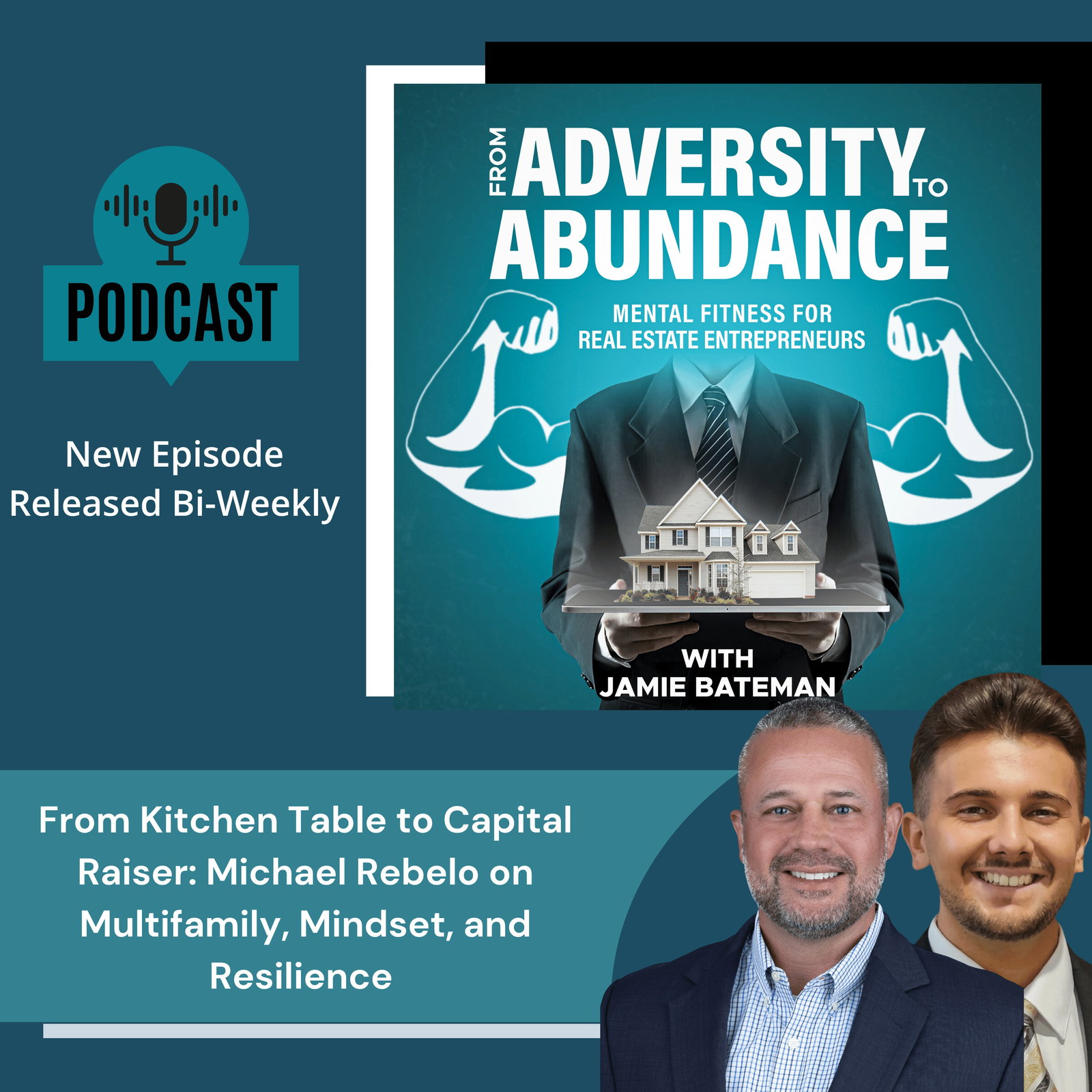
From Kitchen Table to Capital Raiser: Michael Rebelo on Multifamily, Mindset, and Resilience

 Apple Podcasts

 Spotify

 Amazon Music

 iHeartRadio

 RSS Feed
In this episode of From Adversity to Abundance, host Jamie Bateman sits down with Michael Rebelo, founder of Ever Forward Capital Partners, for a conversation about breaking into multifamily real estate at a young age — with purpose, grit, and the right mindset. Michael and his mother started their multifamily business after a candid kitchen table conversation about their finances and the limitations of the traditional investment path. Since then, they've helped raise capital on over 200 units across Texas and Oklahoma, launched a new townhome project in Phoenix, and celebrated Michael's mother stepping away from her W-2 to become a full-time entrepreneur.
But this episode goes beyond the deal count. Jamie and Michael dig into the critical importance of mindset as a capital raiser and entrepreneur — why knowing your investor avatar, leading with your personal story, and saying no to the wrong opportunities are just as important as finding the right deals. For anyone looking to raise capital, launch a fund, or understand the current multifamily landscape, this episode delivers practical value and genuine inspiration.
Guest Introduction: Michael Rebelo
Michael Rebelo is the founder of Ever Forward Capital Partners, a Phoenix, Arizona-based firm focused on multifamily syndications and private real estate projects. Starting his journey at 17 alongside his mother after watching their family get hit by the 2008 financial crisis, Michael has helped raise capital on 152-unit and 64-unit apartment projects and is currently raising for a 14-unit Class A townhome deal in Phoenix. He is also the host of the Ever Forward Mindset Podcast.
Episode Highlights:
- From Kitchen Table to Capital Raiser: Michael shares how a frank family conversation about the 2008 financial crisis sparked his and his mother's decision to pursue multifamily real estate — and how a near-breaking point became the fire that accelerated everything.
- Raising Capital for Multifamily: Michael breaks down what has worked — defining your investor avatar, leading with your personal story and your why, and learning SEC compliance before you need it.
- Mindset as a Business Strategy: Why mental discipline, the ability to say no, and showing up consistently are the real differentiators between entrepreneurs who build lasting businesses and those who don't.
Key Takeaways:
- People invest in people first — your story and your why matter more to potential investors than projected returns alone.
- Define your investor avatar early — serving everyone means serving no one, and the right relationships will strengthen your business far beyond any marketing campaign.
- Mindset is not optional in entrepreneurship — the discipline to show up and say no to distractions separates those who build from those who quit.
Connect with Michael Rebelo:
Instagram: @therealMichaelRebelo
Facebook: www.facebook.com/michael.rebelo.2025
Website: www.everforwardcapitalpartners.com
Podcast: Ever Forward Mindset Podcast
Are you an accredited passive investor?
Learn more about the Integrity Income Fund:
https://labradorlending.com/investors/passive-investors/
Purchase The From Adversity to Abundance Book: https://www.amazon.com/dp/B0CGTWJY1D?ref_=pe_3052080_397514860
Leave us a REVIEW: https://podcasts.apple.com/us/podcast/from-adversity-to-abundance/id1618672867?mt=2&ls=1
https://www.adversity2abundance.com/reviews/new/
Connect with us:
Website: https://www.adversity2abundance.com
Facebook: https://www.facebook.com/labradorlending/
Instagram: https://www.instagram.com/labradorlendingllc/
LinkedIn: https://www.linkedin.com/company/labrador-lending/?viewAsMember=true
YouTube: https://www.youtube.com/channel/UChYrpCUlqFYLy4HngRrmU9Q
Connect with Jamie:
LinkedIn: https://www.linkedin.com/in/jamie-bateman-5359a811/
Twitter: https://twitter.com/batemanjames
Speaker 0
In this episode, we chat with Michael Rebelo of Ever Forward Capital Partners. Michael is focused on capital raising, for certain multifamily projects, and he's also working on a a townhouse project now. He's a young guy. He's, not been out of of school for too long, but he and his mother started a multifamily real estate business, several years ago, and he talks through the why behind that and what inspired them to do that. And they've gotten very serious about this in the last, couple of years. And, I think for those in the, space, if you're trying to raise capital for any any kind of real estate project, this will be a very valuable episode. And, also, we we dive into the importance of mindset. I think that's one of the biggest takeaways is is, our discussion later on in the episode about mindset. I appreciate Michael for joining us, and I think you're gonna enjoy this episode. Thanks, everyone.
Speaker 1
From adversity to abundance, hosted by entrepreneur and seasoned real estate investor, Jamie Bateman, is the ultimate guide for active and passive investors seeking clarity, mental fitness, and the confidence to make inspired decisions in the world of real estate. With a decade plus of investing experience across various niches and a background as a combat with industry leaders and solo explorations of mindset and strategy, listeners will uncover actionable advice and tips to overcome challenges and build lasting financial success. Whether you're a seasoned investor or just starting, from adversity to abundance is your road map to turning obstacles into opportunities and achieving financial freedom.
Speaker 0
Welcome everybody to another episode of the from adversity to abundance podcast. I am your host, Jamie Bateman. And today, we have with us with us Michael Rebelo. Michael is the founder of Ever Forward Capital Partners. Michael, how are you doing today?
Speaker 2
Jamie, I'm doing great. Pleasure to be here. And before we start as well, recording on September eleventh, I just wanted to get a couple of moments to, one, give thanks to all those that are, you know, still alive with us today, but also give thanks to those that gave their lives on September eleventh two thousand one since it's twenty five years today. Of course, always praying for those souls that we've lost and those that are still mourning today. And, just to remember to never forget and always acknowledge those and knowing that the country that we live in, the amount of sacrifice that we've given, and only that to always raise that flag high and never let it touch the ground and to always keep those that we love and those that we've lost in our hearts. But, anyways, Jamie, it's great to be on the show, my friend. Thank you for having me on.
Speaker 0
Yeah. No. I I think that's that's a really great intro. I appreciate that. And, I think it's easy for us to forget. And that was a, I mean, a major turning point in so many ways. It was a dark dark day, but I feel like our country did kind of come together afterwards, which was Indeed. Which was nice and would be nice. Right. You know, again. That said, you're coming from you're you're in Arizona. I know that much. You're you're a multifamily guy. You're good at, raising capital, and and you started in real estate at a young age. We're gonna get into some of that. But before we do, what are you who are you, and what are you, up to today? What's some of the abundance that you're living in?
Speaker 2
That's a great question. You know, I don't get this question asked often, Jamie. And, you know, I'm living in a point in my life right now that, yes, I still have to work quite a bit. Yes. I still have to, you know, figure out finances, you know, juggle a couple of things, you know, you know, underwriting insurance, whatever. But I'm at a point in my life where sometimes I get to sit there and go, wow. I actually don't have to be all in all the time. What do I mean? I don't have to work seven days a week. I don't have to work, you know, days and nights. Sometimes I do depending on the project, but there's points where I can actually take time off and go spend time with my family either for the whole day or we go, I don't know, peach picking in Wilcox, Arizona for some you know? Nice. Just on a random weekend, whatever. And I can work from home, the comfort of my own home, the company of my own family. And not only that, I can provide a service to others to not only just invest to build passive income, but to also teach them and give them a gateway to go, hey. There's more out there than just the traditional path. And and for me as well, I I gotta say this. I love driving my Mustangs in nineteen sixty six, beautiful black.
Speaker 0
Uh-huh. You know,
Speaker 2
I just love to drive that during the day, just not in the summer here because it's usually way too hot. Yeah. For sure. It's the point of, you know, I can wake up and not feel the pressure. I can go to bed and not feel the pressure. Sometimes there is pressure, but it's almost like the freedom of being your own boss, but also the discipline of being your own boss. So it's the fact of time, freedom, and spending time with my why, which is my family. And, that for me is my biggest abundance is to be able to not be in college, not being a full time w two, but to actually be present with my family and not having to be all in all the time like I usually.
Speaker 0
That's that's awesome. Got a lot of control of your own schedule and some time freedom there, it sounds like, because of your financial situation that I I, you know, that you've spent time, you know, building toward. You you did raise an interesting point there. It does take discipline. It it it takes discipline because, you know and I think we've saw that during COVID as a lot of people, you know, left to their own devices may not you had people that kinda doubled down and got twice as productive, basically, and you had the other people who, not that everyone was in the the one of the two extremes, but you had other people kinda gravitate to Netflix and chill all day. And, I think for a lot of people, if they had
Speaker 3
the kind of time freedom
Speaker 0
that many of us either have or are aspiring to have, You know? I don't know that they have the discipline to be able to operate in a productive manner, but that's a podcast episode for another day. Let's jump jump back into your backstory, Michael. I think you started in real estate at age seventeen. Is that right?
Speaker 2
Seventeen, roughly eighteen. Yeah. That's about right.
Speaker 0
Alright. So paint the picture for us. What was going on in your world? What was in your in your head? What did you know? What did you not know? Absolutely. Yeah. Talk talk to us.
Speaker 2
Sure. So when I was sixteen, seventeen at the time, I was fascinated with the aspect that money can make money for me, especially while I'm sleeping. Honestly, when I first heard that, I'm like, okay. There's no way. I know it's bad. Like, that that's just not possible. Right. But after learning and talking with my business and finance teacher, mister Mello, this is when we're back in Massachusetts, and this was during my high school career. And I'm like, What if I invest in the S and P five hundred? What if I invest in airline companies, cars, oil, gas, whatever it may be, or natural resources? I'm like, let's give it a shot because we were playing something called the stock market game, which is affiliated with DECA. And I was like, sure. I love this. I've always loved business and finance. I've loved the aspects of business. So I'm toying around with this, you know, stock market game. And then now we're transitioning into my senior year, and it's around the summertime of that. And I'm doing something at home, and then my mother comes home one day, and she says these words that still terrify me to this day, we need to talk. And I'm going, oh, no. That's not good. I'm like, hold on. Let me let me read the receipts really quick. Seventeen year old male, still in high school. Mother comes home and says we need to talk. What did I do? Because that's immediately what comes to the top of my head. Right. It's like, hey. I'm gonna talk talk to you about, you know, our current finances, you know you know, different investments, you know, the our four zero one k, and all that what happened in two thousand eight. To cut the story short, between what my mother said and told me, it gave me a very hard and harsh glimpse into what our finances look like and what two thousand eight did for my mom, but also my grandparents. So I kinda had to sit there and go, now what? Like, what do we do? Like, what are the possible avenues? So I'm like, wait. I'm going to invest in the stock market. Why don't we do something like that? So we we kinda pulled a little bit of play money. We opened a Fidelity account, and I started to get invested so quick. It was MarketWatch. It was Schwab. It was Yahoo Finance. It was Bloomberg. Going back and forth. Alright. What where do I buy? What do I sell? You know? Day trading.
Speaker 0
Sorry to sorry to cut you off. Just Yeah. Was was, you don't have to get super specific with numbers or anything.
Speaker 2
But
Speaker 0
Yeah. Was a what was your, your mom and your grandparents? What were they invested in? Or how did they get hit by the two thousand eight crash?
Speaker 2
I forget the numerical value, but it was a point where my grandfather had to go back into work. And not only that, there was a lot of rebudgeting that had to happen. So it it was just one of those that, you know, they save, save, save, save, and I believe there's their IRA. And then boom. Two thousand eight
Speaker 0
comes out of nowhere.
Speaker 2
Gotcha. Okay. So it set us back quite a bit. Sure. So fast forwarding back to when I was day trading Yeah. I made some money, but also the point where I couldn't sustain it between transitioning back into high school, my last year of high school, but also I didn't know how to read the market. I didn't have any mentorship. I was making some money, but it was nothing that I could scale and actually build finances for my family.
Speaker 0
Well, the truth is too, day trading is is, is a job. Right? If if even if you do make money doing it, it's not it's not really investing. It's it's it's a job.
Speaker 2
Another w two.
Speaker 0
Right. So, anyway, sorry. It's just it's it's not really having your money work for itself to to make money. You're still the one doing the work even if you do figure out how to be successful with it. But A
Speaker 2
hundred percent. You not only have skin in the game, but you also have sweat equity, time, and energy. It's it's just so not sustainable.
Speaker 0
Right.
Speaker 2
So my mother and I, we went back to the drawing board, the drawing board of what I like to call the kitchen table. And we kind of we still have this notebook to this day. We wrote down every investment possible that we could think of. And it always kept boiling down to real estate, whether it was townhomes, you know, your single family, your duplexes, triplex. And I remember my mother saying that she's like, I live in a nice house. I don't wanna go live in another house and go rent out the other side. She's like, I just don't wanna do that, and I don't have time for that. And I'm like, you know, I respect that because, you know, she had a full time w two, and I was transitioning to my last year of high school, so I wanted to stay focused. Mhmm. But then we, of course, as cookie the cookies of the Internet listen, we start talking about this thing called multifamily.
Speaker 0
Mhmm.
Speaker 2
So an ad comes up on her screen, and it's like, yeah. Invest multifamily. You get this amount of return. Well, of course, my real estate investors out there, you know, if you advertise online, it has to be a five or six c. Mhmm. So we weren't accredited at the time. Mhmm. And when she tried to invest, like, oh, are you a credit investor? You make, you know, two hundred k a year. Do you have a million in net worth or a portfolio? Right. This is kinda just rough sketch. And she was like, nope. So now I went back to drawing board again. But then we learned and figured out that we actually can build teams and work with different lenders. You know, different banks actually purchase these properties, run as a business, and then start generating income. So we're like, well, we could do that. Mhmm. Eventually, in July of two thousand twenty three, we joined a mentorship course. We started, you know, learning a lot of YouTube University, a lot of, you know, looking online, a lot of Google. Mhmm. And then we just started to build and build our company. But here's the point that I wanna make. It wasn't the fact of July two thousand twenty three all the way to this date. It was constant. There was about half of you half of a year that we lost because after I graduated, we were moving from Massachusetts to Tucson. That's where we want to call home. Mhmm. And we lost so much headway with our business. Mhmm. And there was a tough conversation that my mother and I had to have. Excuse me. I believe it was the end of two thousand twenty three, beginning of two thousand twenty four. Mhmm. And, you know, actually, two thousand twenty five. It was kind of one of those moments where we have to figure out how to get an investment deal into this house because we cannot keep sustaining this company anymore. Mhmm. It was kinda like one of those things where I'm super glad that conversation happened because it lit a fire under both of our bus to kinda go, you know what? We need to get this off the ground. Right.
Speaker 0
I told
Speaker 2
my mom, listen. I'll handle the entrepreneurial side of the business. You handle the w two side of everything else. I'll take care of this. And we were grinding, grinding, grinding. And, eventually, we joined a team, and we helped to raise money on a hundred fifty two units. It's apartment complex out of Tyre, Texas with a wonderful team. Later that year, sixty four units in Tulsa, Oklahoma with another wonderful team who I speak everything good about.
Speaker 0
Mhmm.
Speaker 2
And it was kind of one of those moments, Jamie. It was, you know, without that adversity, we wouldn't be here where we are today.
Speaker 0
Sure.
Speaker 2
In fact, at the beginning of this year, in two thousand twenty six in February, my mother stepped away from her w two to be a full time entrepreneur in Capital Partners, who I like to presume as my boss because I'm Yeah. You you get to be the boss. Right. But it was kind of one of those moments where it stacked a lot of adversity and a lot of moments where we go, Yeah. Oh, like, the harsh reality checks, but those are what molded the future of where we are today. I'm very grateful for those moments. So that's what
Speaker 0
I am doing. And so when your mother was, working the w her w two, what role did she play exactly with with your multifamily investing?
Speaker 2
That's a great question. So I I was face as I like to call because I like to do the advertising. I like to do the raising capital, but she is more of the asset management professional business back end. Yeah. Sometimes I look her and go, what do you think of this email? She's like, it looks like you wrote it. I'm like, okay. We need we need to change it.
Speaker 0
Right. Right. Right.
Speaker 2
And she would help advise me, and she'll train me because she's been in business for over twenty years. And, you know, you you're a high level executive in health care. I figured if I could leverage that Yeah. Yeah.
Speaker 0
I I
Speaker 2
wanna need it.
Speaker 0
That makes sense.
Speaker 2
She was more of an adviser and also, you know, a business partner as well. You know? Sure. Underwrite, look at deals, and also to be that pragmatic business end because I haven't developed that yet. But she was definitely there in those moments where it's like shiny object.
Speaker 0
Right. Right. Absolutely. I mean, it's all we all need somebody else to bounce things off of who's more experienced or more talented in a certain area or even just another set of eyes,
Speaker 2
on A hundred percent.
Speaker 0
Project or something specific. So so from two thousand eight to two thousand twenty three, what did what was your situation, you know, beside you know, as you were learning real estate and things like that and multifamily and raising capital, what else did you have going on personally or well, professionally, I guess, I should say?
Speaker 2
Yeah. So, you know, I can't recall two thousand eight because I was born in o five. But, you know, from that time, it was one of those things where I watched my family work and toil so much.
Speaker 0
Yeah.
Speaker 2
But it also kind of inspired me to go, you know what? Hard work is gonna reap a lot, and, eventually, that'll be paid forward in years to come. When that is, I don't know. But, actually, before I started multifamily, I did some wholesale and also did some landscaping business on
Speaker 0
the side. Okay.
Speaker 2
I've always I've always loved it.
Speaker 0
You've only been out of school for a few years at this point. Right? Yeah. Says the old man inter doing the interview. Gotcha. Got it. Yeah. Okay. Well, I I remember two thousand eight, and it was it was pretty brutal for people. I wasn't personally invested in in much of anything at that point, but, I had worked for a title company and a mortgage broker prior to that. And then, yeah, it was it was, it was crazy. But, a lot of a lot of people went broke essentially overnight if they were heavily invested in certain real estate projects or sectors. But
Speaker 2
Yep.
Speaker 0
Okay. So, you did a you did a couple of entrepreneurial things and and a couple side jobs after school, and then had had a kind of a come to Jesus moment or just a a a kick in the pants moment and and realized, okay. We we need to actually do this. This needs to happen
Speaker 2
for real. Serious.
Speaker 0
And then you joined a team and, have helped raise capital for a couple of different projects, it sounds like. So how are those projects going right now?
Speaker 2
Honestly, they were terrifying at first because it was, you know, kind of one of those things, you know, the best way to learn real estate is to do real estate, but it was a great ill and it is a great learning experience. Our first property that we're working with, the one in Tyler, Texas is stabilized, and now we're actively managing it, working through a few kinks with the market. But other than that, it's really cool to see that, you know, starting to stabilize and start to come into its own
Speaker 0
Yeah.
Speaker 2
You know, beautifully. With the Oklahoma asset or the Tulsa, Oklahoma asset that we're working on. We actually closed in that December of last year, and that's starting to slowly stabilize. And, you know, that's starting to come to fruition as well, and we're starting to make this a beautiful community. Nice. The most fulfilling part of it is, you know, one, making distributions to our investors, but also number two is providing a better place to live. You know, actually going and renovating these properties. I just love to see the progression. The before and after,
Speaker 0
it's
Speaker 2
just so fulfilling. There's nothing that can replace that for me.
Speaker 0
Yeah. No. That's I mean, that's one of the reasons we do mortgage note investing. It's, we have some discretion as the quote, unquote lender or note holder as to if a borrower falls behind. Do we wanna just do we wanna work with them? Do we wanna, you know, Sometimes people need a an a a kick in the pants or or a reset. Yeah. And sometimes people need kind of a a restart, and we'll foreclose and you know? But we do have some discretion there, you know, with regard to, no. This person actually just fell on some bad time, you know, had a had a hard time. And, and we can be a little more lenient or a little more patient in certain cases. But we we also end up taking properties back where we end up fixing them up and providing value to the neighborhood, providing value to a new homeowner in certain cases. So I do like that aspect for sure. I like to think we're adding value to communities across the country, while making money doing it. So, you know, maybe that's just what I tell myself, but no. I'm just kidding. So and now what are you are you working on a new project or kind of focused on those two and stabilizing the Oklahoma one, or or how do things look for you guys now?
Speaker 2
Great question. I love that question. In fact, right now, we're working on something a little traditionally different. We're actually looking at and actually working actively now and raising capital for quite quickly is a fourteen unit townhome deal in Phoenix, Arizona just north of me. It's a five zero six z accredited investor deal. Okay. This is different. And I kinda wanna talk about this for a second because, kind of jumping into finances. I'm sure you've seen this in the market as well, Jamie. And and to your listeners out there and operators as well, you're probably seeing it too. There's so many changes with, you know, interest rates right now. We don't know where the economy is right now. It's just gray. There's no color. It's just gray. It's not brown. And this deal came across our desk. This was back in June. And a few of our partners were like, hey. Are you interested in this? It was a fourteen unit townhome class a built in two thousand twenty. We usually like to go for the older value adds, and we're like, it doesn't fit our buy box. Mhmm. But after digging into the financials and talking with the team more, this isn't one of those things where, you know, you appreciate like this. You get cash like that. This is just a steady cash flow preservation, downside protection kind of deal. Okay. I kinda sat there and went, well, maybe that's what we have to do for a little bit until the economy, you know,
Speaker 0
shows two colors.
Speaker 2
Yeah. Yeah. And that's what we're working on right now. And, of course, working with these other two properties and always looking for another opportunity to raise for doing a wonderful team with. But, yeah, that's our creme de la creme right now. It's this fourteen unit townhome deal. And the benefit is I don't have to fly. I can just drive and go see it, which I absolutely love. So that's what we're working on right now.
Speaker 0
Awesome. Alright. So you're what is you know, not not hour by hour, but what does a typical day look like for you or a typical week? What are you really doing? Does this mean you're you're on the phone calling investors? Are you going to real estate meetups? Mhmm. You're are you flying to the project like you just alluded to? What is a typical day and a typical week? What do they look like?
Speaker 2
Oh, I love that question. So usually, I like to in fact, my mother helps me with this because structure isn't my strong suit Mhmm. Where she will build out the weekly schedule to go, hey. These are our priorities that we need to do. In fact, I'll give you an example. Sometimes what we like to do is break our days in the threes. What does that mean? Three hours could be, you know, for media, podcasting, whatever it is. Mhmm. The next three could be acquisitions, you know, active deal management. And the last three could be capital raising, event planning, whatever it is. In fact, we're planning and collaborating with event called the New Orleans Investment Conference, which is coming up in the end of October. And that kind of threw a wrench in the works because it's a bit of a huge project, but I love working with teams like that regardless. Usually, most of the time, it's reaching out to these investors and not just reaching out, but also nurturing them
Speaker 0
Mhmm.
Speaker 2
Where we're providing them education. We're looking through our CRM. Who can we assist the most? You know, who's ready to go? Another big chunk and factor of our day is, you know, one, doing some calls, but also number two, some meetups. We haven't been to a few meetups in a while just because we're buckling down and just rebuilding the back end of our business. But we love to network. Me personally love to network, and we'll go to our local meetup. Sometimes we'll drive to Scottsdale or Phoenix for an event. And, sometimes we do have to fly out to properties. In fact, earlier this year, we did have to do some flying. One, just go about some properties, but also number two, to check on properties and meet with team members. Mhmm. And then we fly back. But it's not like, you know, we're going at a week at a time, just a couple of days.
Speaker 0
Sure.
Speaker 2
So every once in a while, we have to fly. But most ninety five percent of our time constitutes the following, calling investors and making sure they're being educated and they're being well treated. Number two is checking on the properties both financially and also physically. And, also, number three, how can we bring more people in? How can we educate? And now I have the meeting aspect of it.
Speaker 0
Okay.
Speaker 2
And I'm looking for more deals.
Speaker 0
Makes sense. You know, I'd like to break down you know, again, we're in the mortgage note space, but it it this applies to multifamily syndications. It applies to a lot of other business models or different real estate asset classes. But, ultimately, my business breaks down into three components. One is finding deals, finding notes to buy. That's what we buy. Those are the assets that we we purchase or create. But finding those deals is number one. Finding capital is number two, and this is not in any particular order. They're they're equally important. And so finding, you know, access to investors or or a bank or, you know, whatever it is, not your own money. I I do recommend people have their own skin in the game, to be clear. But at some point, if you're trying to scale, you need access to capital. So that's number two. And then the third part is is managing those two. So the operations behind everything. So managing the assets and then managing the capital and the investors. So with regard to, you know, raising capital
Speaker 2
Mhmm.
Speaker 0
You you have a five zero six c for the townhome project. Yep. Our integrity income fund is also a five zero six c, and so we we're pretty free to talk about everything and and solicit generally. Mhmm. What are some one or two tips? I mean, you mentioned a couple things already, but if somebody's let's say I'm I'm creating a mortgage note fund or let's say I wanna start a a multifamily syndication, doesn't doesn't really matter that much. What are maybe a few things, tips for somebody who's creating the the fund right now. They're thinking about contacting an SEC attorney to to draft paperwork and but they're not sure how to go about raising capital. Any points, of advice that you could give that that person, that you've learned along the way or maybe that you're still learning that that, you know, something that works or doesn't work, with regard to raising more capital?
Speaker 2
Absolutely. So when it comes to a fund or a syndication, even just a small project, there's a couple of things I always wanna mention. Number one, who do you want, but also who needs you? So what is what do I mean by that? You know, in fact, Jamie, you're you and I were talking about, you know, we don't wanna serve everyone. You know, we wanna start narrowing it down. The same thing applies to the business. Here's a great example. If you're, you know, serving everybody, you're serving nobody. Mhmm. So you have to figure out, you know, what kind of investor do I wanna bring into my project? Do I want someone that can jive with me on a personal level where I see their phone or or I see my phone ringing, their name comes up, and I know it's either gonna be one or two things. Hey. How's business? Or number two, let's go grab a coffee. Or if you want the investor, we have to go, oh, I don't wanna pick up the phone.
Speaker 0
Just let the voice mail.
Speaker 2
Yeah. You want that person where you not only wanna do business with, you also wanna be friends with because that'll just strengthen the business relationship tenfold. So pick out your investor avatar. That's what we'd like to call is, like, you know, who do you wanna attract? Who do you wanna serve? But also number two, you know, who are you? What's your why? Why are you starting the business? Mhmm. I learned very quickly that, yes, people are sold on returns, but they're more sold on the person and the action behind it. Absolutely. You you know, in the beginning, when I was making content online and on social media, I was talking about, you know, this is what cash flow means, and this is what internal rate of return we who cares. But then when I started to put the personal twist into it, say Mhmm. You know, this is the reason why I started my multifamily business to help retire my mother and help other Main Street middle just like her.
Speaker 0
Sure.
Speaker 2
People started to swivel their heads and go, you know what? That's a legitimate reason for starting a business or you're that investing.
Speaker 0
Yeah.
Speaker 2
So when I pivoted towards that to say, like, you know, hey. I'm starting this syndication. I'm starting this fund to provide another passive investment opportunity. People start talking. They'll start reaching out to you. So I would definitely sit and figure out these two things. One, who you need and then who needs you. So your investor avatar, who can you serve, who can be a steward of capital for? And then also number two, what's your story, what's your why, and why are you starting this business? I know it feels strange to talk about yourself and your business, but it's the two it's the one best thing that I think you could do is reflect to go, this is who I am. This is who I serve. This is why I do what I do because I wanna help people, like, fill in the blank. Yeah. And then I'd say this number three, you know, learn as much as you can online. Ask as many questions as you can. Follow SEC attorneys, you know, compliance, CPAs as well online, either LinkedIn or YouTube, and start learning their lingo, learning their language. Start researching compliance, you know, things to say, what not to say, how do you structure things, how you structure posts. Use ChatGPT, Claude, Grock, whatever it may be, and just start toying around with it, self educating yourself. And then reach out to, you know, a CPA, an attorney, an SCC consultant, whoever it may be, and just start chatting with them. Say, I wanna raise capital. I wanna start a fund. But I gotta be honest with you. I have no idea what I'm doing. I don't wanna cross any red lines.
Speaker 0
Right.
Speaker 2
And you know what? They'll actually sit and take the time to learn and and talk with you as long as you're putting the actual work in. You you don't wanna be, you know, sitting there going, just tell me everything. Mhmm. Line out the questions you have and then not just learn, do. Shake that and go and take action with it because that's the biggest thing.
Speaker 0
Those are some
Speaker 2
of the Those are the three things I'd recommend.
Speaker 0
Now those are three great tips. I I couldn't agree more, especially on the, the first one about the the part about being yourself and and talking about yourself. And, you know, as you said, it may seem self centered at first or or vain or something to some people, but
Speaker 2
Mhmm.
Speaker 0
The truth is that absolutely is the number one factor when someone's deciding who to send a hundred k to or whatever it is. Right?
Speaker 2
Right. Yeah.
Speaker 0
I mean, that's so, you know, I think our investors in our fund I think some of them do genuinely like the some of the attractiveness of mortgage notes, you know, compared to other asset classes.
Speaker 2
Absolutely.
Speaker 0
There are pros and cons to every asset class, and and mortgage notes first lien notes tend to be tend to be a little on the lower, you know, end of the risk spectrum. Doesn't mean you can't lose money, to be clear. Right. You know? So the I think some of them are drawn to that, but the the truth is, you know, they wanna see who you are as a person. Who's running this this show? Who's who's behind the person behind the, you know, behind the wheel and, making these decisions? Because when you when you send, as a passive investor, an LP, you're giving up a lot of control, almost all the control, in most cases. So that you know, if you're raising capital, I I think it's important to be a little bit vulnerable and share your personal story and also, you know, get into the weeds a little bit on the deals. I used to think, oh, like you alluded to. I just need to talk about the returns and what the structure of the fund for the investor. Like, you know, that's important as you said. They wanna know what's the preferred return. What's am I do I get upside? Do I get a k one or a ten ninety nine? What you know, when how often do you do distributions? Mhmm. They wanna know that stuff.
Speaker 2
Downside. Yeah. Matters. They do wanna know. Yeah.
Speaker 0
But they also wanna know that you are trustworthy and you know what you're talking about. So you I can I can this person will follow through? They'll do what they say they're gonna do or at least do their best to do that. Yep. And then, secondly, they they are they know what they're they they have a lot of knowledge in this space. And so, therefore, it's good to talk about yourself and your track record and the asset class or the strategy behind the deal, not just the returns, or what the investor is gonna see if they join, you know, join on the deal. So I I agree with you. I just wanted to kind of reemphasize that.
Speaker 2
Yeah. Absolutely. So,
Speaker 0
I've got some rapid fire questions here. Are you ready for them? Alrighty. Fire away. Alright. Let's do this. If you were given ten million dollars tomorrow, Michael, no strings attached, what would you do with it?
Speaker 2
One, I would book a, trip to the Dominican Republic for my family because I know my mother wants to go there. And, also, number two, start to find that funds and have those funds make money for me. And then only that, pay off everything that's due, whether it's credit card debt or, you know, whatever the mortgages, be free and clear of everything, and put the rest of the money to work. So in five years, I can have maybe twenty million.
Speaker 0
So There you go. I like it. How about a book or two? I don't know if you have time to to slow down and read a book. I I I feel like I've been reading a little bit less recently. But, a book or two that you could recommend for our listeners.
Speaker 2
Oh, hundred percent. You know? Especially for capital raises, you know, How to Win Friends and Influence People by Dale Carnegie. Yeah. That's a great one. That's a
Speaker 0
great one. That's a great one.
Speaker 2
Number two. Oh, number two is a difficult one because I'm wrestling with either the power of positive believing by Norman Vincent Peale or either that the secret. I don't know. But those two are like neck and neck. But I'd have to say, you know, number one, how do I win friends and influence people? Dale Carnegie. But number two, either the secret or the power of positive believing by Norman Vincent Peale. Those two.
Speaker 0
So on that point, I mean, you know, how why do you think mindset matters?
Speaker 2
You know, it always starts up here. It's one thing to start a business. It's one thing to actually show up and do the business. Mhmm. Like, in fact, you know, earlier, you and I were talking about, you know, discipline, being an entrepreneur, being a boss. That's a mindset. Do you have the mental discipline to not only be a boss, but also be an employee to answer to yourself and also hold yourself accountable? Jocko Willink talks about this extreme ownership, which is another book. Yeah.
Speaker 0
That's a good one too.
Speaker 2
Yeah. But it's also the fact of, one, do you have what it takes to, number one, build a business, but also, two, utilize business to serve others? And that takes a serious person. There's not a lot of entrepreneurs out there because a lot of them think, you know, oh, yeah. Everything's gonna come to fruition. You kinda have as an entrepreneur, you have to plan for the worst, but hope for the best. Mhmm. You go in with that kind of mentality to go, you know, it's not gonna be all sunshine and rainbows. It's gonna be a lot of mud, a lot of cactus you have to fight through, and then also, boom, there's a rainbow eventually. Yeah.
Speaker 0
It's kind
Speaker 2
of one of those things, you know, you have to kind of bite the bullet and go, I don't know why I'm gonna get paid out. I don't know if this business is gonna work. I'm sure as hell gonna try. And it's just that mentality of showing up, being consistent, always learning, always building, always growing and improving.
Speaker 0
Right.
Speaker 2
It's that mentality and that mindset of just keep pushing forward, ever forward.
Speaker 0
Yeah. I I mean, I think you're most businesses fail. Right? And Yep. And I think if you, you know, you you have no guarantees if you even if you have a a positive mindset twenty four seven, you have zero guarantees it's gonna work out. That said, if you have a negative mindset and you don't believe, you're guaranteed for it's for almost certainly not going to work
Speaker 2
out. Exactly.
Speaker 0
So if you wanna fail, definitely have a negative mindset. Hundred percent. What's a challenge that you and your mom are facing in your business right now? Because there's always challenges. Every business, every investor has challenges. What's one specific challenge you're dealing with?
Speaker 2
The biggest challenge that we're actually learning to turn into our greatest tool is the word no. And what do I mean by that? You know, we have, students and partners and deals that message us all the time. And, in fact, there's personal relationships that, you know, kind of get in the way of life, and he's like, you know, you have to say no. If you're working on a project and if you are the boss and employee, you have to go, no. This is not important right now. This is not an income producing action right now in IPA. I need to be working on this right now.
Speaker 0
Mhmm.
Speaker 2
It's very difficult to, you know, put your phone on do not disturb or you that put it in a different room. Mhmm. And it's very difficult to say no to opportunities that seem great, but are they aligned with who you are as an individual, number one, but also number two, as a business focus? Does it make sense? So it's the challenge of saying no to either a podcast or a radio show or a stage opportunity, but it always comes down to that mental discipline and the fact of this is what needs to happen right now.
Speaker 0
Yeah.
Speaker 2
It's just being strict with yourself. So Okay. It's a challenge right now, but it's definitely a learning curve.
Speaker 0
Yeah. Couple more questions before we wrap up. So the multifamily space in general, I know you you know, you're younger. You haven't been in the space for forever. But, what are you seeing right now? And and I'm not gonna ask you to predict the future, you know, because nobody can do it and and it's it's impossible. But I know multifamily has, you know, gotten beat up in in general. There's been some, I mean, not to throw, like, Brandon Turner under the bus or but, I mean, it it's a lot of big projects that have not gone so well, and that's not not to say that that operator is a bad operator or anything like that. But the just market conditions have really been tough. So just any any kind of overall view of the the multifamily space? I know you're doing a townhome project now. Yeah. But what are your thoughts on kind of where we are with the market the the multifamily market in general?
Speaker 2
Absolutely. And I wish more operators would be as upfront as I am gonna be right now where you just address this issue head on. A lot of them like to hide behind the facade of, oh, it's great. I'm gonna be honest with you. We're gonna hit rock bottom soon, probably in two thousand twenty seven. It's gonna be a hard bottom. Like, this isn't like, you know, just like, you know, soft sand at the bottom of the lake. No. There's gonna be some rocks. There's gonna be there's gonna be a shipwreck in the way. Mhmm. Like, we're gonna we're gonna hit. Mhmm. But, you know, for those that bought in two thousand twenty, two thousand twenty one, these are gonna be a rough couple of years because the exit plan is not gonna exactly gonna go as the plan. Mhmm. You have people like Brandon Turner that, you know, God bless him. I my heart goes out to him and his team. And, you know, they're trying to do everything they can. We have a lot of operators like him that you knew, you know, they use variable debt. They different structures, and then they got walloped because of the Fed. So now what are you gonna do? You can't exactly say the Fed go, hey. Can you just delay about a year? I wish we could, but, unfortunately, we can't. So where do I see the industry going right now? Yeah. Again, these are just these are just predict, predictions and projections as well. Always, you know You never know. Correct, counsel and, professional legal advice.
Speaker 0
Not not legal advice, not financial advice.
Speaker 2
Yeah. Yeah. Where do I see, you know, multifamily going? Actually, I'm good I'm glad that there's a market correction. Of course, there's gonna be some blood in the investment industry. There's gonna be some blood in the street. Sure. But for those that wanna buy, they're looking to buy. You're gonna have to pivot a little bit. Maybe, you know, pivot away from your traditional value add, start going to more stabilized, projects until the economy kinda takes another deep breath to kinda stabilize itself.
Speaker 0
Yeah.
Speaker 2
We're not gonna see, like, you know, a a jump. We're probably gonna see a steady, slow incline for the next couple of years, if not more. Mhmm. But, yeah, I would definitely focus on you know, for investors out there, don't go for the flashy returns. Stay conservative. Look at the downside and see if there's capital preservation involved. Kind of like an insurance play. Like, for example, you're investing in gold. People invest in gold
Speaker 0
to
Speaker 2
preserve the dollar value. Same thing applies to multifamily like this, fourteen unit townhome that we're doing. So Yeah. It's gonna be a little bit of rough time. I mean, Christmas time is gonna be, you know, ho ho oh no for the entertainment industry. But, you know, I think two thousand twenty seven, two thousand twenty is gonna be a better time to buy for those that are buying. For those that are selling, it's gonna be difficult. Yeah. But I see there's a lot of opportunities coming to fruition.
Speaker 0
Sure. And that's the reality is every time there are there are problems, then there are opportunities that come along with those problems.
Speaker 2
Right.
Speaker 0
Yeah. I've I've seen recently a couple of smart people. This is not financial advice, but talking a lot about gold and silver just because inflation is likely here to stay, for and and probably even increase. But, you know, just being potentially even outperforming the stock market, you know, and not not just an inflation hedge, but it but perform better than, you know, what you would typically consider the high performing equities. Right. Before we wrap up, what's something controversial that you see in your space? You know, in the single family space, we have some seller financing people who I would say are getting have gotten a lot of people into trouble, you know, because they follow these gurus online and do you know, just jump in. And I won't get into too many specifics there, but what do you see in your space? And, again, we're not naming names or anything, but, that's a little bit maybe unethical or controversial.
Speaker 2
Absolutely. So, you kind of hit the nail on the head almost there. I was like, no way he's reading my mind. But but before I dive in, know a hundred percent, you have a lot of these gurus and teachers online that are, you know, promoting this business. You know, they're painting this facade that, you know, multifamily is great. Yes. It's great, but you have to specify what type of multifamily.
Speaker 0
Mhmm.
Speaker 2
You have a lot of people and sponsors that, you know, they're promoting, oh, yeah. Our investments are doing great, but even though their investors are losing money. Mhmm. So and, unfortunately, this is going around a lot. You have a lot of shady salesman and, you know, sponsors are going around promoting that. You know, they they have this track record. They have this. They have that. Mhmm. But sometimes their deals aren't performing. In fact, they're in the negative. They are now out of the black. They're in the red. But everything online shows that, you know, oh, yeah. They have this wonderful life. You know? Hey. This is where I live. Hey. This is where I moved to.
Speaker 0
Right.
Speaker 2
What's the other side of the phone? What's the other side of the screen? Right. And, unfortunately, we're seeing a lot of that. They're not coming out and saying it, but there's investors in the back end that are going, hey. So and so. They're not making distributions, and they're just lying online. So there's a lot of lying, and there's a lot of, of a facade going around online in the real estate industry, not just single family, but also multifamily. Mhmm. And the biggest recommendation I would say is, you know, really do your due diligence. Mhmm. Kind of be ballsy and ask these investors. How are these investments performing? Because Right. I can't tell what's real or fake online anymore. Right. Just ask the question, do your due diligence, and don't be afraid to ask.
Speaker 0
And try to find somebody.
Speaker 2
Lying and shady stuff going around in the industry. Actual facts.
Speaker 0
Yeah. And and don't hesitate to try to find somebody who's invested with that person before or they're in the deal that you're looking at right now. Right? Maybe and ask them, how's it been going? You know? Right. Yeah. I mean, I I had a just real quick anecdote. I just heard the other day is, since I run a mortgage note fund, I'm, you know, asking about other funds sometimes, and somebody told me that a fund that they're in this I wouldn't call this lying necessarily or or fraud or anything, but
Speaker 2
Mhmm.
Speaker 0
The fund went back and apparently didn't explain, you know, to the investors that they were even doing this, which is, I don't know, a little borderline shady, but they went back and and classified prior preferred return distributions for several years, apparently, as return of capital. So, didn't yeah. So not that it's not that they just paused distributions, which I think they did that as well, but they didn't really explain this, and they just kind of relabeled and reclassified prior years distributions, as return of investor capital as opposed to the preferred returns that they thought they were getting. So to me, it's like a a communication thing and just, like you said, being open about things. Right. You know? So there there's there's a a large spectrum between, you know, on one extreme that the, the fraudulent, manipulative, you know, sponsor operator, you know, and then in the middle is more like the they're they're trying to do the right thing, but market conditions change or this deal just didn't work out the way I thought it was going to. Right? Right. And that's you know, like we said before, there's no no guarantees in this. There's risk with all kinds of investing. And then to the other end of the spectrum where you've got, you know, ideally, the best of both worlds. You know? An honest, operator, and the deal goes great. So but there's a lot of in between on that spectrum.
Speaker 2
Definitely.
Speaker 0
Michael, we've covered a lot of ground here. What's one question that I have not asked you that you wish I had?
Speaker 2
Oh, that's a great question. I you you know, I asked you dumb people, Jamie, because you've asked me questions that I've never even thought to even ask. And I love the fact you did. I don't know. I can't think of one. I might think of one probably when the recording ends, but I don't know.
Speaker 0
No. All good. That that tells me I did a good job. So, awesome. Well, Michael, where can our listeners find you online?
Speaker 2
Absolutely. You can follow me on Instagram at the real Michael Rebelo. It's my name down here. Just add the real, all one word, all lowercase. You can also find me on Facebook, Michael Rebelo, Ever Forward Capital Partners, or you can visit us at our website at w w w dot ever forward capital partners dot com. It's the banner behind me. We have a show on there as well, the day before mindset podcast. You can listen to that too. We're almost gonna hit a hundred episodes. And, yeah, feel free to, you know, book a call with us. Feel free to follow us online. All of our social media is there, and, yeah, looking forward to connect and following each other.
Speaker 0
Awesome. Love it. Before we hop off, what's what's the meaning behind one of those things on the wall? The sword.
Speaker 2
Absolutely. So the sword actually is, the sword of Saint Michael, which my mother named me after. And not only that, these images behind me is my why. So that's me, my mom, my grandmother. This is my grandmother as well. This is when we went in St. George, Utah off roading. But that's my why. That is, you know, the question that you asked me at the beginning. What is abundance to you? This behind me is my abundance. That's my family, and that's what I'm able to do with them.
Speaker 0
Love it. Awesome, Michael. Well, thanks a lot for taking the time and, educating and inspiring our our listener. And, yeah, hopefully, people reach out to you and, appreciate you taking the time, Michael.
Speaker 2
Likewise, Jamie. Thank you so much.
Speaker 0
Alright. And to the listener, thank you for spending your most valuable resource with us, and that is your time. Thanks, everyone. Take care.
Speaker 1
Thank you for joining us on From Adversity to Abundance. We hope today's episode has equipped you with valuable insights and practical advice to elevate your real estate journey. For more inspiring stories and resources, visit us at w w w dot adversity to abundance dot com. If this episode has inspired you, please share it with a friend who could also benefit from our conversation. Together, let's turn adversity into abundance. Until next time, keep building your mental fitness and your real estate empire.
Speaker 3
Alright. Here's the deal. You work hard for your money. Isn't it about time you put your money to work for you? If you are an accredited investor, check out labrador lending dot com. Our integrity income fund provides monthly cash flow from an investment backed by hard physical real estate. Our income fund, which is uncorrelated to publicly traded stocks and bonds, invests in first lien mortgage notes diversified by geography, property value, and borrower type. So you're not investing in one project. You're investing in a diversified portfolio of first lien mortgage notes. Our integrity income fund aims to pay its investors monthly distributions at a preferred rate of return of eight percent annually. Possibly the best part though, the fund showcases a short twelve month commitment, so you can invest your capital today and have access to that capital in one year. Check it out today. Labrador lending dot com.
President
I'm Michael Rebelo, Founder of Ever Forward Capital Partners. My journey into multifamily real estate began after watching my mother work incredibly hard while facing many of the same financial concerns millions of Americans experience today: inflation, retirement uncertainty, and the challenge of building long-term wealth.
That experience sparked an obsession with financial education, investing, and entrepreneurship. Rather than following the traditional college path, I immersed myself in real estate, attending events, learning from experienced operators, and building relationships across the industry. At 17, I founded Ever Forward Capital Partners with a mission to help everyday investors better understand multifamily real estate and alternative paths to financial freedom.
Today, I've helped oversee 216 apartment units, raised nearly $2 million in investor capital, and spoken on podcasts and stages across the United States.
The biggest investing lesson I've learned is that successful investing isn't about chasing the highest return. It's about protecting capital, understanding risk, and making disciplined decisions over time. If there's one thing I'd want to share with your audience, it's that wealth is built through education, patience, ownership, and consistency. The best investors focus less on getting rich quickly and more on making smart decisions that compound for decades.