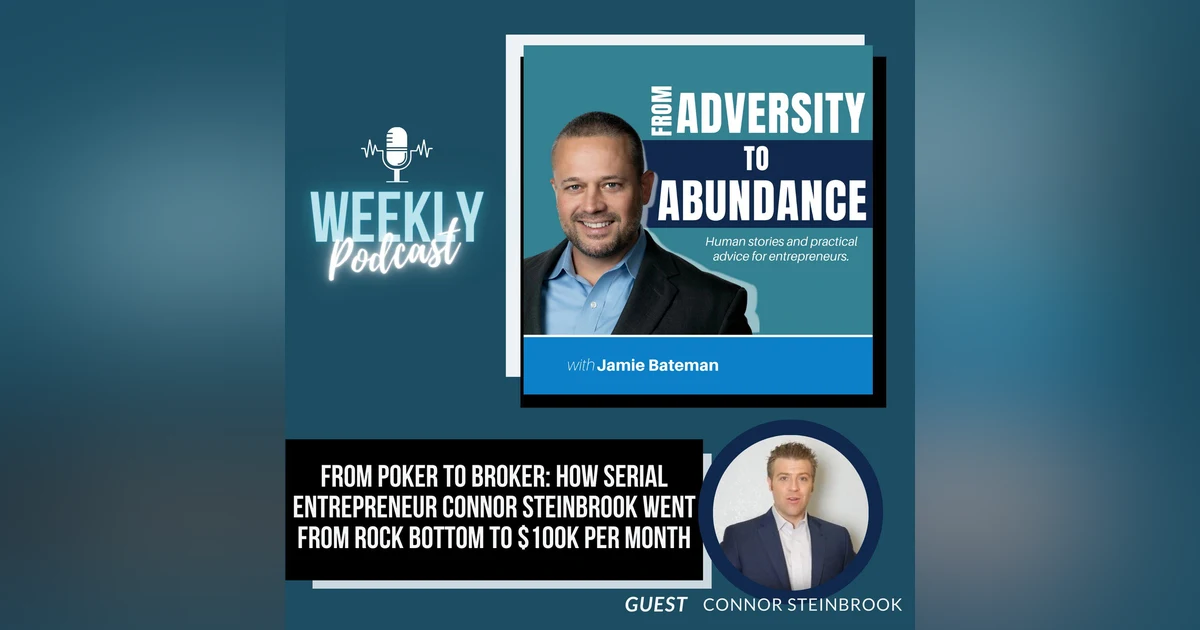
From Poker to Broker: How Serial Entrepreneur Connor Steinbrook Went from Rock Bottom to $100k per Month


 Apple Podcasts

 Spotify

 Amazon Music

 iHeartRadio

 RSS Feed
Welcoming Connor Steinbrook today, a testament of triumph over adversity. A leading online poker player for eight long years, his world changed overnight due to regulatory changes in the industry. Connor came out stronger, choosing to guide others towards enhanced personal growth and financial success. His intriguing journey illustrates the potential magnitude of the compounding effect, both in life and finances.
In this episode, you will be able to:
- Visit the Wolfpack Revenue Share website to learn more about Connor Steinbrook's organization and how it can benefit you.
- Check out the EXP Realty website to find out more about the top 30 influencers in the industry, including Connor Steinbrook.
- Consider the power of compounding and how it can work for you in both positive and negative ways. Reflect on past experiences and make conscious choices to compound positivity in your life.
- Remember that no storm lasts forever and have faith in the future. Seek support if you're struggling and reach out to those who can help.
- Take control of your emotions and practice emotional awareness and control in the face of adversity. Don't let one problem compound into others.
“Our thoughts create our environment. We move towards what we think about.”
Books and Resources
Influence : The Psychology of Persuasion
As a man Thinketh: The Original 1902 Edition (The Wisdom Of James Allen)
Rich Dad Poor Dad: What the Rich Teach Their Kids About Money That the Poor and Middle Class Do Not!
The Power of Your Subconscious Mind
Connect with Connor Steinbrook:
LINKEDIN: https://www.linkedin.com/in/connor-steinbrook-58b2b9a1/
LINKTREE: https://linktr.ee/connorsteinbrook
INSTAGRAM: https://www.instagram.com/connor_steinbrook/
YOUTUBE: https://bit.ly/Investor-Army-Youtube and https://bit.ly/Connor-Steinbrook-Youtube
Haven Financial:
https://www.myfinancialhaven.com/jamiebateman/
ATTENTION:
Unlock the secrets to a transformative life with “From Adversity to Abundance: Inspiring stories of Mental, Physical and Financial Transformation”. Buy your copy now and embark on a journey from challenges to triumphs!
AMAZON: https://www.amazon.com/dp/B0CGTWJY1D?ref_=pe_3052080_397514860
Connect with us
WEBSITE: https://www.adversity2abundance.com
Leave us a rating or review: https://www.adversity2abundance.com/reviews/new/ or here
Got comments, feedback or suggestions? We’d love to hear it! https://www.adversity2abundance.com/contact/
Follow From Adversity to Abundance Podcast
FACEBOOK: https://www.facebook.com/profile.php?id=100089126144055
INSTAGRAM: https://www.instagram.com/adversitytoabundancepodcast/
LINKEDIN: https://www.linkedin.com/company/89949391/admin/feed/posts/
YOUTUBE: https://www.youtube.com/@FromAdversity2AbundancePodcast
Connect with Jamie
BOOK: From Adversity to Abundance: Inspiring Stories of Mental, Physical, and Financial Transformation
LINKEDIN: https://www.linkedin.com/in/jamie-bateman-5359a811/
TWITTER: https://twitter.com/batemanjames
0:00 Speaker 0: Today, you get the opportunity to hear from Connor Steinbrooke. Speaker 0: Connor has a wild story. Speaker 0: He was a an online poker player for about eight years, and Speaker 0: then that entire industry was shut down overnight. Speaker 0: And so his his identity and income and everything that was wrapped up in Speaker 0: playing poker vanished instantaneously. Speaker 0: He reached a really dark point after that, after having made some poor Speaker 0: decisions that got him into a place where he wasn't Speaker 0: sure if he was gonna, you know, actually carry on with with life, Speaker 0: frankly. Speaker 0: So it's an incredible comeback story. Speaker 0: You know, we talk a lot about mindset. Speaker 0: He's a high energy kinda guy.
0:41 Speaker 0: He's used a ton of information. Speaker 0: It's just nonstop. Speaker 0: You know, you're gonna wanna get at your your pen and paper, for this Speaker 0: one, for sure. Speaker 0: It's one you might have to listen to two or three times because he Speaker 0: just is a very energetic encouraging inspiring individual with Speaker 0: a lot of real world examples and a lot of just Speaker 0: mindset knowledge and a lot of just a lot of good stuff in this Speaker 0: one. Speaker 0: Connor turned it around, and he's an influencer. Speaker 0: He's a real estate, you know, he's done a ton of different types of Speaker 0: real estate investing. Speaker 0: And he's actually the founder of Wolfpack revenue share organization, and he's Speaker 0: one of the top thirty Exp realty influencers. Speaker 0: He's got a team of almost three thousand agents under him with Speaker 0: EXP, and he's making a hundred grand a month.
1:26 Speaker 0: It sounds like just from just from that. Speaker 0: So it's a fascinating story, and you're not gonna wanna miss it. Speaker 1: Welcome to the from adversity to abundance podcast. Speaker 1: Are you an entrepreneur or aspiring entrepreneur, then this show Speaker 1: is for you. Speaker 1: Each week, we bring you impactful stories of real people who Speaker 1: have overcome painful human adversity to create a life of Speaker 1: abundance. Speaker 1: You are not alone in your struggle. Speaker 1: Join us, and you will experience the power of true stories and Speaker 1: gain practical knowledge from founders who have turned poverty into prosperity Speaker 1: and weakness into wealth.
2:09 Speaker 1: This podcast will encourage you through your health, relationship, and financial Speaker 1: challenges So you can become the hero in your quest for Speaker 1: freedom. Speaker 1: Take ownership of the life you are destined to live. Speaker 1: Turn your adversity into abundance. Speaker 0: Welcome everybody to another episode of the from adversity to abundance podcast. Speaker 0: I am your host, Jamie bateman, and I'm pumped today to have with us Speaker 0: Connor Steinbrook. Speaker 0: Connor is the founder of the Wolfpack revenue share organization, Speaker 0: and one of the top thirty Exp realty influencers. Speaker 0: And among other things, we'll we'll get into everything else of the other things Speaker 0: that you have your hands in, Connor, but Connor, how are you doing today?
2:53 Speaker 2: I'm doing great. Speaker 2: How are you doing, man? Speaker 0: I'm doing great as well. Speaker 0: This is, I've already had a a fun time chatting with you before we Speaker 0: hit record. Speaker 0: So we just needed to hit record so the the audience could enjoy this Speaker 0: time as well. Speaker 0: For for the listener out there, beyond what I just said, who are you, Speaker 0: Connor, and what are you up to today? Speaker 2: Yeah. Speaker 2: I got it in a nutshell. Speaker 2: I had, some doors open to other doors, and I think that's how business Speaker 2: is for a lot of entrepreneurs where sometimes they start doesn't always end up Speaker 2: where they thought it was gonna go and leads to other doors. Speaker 2: It actually could be that business that was the one that made them. Speaker 2: But, I started out on a weird path. Speaker 2: I live in Dallas, Texas, I went to University of Oklahoma for, when I Speaker 2: went to college back in two thousand three, which is Speaker 0: a little bit little bit Speaker 2: time ago.
3:34 Speaker 2: I'm getting up there now about sort of thirty nine, but I went to Speaker 2: college. Speaker 2: And at the time, I was living in the freshman dorm. Speaker 2: And what happened was the online poker boom exploded and named Chris Moneymaker Speaker 2: won the World Series poker and satellite it in from an online tournament or Speaker 2: something like that. Speaker 2: Okay. Speaker 2: And did it he made millions of dollars off, like, an initial forty dollars, Speaker 2: some type of investment. Speaker 2: And every college kid and America's head exploded and said, my mom gave me Speaker 2: forty bucks or I gave forty bucks and created a big boom on the Speaker 2: internet. Speaker 2: And so I started playing for really low stakes and worked my way up Speaker 2: from pennies to dollars, tens of dollars, and was one of the top online Speaker 2: poker players for, you know, about eight years. Speaker 2: And then, government regulation kicked in. Speaker 2: And, the US Department Justice shut down the big poker sites.
4:14 Speaker 2: They were just kind of a weird thing going on. Speaker 2: They were not really regulated. Speaker 2: They were hosted off outside the US on islands from, like, out during gaming Speaker 2: is kinda where situation and what does government do when they can't tax you Speaker 2: or regulate you. Speaker 2: They either figure out how to get their peace or they destroy pretty much Speaker 2: what happened. Speaker 2: Yeah. Speaker 2: And the the websites got shut down. Speaker 2: And, it wasn't that they got shut down It was the way that they Speaker 2: got shut down. Speaker 2: Imagine waking up to go to work and logging on, and the US Department Speaker 2: Justice sees the way you make a living, and you did nothing wrong. Speaker 2: So it wasn't like the poker version of the sites. Speaker 2: And so what happened was, they seize the the sites in almost a decade Speaker 2: in my life with surrounding one skill set and I didn't have any of Speaker 2: anything else going on, and it was now gone.
4:57 Speaker 2: And so my identity disappeared overnight. Speaker 2: So did my environment. Speaker 2: So all my best friends everybody, we were all doing this together. Speaker 2: It wasn't just like me. Speaker 2: So it was a really crazy time. Speaker 2: P people took their own lives. Speaker 2: There's all sorts of problems came from it. Speaker 2: And, Yeah. Speaker 2: Well, let me let me go very Speaker 0: far. Speaker 0: So, honestly, Speaker 2: I was a young kid. Speaker 0: Yeah. Speaker 0: Yeah. Speaker 0: So I had a I had a friend. Speaker 0: I'm a little bit older than you, and I had a friend, my agent Speaker 0: from college who was playing poker as well. Speaker 0: And honestly, at the time, you know, I was like, what do you what Speaker 0: do you mean? Speaker 0: You're you you play poker for a living. Speaker 0: I I don't get that. Speaker 0: Like, it So and I I do remember Speaker 0: this change in his life as well. Speaker 0: It was it was a massive overnight shift.
5:39 Speaker 0: And and to your point about your identity, I think that's easily glossed over Speaker 0: because and we've had some some guests on the show. Speaker 0: In fact, I've talked about Speaker 0: this myself with, Speaker 0: you know, my identity in college was wrapped up in in playing lacrosse. Speaker 0: I was, you know, a good, very good lacrosse player. Speaker 0: We were number one in in the country in division three. Speaker 0: And you know, the listener might if you're not familiar with that sport, Speaker 0: they might say, well, you you were playing a sport who cares. Speaker 0: It's like you're playing this online game who cares. Speaker 0: Right? Speaker 0: But it's like, no. Speaker 0: You did this for eight years. Speaker 0: This is who you were, and you said you were one of the top Speaker 0: poker players in the in the country. Speaker 0: It's not just about the your income that's vanished overnight Speaker 0: due to outside, you know, conditions, but it's who you were.
6:22 Speaker 0: So to me, that's, like, I don't wanna gloss over that because that's it's Speaker 0: it's just a massive thing. Speaker 0: We've had a professional baseball player on the show who got injured Speaker 0: and had to kinda come back home and and put his tail between his Speaker 0: legs and just reinvent himself. Speaker 0: And it's like, yeah. Speaker 0: You could say, well, he was a professional baseball player. Speaker 0: Must be nice. Speaker 0: Yeah. Speaker 0: He did that for a year or two, and then his entire world was Speaker 0: rocked. Speaker 0: So I don't wanna, keep rambling on because this show is not Speaker 0: about me, it's about you. Speaker 0: But, I mean, kinda just dive into that a little bit more as far Speaker 0: as the the identity piece. Speaker 0: I mean, eight years You don't have to say how much you were making Speaker 0: or anything, but what was the context kind of give us a little more Speaker 0: detail about the context leading up to that that Friday where everything was shut Speaker 0: down.
7:08 Speaker 2: Yeah. Speaker 2: I mean, it's interesting you brought that up. Speaker 2: So I was actually, I played the cross. Speaker 2: I played those sports, but, actually, I was a v pull Okay. Speaker 2: Nice. Speaker 2: Plano West, which our high school is, the Wolfpack. Speaker 2: So if you look at Plano West in that north house, we have the Speaker 2: Wolfpack, which later Speaker 2: hence where I brought the team name, the Wolfpack from. Speaker 2: Yeah. Speaker 2: So, I think that's why I went into poker for the first for for Speaker 2: one reason. Speaker 2: Was that I did play a lot of team sports and that was in Speaker 2: that kind of environment and played a lot of team sports. Speaker 2: And then when everything disappeared, and I went off to call or I stopped Speaker 2: playing sports. Speaker 2: I went off to college. Speaker 2: And I kinda had an maybe an identity crisis there because I was always Speaker 2: an athlete I didn't really, maybe identify it like that, but when I came Speaker 2: across poker, it filled in the loss of competition, loss of, Speaker 2: you know, everything that we get from playing sports.
7:54 Speaker 2: If that kind of makes sense. Speaker 2: So, like, should poker fill the gap of when I stop playing baseball basketball Speaker 2: football across and all that type of stuff. Speaker 2: But, yeah, I mean, with my poker career, I made good money. Speaker 2: I don't think that, you know, people probably think, you know, we made way Speaker 2: more than we did. Speaker 2: I mean, some people made millions of dollars and probably making seven figures a Speaker 2: year. Speaker 2: I mean, I made decent money, but, I made it. Speaker 2: I was at a point where a lot of people ask me, like, when Speaker 2: the sites got shut down to that money tied up on them and things Speaker 2: like that, negligible amounts. Speaker 2: Like, the the big hurt from this was the future opportune cost Speaker 2: of the skill set of what the incoming can create from it. Speaker 2: I didn't capitalize. Speaker 2: So you think about a business or anything, growing anything like social media, Speaker 2: the effort and risk in and and the adversities of mostly front loaded and Speaker 2: then the payoffs on the back end and what was so tough was I Speaker 2: I did have struggles along the way and I went broke a number of Speaker 2: times and I started over And I'd just gotten into, like, where I was Speaker 2: at the peak of my career.
8:47 Speaker 2: Like, I was really, like, crushing everybody just because I was not flexed, but, Speaker 2: like, I was really at where I was figured the game out and then Speaker 2: then pulled the plug and it's like, holy crap, you know, like, all this Speaker 2: that I invest in, everything that I've done to get to that point is Speaker 2: just gone. Speaker 2: And I was just really because Speaker 0: Set this. Speaker 0: Yeah. Speaker 0: Sorry to cut. Speaker 0: So but the there was zero warning. Speaker 0: It's not like you had a warning of in twelve months. Speaker 0: They're thinking about doing this there was zero warning whatsoever. Speaker 0: Right? Speaker 2: Not for my mindset. Speaker 2: So I had no ideas coming. Speaker 2: Now maybe going back historically, there might have been some some Speaker 2: back whispers in the wind, maybe that something like this could happen. Speaker 2: But, Speaker 2: for most of us, like, it was literally we went to bed.
9:30 Speaker 2: I mean, like, literally I got up that day. Speaker 2: So I did, like, a a pre, a re pre routine before I started Speaker 2: playing. Speaker 2: Where I'd stretch and get all my drinks at the table, and I had, Speaker 2: like, a whole system because I'm getting ready to go at war for the Speaker 2: day. Speaker 2: And, I got all that done. Speaker 2: I get on a log on, and this is a big banner. Speaker 2: US department of justice has seized full top poker. Speaker 2: And I'm like, that's weird. Speaker 2: What's going on here? Speaker 2: And I was like, that's okay. Speaker 2: Something's happening, you know, they'll figure it out. Speaker 2: And then I'm I'm like, I'm gonna go log in to poker stars. Speaker 2: And then that same thing, I logged in to poker stars. Speaker 2: And that same thing, US Department Justice sees poker stars and shut it down. Speaker 2: I was like, holy crap. Speaker 2: Wow. Speaker 2: What is going on? Speaker 2: And, I actually was in a little bit of denial in the beginning where Speaker 2: don't think I let it emotionally hit me because there's, like, a week or Speaker 2: two where, like, I really didn't let it.
10:15 Speaker 2: So there's, like, a weird one of time where, like, didn't hit and then Speaker 2: it hit, like, really hard. Speaker 2: And, and it was I've made some bad mistakes, and this is a good Speaker 2: lesson for you entrepreneurs that you are going to come across massive adversity on Speaker 2: your journey. Speaker 2: And you're gonna have problems and all sorts of things that seem unfair or Speaker 2: you're even cursed, but, maybe we'll go on this later. Speaker 2: Sometimes these are blessings for you. Speaker 2: But, you know, like, you're gonna you're gonna have to go through these Speaker 2: things and, and you just have to take it on the chin and keep Speaker 2: going because like, what if I stopped at that moment? Speaker 2: I gave up on life, which is a choice I had. Speaker 2: And, one of the big things I want you guys to understand is when Speaker 2: bad things happen or just even small problem in the business happens. Speaker 2: Mhmm. Speaker 2: Emotional awareness and emotional control, don't let the problem that you're facing lead to Speaker 2: other problems.
10:58 Speaker 2: Problems are normal and not been natural. Speaker 2: What's not a problem or what is the problem is when you have one Speaker 2: problem that compounds itself into others. Speaker 2: So let's say I have like a a rental property and a HVAC Speaker 2: goes out. Speaker 2: Well, if I take that problem of the headache and I take the emotion Speaker 2: from it and I go back now I'm on the road and someone's driving Speaker 2: by me and they almost cut me off and I'm getting in a road Speaker 2: rage fight, I go home, and I at bad mood, I giving attitude to Speaker 2: the kids and kick the dog away from me and fight with the wife. Speaker 2: This is where Bif gets hurt and other businesses get hurt, not just for Speaker 2: ourselves, but others. Speaker 2: Yeah. Speaker 2: Where we take negative emotion and problems and compound it. Speaker 2: Compounding is I lost all my money playing blackjack and crap. Speaker 2: So I took the emotional hit from that, and I made Speaker 2: some very immature emotional decisions to go gamble off pretty Speaker 2: much the rest of what I had.
11:47 Speaker 2: And I gambled off playing back with your crafts. Speaker 2: And before I knew it, I was in debt, and had to move back Speaker 2: home with my parents, and I was living in my sister's old bedroom, my Speaker 2: three year old sister, because mine was not storage, and trying to figure out Speaker 2: what the hell I'm gonna do in life. Speaker 2: And I literally gone from sports cars, Diamond watches, thousand dollar nights at the Speaker 2: bar to living in my sister's bedroom on a single twin bed with Speaker 2: a bar stool as my computer desk and wondering out wondering Speaker 2: how I got here. Speaker 2: And, it actually led me to a point where I almost took my own Speaker 2: life, and I am a little bit more open with this over time because, Speaker 2: I understand that people get trapped in this. Speaker 2: And for me to get out of what I was in and when I Speaker 2: thought there was no escape from it, to have a life I have now, Speaker 2: I want you guys to understand no storm lasts forever.
12:30 Speaker 2: And I did get in kind of that that mindset trap, and it wasn't Speaker 2: that I wanted to take my life. Speaker 2: It was that I didn't didn't know how to live life at the moment Speaker 2: where I felt my best days were behind me and my future was never Speaker 2: gonna be as good as the days that I once had. Speaker 2: And it kind of created like this very cyclical negative loop where I just Speaker 2: took all hope and faith out of my future. Speaker 2: And then really what happened was, two things happened simultaneously. Speaker 2: I I brought my faith back into the back end of my life. Speaker 2: And then I came across personal education and self development, came across Speaker 2: Napoleon Hills principles of success to seventeen principles that's assessed those old black and Speaker 2: white recordings, which led me to think and grow rich, which led me to, Speaker 2: like, a lot of cliche entrepreneurship books, as man thinketh, richest man in Babylon.
13:11 Speaker 2: Mhmm. Speaker 2: And I went down that path and got big into Earl Nightail about Proctor, Speaker 2: Lesley Brown, zig zigger, and and it really got heavy into personal Speaker 2: education. Speaker 2: Now what that did was. Speaker 0: Yeah. Speaker 0: No. Speaker 0: Well, just to jump in for a minute. Speaker 0: Basically, I mean, one thing I just draw drew out is that, Speaker 0: I wanna draw out for the listeners that compounding can go both ways. Speaker 0: Right? Speaker 0: You compounded it in a negative way for for a little while there, making Speaker 0: bad decisions based because of the previously the previous kind Speaker 0: of bad storm you were in even if it wasn't you're doing per se. Speaker 0: But then once you were able to flip that around to a positive mindset, Speaker 0: and positive actions and positive behavior, those started to compound Speaker 0: on each other in a in a good way.
13:56 Speaker 0: So compounding is super super powerful, whether negative Speaker 0: or or positive. Speaker 0: So but, mom, you know, before we Morning stress. Speaker 0: Yeah. Speaker 2: It's just, yeah, your what he's saying is just a building momentum or a Speaker 2: winning streak. Speaker 2: So you hear losing streaks and winning streaks. Speaker 2: That's exactly what you saw about your compounding off of Speaker 0: Absolutely. Speaker 0: What'd you say? Speaker 0: That's that's really good. Speaker 0: So now just look, most of our listeners Speaker 0: were never professional poker player right, and are never going to be. Speaker 0: And, you know, so your story is is unique, which is awesome. Speaker 0: I mean, it's we've never had had the story on the on the show Speaker 0: before, But the reality is the the principles are essentially are are Speaker 0: applicable across really anyone's story who's going through a hard time Speaker 0: And we've had guests on the show where, look, they were the primary cause Speaker 0: of the hardship that they that they, you know, it's really that compounding thing.
14:48 Speaker 0: But, you know, And in this case, you know, you weren't, Speaker 0: you know, you weren't the cause of of poker being shut down, but it's, Speaker 0: like, it really doesn't matter because that's the situation you found yourself in. Speaker 0: So what we're trying to do here with the show is just inspire people, Speaker 0: tell people, look, it it is gonna be okay. Speaker 0: You you but in hardship is normal, whether caused it or not, it's going Speaker 0: to happen. Speaker 0: And so when you get there, don't be surprised. Speaker 0: And so talk talk us through a little bit of that know, mindset shift Speaker 0: of, like, you once you were at rock bottom, you know, I Speaker 0: know you you took started to talk touch on it as far as finding Speaker 0: different, you know, inspirational books and things. Speaker 0: But how did you shift from I don't wanna Speaker 0: say woe is me, but feeling like you didn't have a way out or Speaker 0: your future was dark.
15:37 Speaker 0: Really, what was that turning point for you? Speaker 0: How did you shift to to the future? Speaker 0: Has hope and and light? Speaker 2: I mean, the story that we tell ourselves is very important. Speaker 2: So, Speaker 2: one thing was I I'd convinced myself god hated me. Speaker 2: I was cursed, and then I realized at one point, I didn't ban a Speaker 2: god or I thought god abandoned me. Speaker 2: I realized that I abandoned god, so that was a thought process I turned. Speaker 2: And then for there's a good ending to store guys. Speaker 2: I run a business that has twenty hundred agents that clears sub figure net Speaker 2: income. Speaker 2: So at the time, that adversity of almost every take my Speaker 2: life was the best thing that could ever happen to me because it led Speaker 2: me to a new life, but I didn't know that at the time. Speaker 2: So I'm going through this. Speaker 2: Could you imagine that I had done that? Speaker 2: And the outcome would have been this, or anything else that you wanna believe Speaker 2: that you guys can create with your mind.
16:22 Speaker 2: So this is something so when I started ringing think of a rich and Speaker 2: all these different things, I was an incredibly negative person, I was, Speaker 2: I didn't like myself. Speaker 2: I didn't like the world. Speaker 2: I didn't like, god. Speaker 2: I didn't like my parents. Speaker 2: Like, hated everybody, blamed everybody. Speaker 2: You know, I've I was very negative and I didn't realize that my thoughts Speaker 2: were creating my environment. Speaker 2: So there's two different thought processes. Speaker 2: Does our internal thinking process create the environment, meaning that the house car, the Speaker 2: lifestyle that we have, or does the environment create our thinking process? Speaker 2: Meaning, is it the government, the president is in control, who our partners are, Speaker 2: who what our parents are, do we have money or not what I look Speaker 2: like. Speaker 2: My skin like all these things that are external do not matter. Speaker 2: The only thing that matters is your internal thought process because we move towards Speaker 2: what we think about.
17:02 Speaker 2: And so in the beginning of personal education, you're gonna hear this. Speaker 2: You're gonna hear about the law of attraction, law of vibration, all these different Speaker 2: things, and it gets you super pumped up and super excited. Speaker 2: And what happened was I ran out there so confident, like, you know, like, Speaker 2: I'm just, like, you hear Jim Carey talking about. Speaker 2: He wrote a check and he's, like, you know, manifesting his future. Speaker 2: And, like, I was, like, I'm gonna be this huge real estate type a Speaker 2: tycoon, do all this type of stuff, but then I hadn't built skill sets Speaker 2: yet. Speaker 2: And I I took unnecessary risks that I would not have if I didn't Speaker 2: get so hyped up on this. Speaker 2: Like, I'm just gonna anything and do all this. Speaker 2: Sure. Speaker 2: And that's how I really kinda got myself into debt. Speaker 2: And I think a lot of people go down this process in personal education Speaker 2: and and and that understanding of what we're talking about here And they Speaker 2: run out real quick, and they don't see an immediate result, and they start Speaker 2: to doubt what they're doing, and they question it, and then they back off Speaker 2: the process, or they run out too quick and stumble over cells didn't get Speaker 2: themselves into a negative spot and and back off of it, and now they Speaker 2: have a life problem that they can't get out of.
17:54 Speaker 2: But I just I con convicted my belief this was gonna work, and Speaker 2: I continued down that process even during this hard time. Speaker 2: But, for you guys, they're struggling, maybe doing business. Speaker 2: Yeah. Speaker 2: From the day I started my business, I went a hundred grand in debt. Speaker 2: And it took me eleven hundred days to get to the day where I Speaker 2: came out of debt. Speaker 2: Some every single day, I didn't take a single day off. Speaker 2: Not flex. Speaker 2: Like, I was terrified that was gonna everything was falling apart. Speaker 2: So it's like I was thrown off this cruise ship in the ocean and Speaker 2: nowhere to go. Speaker 2: So you just keep swimming So I was sun up sun down every single Speaker 2: day because there's survival mode. Speaker 2: And then what happened was I finally got to where I got out of Speaker 2: debt, and my partners to, like, thirty grand went right back into debt. Speaker 2: So for many of the years of my beginning of my business, I've worked Speaker 2: extreme amounts of time, put a massive pressure on my body, Speaker 2: It was horrific and nothing came out of it is what most people think, Speaker 2: but what came out of it was the person that I built through all Speaker 2: that adversity and struggle that was now strong enough and aware enough to capitalize Speaker 2: on future opportunities and hold them up and build them that I could not Speaker 2: have done without going through the struggles.
18:56 Speaker 2: So I think a lot of people feel problems and and, you Speaker 2: know, in the early business and they they they think this is happening just Speaker 2: to me. Speaker 2: It happens to all of you guys, but you need to look at your Speaker 2: problems as gifts to get stronger. Speaker 2: So Speaker 0: -- Speaker 2: Yeah. Speaker 2: -- a problem is like lifting a weight. Speaker 2: You don't go the gym to run from the weight bench. Speaker 2: You go there to specifically find it. Speaker 2: So you're trying to find a verse. Speaker 2: You're trying to find repetition and resistance. Speaker 2: So the two things that make us grow in life are pushing against resistance Speaker 2: and repetition. Speaker 2: So you can't just do like ten reps when you could do a hundred. Speaker 2: You're not gonna break down the build ups. Speaker 2: You need that resistance. Speaker 0: And there's definitely, you know, there there's definitely an art to it. Speaker 0: It's not just a a science and as far as, you know, Speaker 0: when to pivot, when to change course, but but one thing I'm pulling out Speaker 0: is not just it that your options are to give up or pivot, Speaker 0: but there's also I'll call it a governor, like, a a throttle, Speaker 0: a governor on your throttle, if you will.
19:50 Speaker 0: So in other words, Speaker 0: you were going in the right direction. Speaker 0: It sounds like Speaker 0: but you initially when you when you, you know, really started to ramp up Speaker 0: with the the growth, personal growth stuff. Speaker 0: And it wasn't that your direction was wrong. Speaker 0: It was just sounds like your your pace was was too fast. Speaker 0: And you didn't have that governor because you hadn't built up the skill sets, Speaker 0: in order to keep things, you know, and moving in a in a safe, Speaker 0: safe way. Speaker 0: I was actually just watching, just real quickly. Speaker 0: We were watching this. Speaker 0: It's called the quarterback on on Netflix. Speaker 0: It's got, Patrick Mahomes and And, Kirk Cousins and Marcus Speaker 0: Marietta. Speaker 0: Anyway, they go through the the the, this last season. Speaker 0: And one of the things Kirk Cousins was talking about was he gets so Speaker 0: fired up all the time and and his coach was like, okay.
20:36 Speaker 0: First of all, I just need you to chill out. Speaker 0: Just take a step back. Speaker 0: And, so it's not that the passion is bad. Speaker 0: But you might need to bounce it off of your coach or someone else Speaker 0: to to help you kind of keep it in check or, you know, keep Speaker 0: that governor on it. Speaker 0: But, Speaker 0: So, yeah, what what are your thoughts to that? Speaker 2: Yeah. Speaker 2: I think I just, like, I'm sure others think, like, they're just gonna go Speaker 2: on this perfect just I start here and I go, upward trajectory. Speaker 2: Like, I can't I see it right now, but I think it's just gonna Speaker 2: be a straight up, you know, path. Speaker 2: Right. Speaker 2: And, lot of times it gets worse before it gets better. Speaker 2: Not always. Speaker 2: I mean, you've seen, like, you've seen people come in as, like, their first Speaker 2: business that happens. Speaker 2: Just not often.
21:16 Speaker 2: And, and also, like, you know, like, all that really matters is where you're Speaker 2: at today. Speaker 2: You know, you're at a bad spot. Speaker 2: Nothing's going the way you want. Speaker 2: You need to know where you wanna go tomorrow. Speaker 2: And so that's all that you need to know. Speaker 2: You need to know the outcome like GPS. Speaker 2: Like, know where you're at, your address, you know, the outcome is the address Speaker 2: you wanna go to. Speaker 2: You type that in. Speaker 2: In the middle, there's lots of turns and directions that you're gonna have happen. Speaker 2: Now you don't get to see that part along your journey. Speaker 2: So it's kinda like Steve Jobs saying, like, you can't connect the dots until Speaker 2: looking back. Speaker 2: Now I can look back at my story and saw how everything opened up Speaker 2: and how this led to this and this led to that and how doors Speaker 2: led to doors. Speaker 2: But, Most times the first business you're gonna start is not gonna be the Speaker 2: business you end out with. Speaker 2: And, so I started with Hoker end up in real estate investing. Speaker 2: They went into YouTube and social media that led to team building and other Speaker 2: businesses along the So all that you need to know that this Speaker 2: this is the key to success.
22:04 Speaker 2: Literally show up every day and work every Speaker 2: day. Speaker 2: And never stop until what you have in your mind that you're focusing on Speaker 2: is hit. Speaker 2: And so I can tell you right now that I had goals to become Speaker 2: the number one, you know, net growth leader at EXP. Speaker 2: And all these different things that now as of just a couple months ago, Speaker 2: for some of the recent statistics, I was number one net growth in the Speaker 2: month of May out of eighty eight thousand agents at our company. Speaker 2: So these were things that, like, could seem almost impossible Speaker 2: when you were at the point of where I was. Speaker 2: I was actually working a minimum wage job. Speaker 2: I was stocking shelves academy sports and outdoors while I was trying to keep Speaker 2: enough money to keep my websites going. Speaker 2: And, so along the way, it definitely did not pan out the way I Speaker 2: had in my vision and beginning.
22:45 Speaker 2: But if you stay in for long enough and you stay in the game Speaker 2: for long enough, what happens is the world's gonna introduce you to the right Speaker 2: people. Speaker 2: The right opportunities are gonna come across at the right time. Speaker 2: But you have to be active. Speaker 2: You can't just sit there in a room and say, this is, you know, Speaker 2: I'm a millionaire, I'm a millionaire, whatever it is. Speaker 2: You need to get out there and be around people. Speaker 2: So the first thing that really actually post pandemic when people are antisocial. Speaker 2: People have your opportunities. Speaker 2: People have your money. Speaker 2: People have your systems. Speaker 2: Everybody else out there has something of value that they can give to you Speaker 2: and you can give to them. Speaker 2: And so by getting out to networking events and finding Matt mentors Speaker 2: and, you know, trying to do podcasts and just the more people you know, Speaker 2: the more you're gonna grow, And so I would think about if your guys Speaker 2: are newer in business, just think about building your database as far as Speaker 2: how many phone contacts you have in your email list or in your phone Speaker 2: and in your email list.
23:31 Speaker 2: There's a direct relationship, the amount of contacts that you have that leads to Speaker 2: a back end income stream. Speaker 2: And then, I'd hope not just building your mind. Speaker 2: Build your body. Speaker 2: So the first thing I did was I I changed my fitness. Speaker 2: I had low self esteem. Speaker 2: I hated how I looked. Speaker 2: I lost like sixty, seventy pounds. Speaker 2: I got jacked. Speaker 2: Now I respect myself. Speaker 2: It gave me the ability to go out there and others respect to me. Speaker 2: So the first step I think in personal growth is physical vitality. Speaker 2: If you don't have the energy to work hard, you'll not work hard when Speaker 2: things get tough. Speaker 2: You're gonna Mhmm. Speaker 2: Like if you're if you're struggling in business, but you also feel bad in Speaker 2: your body, this is a recipe for failure that you're gonna step back. Speaker 2: So fix your body first as it affects your mind because if you're Speaker 2: always feeling, you know, bad about yourself, you're not gonna get on social media Speaker 2: and things like that.
24:15 Speaker 2: So build your body. Speaker 2: Build your mind and then you'll both those once they're built, your bank account Speaker 2: naturally gets built behind it. Speaker 2: But it's not gonna be quick and you're gonna have some punches in the Speaker 2: face along the way. Speaker 2: But trust that your vision and your goals will hit at some point Speaker 2: as long as you show up every single day. Speaker 2: And I can tell you most days along the journey I wanted to quit Speaker 2: And I didn't think it was gonna happen. Speaker 2: I just had I convinced myself I just keep going at some point at Speaker 2: will and it did. Speaker 2: And it took a lot longer than I thought it would, but, just stay Speaker 2: in the game guys. Speaker 0: With regard to the you touched on this before we hit record and we Speaker 0: danced around it a little bit already, but as far as is there such Speaker 0: a thing as too much mindset, you know, or personal Speaker 0: growth, consumption.
24:58 Speaker 0: Is it is can you take it too far? Speaker 0: Or as long as you're taking action, there's no such thing as too much, Speaker 0: or what are what are your thoughts on that? Speaker 0: I Speaker 2: look at personal I look at, you know, like, how we strengthen our mind, Speaker 2: the same way we strengthen our body. Speaker 2: There is probably an excessive amount, not because it's too much. Speaker 2: It's it's just there's an opportunity cost of your time that can go into Speaker 2: other things. Speaker 2: Like, you can get pretty you can get pretty good shape going to gym Speaker 2: two hours a day. Speaker 2: You don't need to go ten hours a day. Speaker 2: If that makes sense a little bit. Speaker 2: Like, you but you need to stay consistent on it. Speaker 2: Like, it also, like, the thing about personal education and and building your intelligence Speaker 2: and, your mental fortitude, it's not a I go to college for, Speaker 2: you know, four years and I get my college education, never read a book Speaker 2: again, and it just stays with me.
25:42 Speaker 2: Your mind your your mind's gonna go just as your body does. Speaker 2: If you work out really hard for three years and you're stage ready, you Speaker 2: jacked, and all of a sudden you stop, and you change all your patterns, Speaker 2: and now you're went from water, clean eating, to sodas, and hamburgers Speaker 2: for every meal, you're gonna lose your body. Speaker 2: Sure. Speaker 2: You can't just, like, read a whole bunch of, you know, go down the Speaker 2: path yourself to hard for, like, a year or two and be like, I'm Speaker 2: good. Speaker 2: I got it. Speaker 2: Yeah. Speaker 2: I'm good to go. Speaker 2: And then the next ten years, you don't pick up a book. Speaker 2: It's a continuous growth effort throughout our life to maintain, but I would say Speaker 2: in the beginning, just like your body, build it aggressively, get in there. Speaker 2: But once you get plane off the ground, meaning you've kind of felt a Speaker 2: strong foundation, then it's more in coast mode.
26:23 Speaker 2: So I was pretty aggressive. Speaker 2: I was reading tons of books, podcasts. Speaker 2: Like, it was, like, say I'm in a meeting with the contractor something as Speaker 2: soon as I got my car driving the next property. Speaker 2: Put on Jim Rome, zig zig or whatever it is. Speaker 2: Yeah. Speaker 2: And, you know, it was all day every day for, like, five years Speaker 2: really, really aggressively. Speaker 2: So I was about five year one. Speaker 2: Now I still do it. Speaker 2: Heavy personal education, but it's not like It's not as expensive as maybe an Speaker 2: hour a day. Speaker 2: Sure. Speaker 0: Got it. Speaker 0: Yep. Speaker 0: Yeah. Speaker 0: Makes it makes perfect sense. Speaker 0: And more maintenance. Speaker 0: And you're still experiencing growth, I'm sure, but it's just not as much time Speaker 0: as necessary to invest. Speaker 0: And I love what you pointed about the opportunity cost because your time is Speaker 0: finite. Speaker 0: You cannot replace it. Speaker 0: So it's it's not to say that listening to Jim Row now is bad, Speaker 0: but what are you not doing instead of doing that?
27:09 Speaker 0: And that's that's huge. Speaker 0: And I I was a similar way where when I I went part time Speaker 0: at my job in twenty fifteen, I was still had a really long commute, Speaker 0: like an hour and fifteen minutes. Speaker 0: One way just started cranking on, you know, real estate Speaker 0: podcasts and different different, the things that were gonna inspire me and to Speaker 0: take and it really did change the trajectory of my career. Speaker 0: And last year, I quit my w two and, you know, much more focused Speaker 0: on business now. Speaker 0: And but I but I but I agree with you that it there's a Speaker 0: it doesn't need to be that intense all the time. Speaker 0: There's just kind of a season for intensity and then you get up off Speaker 0: the ground and then and then you kind of can work it into your Speaker 0: life at, you know, different levels as you need to.
27:49 Speaker 0: But I'm, you know, it may not be balanced every day, but you do Speaker 0: need to address. Speaker 0: Like you said, personal growth in the mind, mindset, but also physical. Speaker 0: And it you can't just let one completely slide long term for the Speaker 0: other. Speaker 0: So I love I love everything your your spitting out. Speaker 0: It's awesome. Speaker 2: Yeah. Speaker 2: And I think it helps, like, a lot of people, Speaker 2: when they see someone successful like myself. Speaker 2: So Speaker 2: It's like you see, I still I don't know if y'all are doing just Speaker 2: some audio, but I got like vision boards. Speaker 0: Vision boards. Speaker 2: Yeah. Speaker 2: This is I do do these things. Speaker 2: This is what led, you know, affirmations, Speaker 2: vision boards, creating visions, in tenfold goal setting, I've done Speaker 2: this for years that, like, this is the outcome of what this does.
28:32 Speaker 2: So it's not -- Yeah. Speaker 0: -- Speaker 2: wish washy or woo, woo, or anything like that. Speaker 2: Yeah. Speaker 2: You move towards what you think about and what you focus on. Speaker 2: It's like if you want a lamb so you can't have a Lamborghini if Speaker 2: you never think about Lamborghini. Speaker 2: If you see Lamborghini, now it triggers what's, you know, now. Speaker 2: So the awareness, hey, that's the Lamborghini. Speaker 2: And now no one exists. Speaker 2: Now I might want one. Speaker 2: So you can't have anything you don't think about. Speaker 2: So, like, you cannot just have a Lamborghini show up in your driveway if Speaker 2: you don't even know what a Lamborghini is. Speaker 2: The first thing is you need to think about what you want. Speaker 2: That's the first step. Speaker 2: So everything goes from an intellectual, emotional, to a physical process. Speaker 2: So the first thing is an intellectual understanding. Speaker 2: Okay. Speaker 2: I wanna build a business or I want a wife or I want this. Speaker 2: You create a picture in your mind. Speaker 2: Can you emotionally involve yourself in it?
29:12 Speaker 2: Oh, well, That car is really sick. Speaker 2: What is it? Speaker 2: That's why I'm beginning. Speaker 2: Oh, I really want one. Speaker 2: Now you emotionally involve yourself in it. Speaker 2: And if the emotional valve is high enough, you'll push past and start taking Speaker 2: risk to go get it. Speaker 2: And it and that's why people you hear about getting a why. Speaker 2: If your why is not emotionally strong enough when things get tough, you sit Speaker 2: down. Speaker 2: So you need to pick a why that's gonna push you past your emotional Speaker 2: ups and downs because they're gonna come. Speaker 2: And then if you stay in the game long enough, you'll physically have the Speaker 2: car show up in your driveway. Speaker 2: So, like, let's say you're gonna make a pain paint a picture, like the Speaker 2: mona lisa. Speaker 2: Yeah. Speaker 2: Well, did it just show up on a piece of paper or is it Speaker 2: visually seen in the mind first? Speaker 2: So is the intellectual understanding the visual picture in the mind? Speaker 2: Sure. Speaker 2: Emotional attachment that this is what I wanna do with my time and take Speaker 2: the risk of sitting there painting something And then physically, it shows up.
29:58 Speaker 2: But the most important thing you need to understand is you cannot have anything Speaker 2: you do not think about. Speaker 2: So it's very important to keep everything you want in your mindset at all Speaker 2: times. Speaker 2: And, that's what's gonna help. Speaker 2: And then follow it up with the the time and effort and the risk Speaker 2: along the way. Speaker 2: But, a lot of people just don't have the things they want. Speaker 2: Cause they never think about it. Speaker 2: And then -- Sure. Speaker 0: -- Speaker 2: they touch on it for a second, but they don't believe they can actually Speaker 2: have it. Speaker 2: So it's the thought of what you want and the belief tied to it Speaker 2: that you can have it. Speaker 2: So if you think about, like, Napoleon's favorite famous saying it's whatever mind can Speaker 2: conceive and believe it can achieve, right? Speaker 2: Mhmm. Speaker 2: Mhmm. Speaker 2: Conceives conception. Speaker 2: Most people just don't understand it. Speaker 2: Intellectual understanding. Speaker 2: Believe, if we think about the emotional involvement in the achieve Speaker 2: is the physical manifestation of it.
30:38 Speaker 2: But nobody there really understands it enough. Speaker 2: They read the book like once, but they really don't understand the whole type Speaker 2: type of process. Speaker 2: So ultimately, the main thing is, what do you want in life Speaker 2: figure it out, think about it, keep it in front of you at all Speaker 2: times, and never stop focusing on it. Speaker 2: And naturally, your body is gonna move towards what you're thinking about Speaker 2: all the time. Speaker 2: That's what it is. Speaker 2: Sure. Speaker 0: Yeah. Speaker 0: That's really good. Speaker 0: I've been, she doesn't wanna hear from me, but my my daughter, you know, Speaker 0: I've been talking about you know, look, who you follow on Instagram or anywhere Speaker 0: else, it matters a ton. Speaker 0: It it really is. Speaker 0: That's those are your thoughts. Speaker 0: I mean, that's that Those people heavily influence your thoughts Speaker 0: and your thoughts eventually become your behavior and your behavior really Speaker 0: is you know, defines who you are at the end of the day.
31:25 Speaker 0: So, that's really good. Speaker 0: So talk to us because I I do have a some rapid fire questions Speaker 0: to get to, but talk to us you know, more recently about, as far Speaker 0: as, say, the last five years of your your professional career, what does that Speaker 0: look like? Speaker 2: Just leave one more thing for you guys. Speaker 2: So you guys, your thoughts are the paintbrush of your future. Speaker 2: Meaning, every time you have a thought, it's like a a brush on a Speaker 2: painting. Speaker 2: So it's a lot of them that go hand in hand, but they all Speaker 2: have to be right over going towards the same painting, you can't just go Speaker 2: all over the place. Speaker 2: But, as like the, like, past five years so the first five years pretty Speaker 2: tough. Speaker 2: My business journey, and then the next five years a lot of stuff start Speaker 2: taking off rapidly and accelerating. Speaker 2: Mhmm. Speaker 2: So what happened was I was running out of money. Speaker 2: I was about to go bankrupt, but I was teaching myself watching free YouTube Speaker 2: videos how to build WordPress websites, SEO, and search engine optimization Speaker 2: opt in in that type of stuff.
32:13 Speaker 2: And I built the number one lead duration websites in North Texas for most Speaker 2: of the biggest keywords, like Wiba houses, Dallas, some of house staffs for a Speaker 2: number of years have kind of been dethroned from that for a while. Speaker 2: By the time I started doing a lot of leads, I started wholesaling houses, Speaker 2: then I moved into flipping houses, like you guys see an HTTP used to Speaker 2: flip eight twelve houses at a time. Speaker 2: Start building a rental portfolio, transition more into like creative financing, investing, Speaker 2: creating notes and selling notes, holding partial notes because what happened was I bought Speaker 2: some rentals. Speaker 2: And I ran out of working capital, and I got myself into a pinch. Speaker 2: I got over I got over leveraged. Speaker 2: Mhmm. Speaker 2: And I came across a man named Mitch Stephen, wrote a book called my Speaker 2: life in a thousand houses. Speaker 2: He's really good guy. Speaker 2: He's a good friend of mine now.
32:53 Speaker 2: Yep. Speaker 2: And he was telling about, owner financing. Speaker 2: And and so what I did was I sold some of those properties, which Speaker 2: brought in the down payment money on the front end, which brought the working Speaker 2: capital into my business that needed to run my business, I maintained my cash Speaker 2: flow position because getting residual from the middle side of the, that transaction, Speaker 2: but then I avoided a back end expense that's hurting me, which is what Speaker 2: I think a lot of investors struggle with is like landlords, They can Speaker 2: run they learn pretty well how to run numbers on the front side, but Speaker 2: they have no expectation of kind of like how it could go bad on Speaker 2: the backside. Speaker 2: And so I avoid a lot of back end risk freed up work cap Speaker 2: on the front end. Speaker 2: And so I went into that space and then, did lay in deals and Speaker 2: mobile homes, Speaker 2: and things like that. Speaker 2: Then what happened was I my investor army channel, which is if you guys Speaker 2: are interested in learning about investments, that's my investment channel called investor army.
33:40 Speaker 2: People, a new brokerage popped up called EXP Realty. Speaker 2: And it started kinda growing quick. Speaker 2: And there's a global brokerage model that allowed us to build teams to this Speaker 2: model. Speaker 2: And, what happened was people started reaching out to me didn't really understand what Speaker 2: was going on. Speaker 2: I wasn't a licensed real estate agent, and I kinda blew it off for, Speaker 2: like, two years just to be honest and I had tons of people reach Speaker 2: out to me and they're all, like, this is Superkside, future real estate. Speaker 2: And I'm like, that's great. Speaker 2: I'm not an agent. Speaker 2: And, so what happened was this is where, like, the world just kinda placed Speaker 2: crazy tricks on you. Speaker 2: I had to speak in Mississippi at a creative real estate conflict that Speaker 2: donor financing events, essentially. Speaker 2: And the event holder had a number of speakers down there and they put Speaker 2: me up into a speaker's house, like, kinda like an Airbnb property.
34:21 Speaker 2: Okay. Speaker 2: And just where we're all staying in the number one team leader at EXP. Speaker 2: Some people know Rob, was staying at was speaking at the same event, so Speaker 2: I stayed for three or four days. Speaker 2: And it's just like Louisville Wall Street, the movie where he said, the diary Speaker 2: is like, you prove to me you're making seventy two k a month. Speaker 2: I quit my job. Speaker 2: I work for you. Speaker 2: I was like, he showed me he's making I couldn't really escape because I Speaker 2: was staying in Airbnb with him. Speaker 2: He showed me he's making a hundred k a month residual income in just Speaker 2: a little over a couple of years, and I was like, You prove to Speaker 2: me this is real. Speaker 2: I'm gonna go get my real estate license. Speaker 2: I'm a pivot, and I'm gonna go around the world and and build this Speaker 2: with you. Speaker 2: And he proved to me is real. Speaker 2: I went out there knocked out my real estate license here. Speaker 2: I'm five years later with an equal to or larger residual income than he Speaker 2: had at that time. Speaker 2: So, wow, was never my path.
35:01 Speaker 2: I never meant to be an agent. Speaker 2: Never meant to build a team. Speaker 2: I never meant to do any of this. Speaker 2: It was all sequence order processes staying in the game. Speaker 2: Mhmm. Speaker 2: Fighting universities, doing the best I could at the present moment. Speaker 2: And then the world will open up the opportunities along the way. Speaker 2: The right people will come in. Speaker 2: You just naturally end up in a house with the number one person in Speaker 2: the world. Speaker 2: But what I also don't talk about is, like, how, like, how strong the Speaker 2: energies and the manifestation side of things are because I For time purposes, I Speaker 2: leave this out, but I'll tell this here for y'all. Speaker 2: Sure. Speaker 2: I convinced myself in my mind after I stayed with Rob that I was Speaker 2: gonna go back and get my license. Speaker 2: And this isn't if you're in sales or in in any follow-up business, this Speaker 2: is important to understand. Speaker 2: My temperature was raised from disinterested to interested, but temperatures Speaker 2: can go up and down.
35:45 Speaker 2: When I got back, life kicked in. Speaker 2: I had a bunch of problems and fires and contractor stealing, but three weeks Speaker 2: later, my interests had dropped to disinterested. Speaker 2: Now not that I was disinterested, it was that I was now distracted, and Speaker 2: it wasn't that it was leaving my thought process so that you need to Speaker 2: have a strong follow-up because, if If this didn't Speaker 2: happen, I would not be here because what happened was I had to speak Speaker 2: at another real estate conference on the other side of the country. Speaker 2: And there's an Arizona And this was, like, maybe a month later, and I Speaker 2: get to this event, and there's, like, four or five speakers. Speaker 2: And, ironically, guess who was speaking of that event. Speaker 2: Rob flick. Speaker 2: Okay. Speaker 2: So myself and Rob, two different events within a month of each other. Speaker 2: Just however you wanna think about god universe, attraction energy, however you wanna look Speaker 2: at it.
36:28 Speaker 2: I never met him before. Speaker 2: Didn't know who he was, and I and I've been speaking for years. Speaker 2: And so at that point, that point I connected to. Speaker 2: I was like, Okay? Speaker 2: Yeah. Speaker 2: Yeah. Speaker 2: Gotcha. Speaker 2: That's when I got back and I got I I signed up at that Speaker 2: event for my real estate course. Speaker 2: I landed and, on that Monday, and I knocked out the tests as Speaker 2: fast as the state would legally allow me. Speaker 2: I was all in, passed the test, got licensed within five, weeks And Speaker 2: we went to a hundred and fifty agents our first year, three hundred second, Speaker 2: near six hundred or so third year. Speaker 2: At a thousand agents, my fourth year of the company, went about sixteen hundred, Speaker 2: and now we're currently on twenty nine hundred agents adding between a hundred and Speaker 2: fifty and a hundred and seventy five a month. Speaker 2: And this year, we're tracking to already do about four billion dollars in Speaker 2: sales so far this year.
37:12 Speaker 2: Wow. Speaker 0: I mean, and and, you know, I just wanna re emphasize that, like, Speaker 0: the whole poker thing happened completely outside of your control. Speaker 0: Right? Speaker 0: And you know, and a lot of what has happened to you in the Speaker 0: last five years also was outside of your control. Speaker 0: I mean, you you you mentioned the these two events with with, Rob, Speaker 0: and it's, like, it's not like you controlled that at all, but you also Speaker 0: showed up every day and continue to, you know, take the long term view Speaker 0: and work and work and work. Speaker 0: So it's I think, you know, I love the fact that, you know, in Speaker 0: a sense, the universe, you know, screwed you over if you will back in Speaker 0: your poker days, but now you're kinda being rewarded for staying Speaker 0: in it, staying the game, and and, that's that's awesome.
37:52 Speaker 0: So now what is what what does it look like today? Speaker 0: Like, what is a a week look like for you right now? Speaker 2: Yeah. Speaker 2: So Speaker 2: It can vary quite. Speaker 2: So I have set schedule throughout the week where I have I run mastermind Speaker 2: calls for the group. Speaker 2: I do a lot of live trainings. Speaker 2: Do certain presentations and and certain things are set in my schedule. Speaker 2: Mhmm. Speaker 2: And then what a lot of the rest of my week does I do Speaker 2: is, I support a lot of our team leaders and agents in our group Speaker 2: by helping them build their organizations. Speaker 2: For example, talking to agents or team leaders or broke owners that they may Speaker 2: not have the ability to communicate effectively enough. Speaker 2: Let's say I we've a brand new agent that came on, but their best Speaker 2: friend's mother is a broker, something like that.
38:34 Speaker 2: Where they may not have the ability to communicate right then that that this Speaker 2: is an opportunity and how to do so. Speaker 2: So they use me kind of to lean on. Speaker 2: I do a lot of three way calls and closing calls for my partners Speaker 2: and helping train them, and I do a lot of, like, consulting calls just Speaker 2: for inside the business. Speaker 2: And I'm doing, you know, more social media like this now. Speaker 2: More podcasting. Speaker 2: I run a podcast, but just kind of for our team just as a Speaker 2: promotion for the agents. Speaker 2: I used to run an investor army podcast. Speaker 2: There's actually an investor army podcast channel out there that have not been active Speaker 2: on years There's still about a hundred good podcasts on there. Speaker 2: Some creative financing ones and, at least option, sub two wraps. Speaker 2: If you guys really like sub two and owner finance, look for the ones Speaker 2: with Grant Kip and Tim Cook.
39:14 Speaker 2: Those are really good. Speaker 2: And, Speaker 2: I mean, so, it just it just things just, like, know Speaker 2: where you wanna go guys and just wake up every day. Speaker 2: And things will pan out. Speaker 2: You don't know who's gonna come in your life. Speaker 2: You don't know what business is gonna be the one that that makes it. Speaker 2: Just know that every day you're meeting people, every day you're learning something, and Speaker 2: every day you get closer to your goals no matter what's happening. Speaker 2: But it's when you take time off and stop and break momentum, and, you Speaker 2: know, two weeks in one week out and you start doubting yourself. Speaker 2: So the one thing that I I I really Speaker 2: linked on too hard was at one point I've met a lot of successful Speaker 2: people and it wasn't like a slide on them. Speaker 2: It was just like they're cool, normal people.
39:55 Speaker 2: And I just realized that all these normal people just like me that were Speaker 2: born in this world just like me that have a heart, yeah, goals and Speaker 2: blood run through your body. Speaker 2: Mhmm. Speaker 2: They didn't come for they had to figure it out. Speaker 2: And I just had this understanding that I will figure it out, and I'll Speaker 2: never stop until I do figure it out, and I did. Speaker 2: Yeah. Speaker 2: You will figure it out if you never stop. Speaker 2: But if you stop and you doubt yourself and you pivot and change things Speaker 2: all around, go this way for a day, come back and go this way Speaker 2: for you gotta stay convicted in the path for long enough. Speaker 2: Even if that's not the business that's gonna make it, But you can't just Speaker 2: change things every two months. Speaker 2: So even my investment business in poker and all this per year, multi year Speaker 2: commitments, they weren't just like, oh, I try this six months and it went Speaker 2: to this and then this. Speaker 2: Right. Speaker 2: It was big efforts over a long period of time that build credibility that Speaker 2: allowed people in those that in those little micro universes that had credibility Speaker 2: that also bridged other microservices that helped me walk across the bridge with them Speaker 2: to find for example, I wouldn't have been able to meet a Rob flick Speaker 2: if I hadn't become successful enough in the investing side to be able to Speaker 2: speak at the same event with them.
40:54 Speaker 2: Sure. Speaker 2: So that kinda makes sense. Speaker 2: And that led me to a bridge to a different environment, which Speaker 2: was the outcome, which was the one that gave me the outcome I have Speaker 2: now. Speaker 0: Yeah. Speaker 0: But I but I love what you're kinda hinting at as far as when Speaker 0: you're looking at these other successful people You know, I I'm the same way. Speaker 0: It's not it doesn't there's normally not anything special Speaker 0: about them. Speaker 0: It it's not that they're not special. Speaker 0: I I don't mean to put them down, like, as a person, but it's, Speaker 0: like, Speaker 0: they've just learned how to create the right mindset and the right habits to Speaker 0: produce the right behavior to produce the right results. Speaker 0: And no, not everything is within our control, but at the end of the Speaker 0: day, For the most part, I it's yeah. Speaker 0: These people, they're just they're just people.
41:34 Speaker 0: Yeah. Speaker 0: They put their pants on one leg at a time just like you and Speaker 0: I do. Speaker 0: So There's a lot of com I think most a lot of us tend Speaker 0: to sell ourselves short and use that as an excuse. Speaker 0: Oh, it must be nicer. Speaker 0: Oh, They're different. Speaker 0: They're successful. Speaker 0: I'm not or something. Speaker 0: And it and they're just people that have figured it out. Speaker 0: And if they if it you know, so I to me, that's That's super Speaker 0: encouraging. Speaker 2: It's incredibly important. Speaker 2: I remember a lot of long nights where, like, I'd be sitting at end Speaker 2: of a long day where I was struggling, like, not to break down and Speaker 2: just thinking, like, I had been successful yet. Speaker 2: I hadn't even made money. Speaker 2: I was going that I'm like, is it even possible or is the system Speaker 2: completely is it rigged? Speaker 2: Like, can even a normal person like me actually really make it or do Speaker 2: it does without cheating or scamming people?
42:17 Speaker 2: Mhmm. Speaker 2: Or did all these people just come because they had a a family member Speaker 2: give them opportunity? Speaker 2: Or they caught a lucky break or they came from I I I had Speaker 2: this battle in my mind, can is it actually even possible? Speaker 2: Now when I started coming across more people actually had relationships with because when Speaker 2: you're seeing successful people for, they're either on stage or they're on the NFL Speaker 2: football field or they're on camera or something where you don't have a personal Speaker 2: relationship and you didn't see kinda how they got there and you don't you Speaker 2: create a belief system of how they did it in your mind. Speaker 2: That's, like, somehow they're special and they're beyond what you are. Speaker 2: Therefore, you can't do it too. Speaker 2: Once you understand it, these are all just normal people just like you. Speaker 2: And it was a process that they went through just like cooking a cake. Speaker 2: If you follow the right steps in the right order, you're gonna get the Speaker 2: right cake out.
42:59 Speaker 2: Sure. Speaker 2: This what it does is it it gives you the confidence in yourself that Speaker 2: you can figure it out, which eliminates the fear, and it gets you to Speaker 2: push past risk. Speaker 2: And burn the shifts and go completely all in because up until that moment Speaker 2: for me, I was a little bit hesitant to really go on and take Speaker 2: full commitment to it, which is what it takes to to win at a Speaker 2: big level. Speaker 2: Because if there's always this doubt that it's not even possible to even achieve Speaker 2: and, you know, or it's just like, you have to win the lottery. Speaker 2: Like, if you're convincing yourself that that, there's that few of a chance out Speaker 2: of a million to actually do it. Speaker 2: You're not when things get tough, your brain's gonna move towards the thought process Speaker 2: that the risk or the the prices too high to pay have already put Speaker 2: too much time money and effort into this. Speaker 2: If I keep going down this road for another year, then I'm just farther Speaker 2: into the hole.
43:40 Speaker 2: In another year, I'm farther into the hole. Speaker 2: Instead of understanding this, you know, you you just stay on that road and Speaker 2: it's gonna pan out. Speaker 2: But, I think that would help a lot of people understanding that Speaker 2: I came from nothing. Speaker 2: Not nothing. Speaker 2: I mean, I had good parents. Speaker 2: They always had closed them up, you know, I got clothes, food, never was Speaker 2: hungry or anything like that, had great parents, but I didn't come from like Speaker 2: wealth or anything like that. Speaker 2: And -- Right. Speaker 2: We had money problems just like a rails, normal middle class family. Speaker 2: I had no lucky breaks. Speaker 2: I had no, you know, handoffs, nobody to introduce. Speaker 2: Like, I just straight did this from internal creation process from Speaker 2: believing I could and and following up with energy. Speaker 2: So you guys no matter where you came from, no matter what you look Speaker 2: like, who your parents are, what what city you came from, you know, none Speaker 2: of this matters because there's kinda two belief systems here.
44:27 Speaker 2: It's either I don't know if we talked about this earlier, but it's either Speaker 2: our thought process or thinking process creates our environment our environment creates our thinking Speaker 2: process. Speaker 2: So Speaker 0: -- Speaker 2: Right. Speaker 2: -- is it the things I tell myself and believe in my mind that Speaker 2: leads to outcome? Speaker 2: I mean, my results, the house, the car, the businesses I built? Speaker 2: Or is it the environment around me? Speaker 2: Who's who's the president? Speaker 2: How do I look? Speaker 2: Who are my parents? Speaker 2: Did I come from money? Speaker 2: Do I speak with a list? Speaker 2: You know? Speaker 2: Whatever it is, does that create my thinking? Speaker 2: So it has to be one or the other. Speaker 2: We either internally control our future or the environment around us dictates where we Speaker 2: show up. Speaker 2: And most of the world feels it's the president. Speaker 2: I mean, think about this next election. Speaker 2: How many people are gonna get hyped up on? Speaker 2: Who cares? Speaker 2: Like, seriously? Speaker 2: I have to go off the deep end, but it's they're all the same Speaker 2: anyway.
45:10 Speaker 2: It's like it does not matter, guys. Speaker 2: It does not matter what you look like who you are, guy, girl, colors. Speaker 2: Like, this does not matter have so many successful people in our organization from Speaker 2: every walk of life, from every belief system, some are religious, some, you Speaker 2: know, not. Speaker 2: It's All that matters is that you pick a goal that's big enough Speaker 2: that you'll stick to it that's worth achieving when things get tough and you Speaker 2: never stop and you show up every day, you will get there. Speaker 2: But, if you stop, then you can't get there. Speaker 0: That's That's really good. Speaker 0: So you ready for some quick, rapid fire questions? Speaker 0: Let's get them. Speaker 0: Alright. Speaker 0: What is one thing that people misunderstand about you, Connor? Speaker 2: That I have like a crazy bass fishing addiction.
45:50 Speaker 2: So, I think it's weird to people that, like, I fish all the time Speaker 2: as a hobby of mine. Speaker 2: So when I was little, like, when people wanna be like a professional, Speaker 2: like, athlete or an astronaut or a doctor, I would wrote I wanna be Speaker 2: a professional bass fisherman. Speaker 2: So, like, when I get out of school, and I'm like, ten, I'm going Speaker 2: to the pond every day. Speaker 2: And now they see me fish. Speaker 2: But what they so one of the cool things is I just ordered my Speaker 2: dreamboat. Speaker 2: It comes in actually, like, a week from now. Speaker 2: I'll be fishing and the bassmaster opens here at some point in the future, Speaker 2: which was my childhood dream. Speaker 2: So so I have that kind of weird hobby, but there's a lot of Speaker 2: things that Fishing does as far as, like, giving me the ability Speaker 2: to get outside, clear my mind, disconnect from technology, gives me the ability to Speaker 2: connect to the world, it, it gives me the ability to have enjoyment in Speaker 2: my life because for many years of my business career, I was a lot Speaker 2: more miserable when I didn't have a hobby.
46:37 Speaker 2: And I worked, yeah, really long hours. Speaker 2: I was working sixteen, eighteen hours a day. Speaker 2: I believe that it's better to work maybe ten to twelve hours a day Speaker 2: and have a fulfilled hobby on the side. Speaker 0: Yeah. Speaker 0: So that that's interesting. Speaker 0: You you you have so much energy. Speaker 0: I would not have paid you for someone who enjoys fishing, but that's that's Speaker 0: fantastic. Speaker 0: Alright. Speaker 0: Are you ready to keep rolling? Speaker 0: What is, what is one of your biggest? Speaker 0: Actually, what what's if you could give your eighteen year old self some advice, Speaker 0: what would that be? Speaker 2: Drop out of college and go right into business and -- Okay. Speaker 0: -- Speaker 2: never stop until I achieve it. Speaker 2: And not go into any business, like, the biggest mistakes that I made starting Speaker 2: out guys was I chose my first business as the high liability Speaker 2: intensive business, meaning it has a a run rate, meaning expense driven business, Speaker 2: The way I got in debt was I had marketing expenses and and dollar Speaker 2: expenses.
47:25 Speaker 2: So I was going backwards, you know, five, six, seven thousand dollars a month. Speaker 2: Yeah. Speaker 2: What I would have done differently is, like, my first business, why I got Speaker 2: in debt chose it's going to real estate investing and had high marketing costs Speaker 2: and big expenses. Speaker 2: I needed websites. Speaker 2: You know, lots of different things that had me going backwards each each month. Speaker 2: Now what this does is it clouds the mind. Speaker 2: You're going backwards. Speaker 2: So you're in a negative mindset when you're regressing or going backwards, it creates Speaker 2: stress, anxiety, depression. Speaker 2: When we're progressing life, we have hope that, you know, we're in the positive Speaker 2: emotion state. Speaker 2: So I would have gone straight into sales with some type selling real estate, Speaker 2: selling insurance, mortgages, network marketing, something that I could Speaker 2: build my business with my work ethic and not my dollars. Speaker 2: And because I went into debt, which is really what slowed me down for Speaker 2: years.
48:05 Speaker 2: And then I would not have gone to college. Speaker 2: And I don't want you to misconstrue what I'm saying here. Speaker 2: I'm not saying don't get educated. Speaker 2: Saying educate yourself on something that matters, which is business. Speaker 2: If you wanna make money, I mean, I literally I'm not gonna tell you Speaker 2: what you're gonna I mean, I guess, newest or a pretty good education. Speaker 2: I literally can't tell you anything I learned from college back to high school Speaker 2: aside from generic math and some basic things, but Speaker 2: everything I learned that made me successful in life came after college through personal Speaker 2: education. Speaker 2: And I think people here, when I say don't go to college, like, don't Speaker 2: get educated if you're listening to it. Speaker 2: That's now what I'm saying. Speaker 2: The most important thing that got me here was my education, but it was Speaker 2: on the right things. Speaker 2: I study what you want in life. Speaker 2: If you wanna be a baseball player, aggressively study baseball.
48:47 Speaker 2: You know, all the different things you can find in baseball, find baseball mentors. Speaker 2: If you wanna become wealthy, what I did when I started out, I studied Speaker 2: well. Speaker 2: I looked into the back backstories of the wealthiest people in the world. Speaker 2: Andrew Carnegie, Vanderbilt, Henry Ford, JPMorgan Chase, you know, and Speaker 2: I studied success. Speaker 2: How do you become successful? Speaker 2: I studied people like Bruce Lee. Speaker 2: I studied people like Arnold Sorsenaker. Speaker 2: I studied successful people. Speaker 2: So whatever you want, educate yourself on it, and find the patterns that they Speaker 2: use get to where they got to and recreate those patterns, and you're gonna Speaker 2: show up at, hopefully, the same result if you don't ever stop. Speaker 2: But, yeah, so I would have saved those two years and gone right into Speaker 2: business, and I could tell you I would have been way further along. Speaker 2: So parents don't get mad at me, but, Speaker 2: take you all over the world.
49:30 Speaker 0: Yeah. Speaker 0: Saving the parents a lot of money. Speaker 0: You've mentioned that residual income. Speaker 0: That is that personal income or is it spread out among different partners? Speaker 0: Or just curious, you know, you Speaker 2: Yeah. Speaker 2: So Speaker 2: Yeah. Speaker 2: My which one? Speaker 2: Like, all my income streams are just like the each You know, Speaker 0: however you're, I guess, whatever you're comfortable sharing, you know, we don't wanna get Speaker 0: too personal, of course. Speaker 0: But look, you were at rock bottom. Speaker 0: You were, you had nothing. Speaker 0: Financially. Speaker 0: And so can you speak to kinda where Speaker 2: you are now? Speaker 2: Yeah. Speaker 2: So over the years, I probably Speaker 0: had over, I've tried probably, like, Speaker 2: at least twenty five separate income streams I've had over the years. Speaker 2: Now I definitely don't have twenty five active income streams. Speaker 2: Some of them would be, like, I tried insurance for a little bit.
50:12 Speaker 2: Did that five year, didn't wanna do it. Speaker 2: So I tried lots of different stuff. Speaker 2: So be rapid trying things. Speaker 2: But, by far, then my favorite extramura built is the EXP revenue share model. Speaker 2: And, it's not shared with anybody else, but just for Speaker 2: republic trade. Speaker 2: So I can't go to to to to to to to to to to Speaker 2: to to to to to to to to to to to to to to Speaker 2: to to to to to to to to to to to to to to Speaker 2: to to to to to to to to to to to to to to Speaker 2: to to to to to to to to to to to to to to Speaker 2: to to to to to to to to to to to to to to Speaker 2: to to to to to to to to to to to to to to Speaker 2: to to to to to to to to to to to to to to Speaker 2: to to to to to to to to to to to to to to Speaker 2: to to to to it was substantially over six figures a month. Speaker 2: And that's a net residual income. Speaker 2: There's no it's not gross or, like, that's a net residual income. Speaker 2: Right. Speaker 2: It's over six figures last month. Speaker 0: That's amazing. Speaker 0: That's awesome. Speaker 0: If you were given ten million dollars tomorrow, what would you do with it? Speaker 0: Not for your business, just to just to check to you. Speaker 2: So can I spend it into other businesses? Speaker 2: Or you mean you can't you Speaker 0: can't, but there's no strings attached, whatever you wanna do.
50:56 Speaker 2: I'll just accelerate at the way I'm doing. Speaker 2: I would Speaker 2: I would so anytime I get ahead, I use some money to gamble Speaker 2: with, because I came from that background. Speaker 2: So you wanna take some to play high risk strategies. Speaker 2: You know, like, for example, maybe, like, say you're trading in some some long Speaker 2: term stocks that are pretty safe and then maybe playing some, like, small, like, Speaker 2: little penny stocks or, you know, like, Bitcoin, not Bitcoin, but, like, small crypt. Speaker 2: So you I take some hopefully, what if type of money I Speaker 2: play that? Speaker 2: Then I put some long term secured money at a lower rate. Speaker 2: So you have security foundation where you're investing it where you're like, I can Speaker 2: get a guaranteed good return off this, but then you don't wanna tie all Speaker 2: your money up. Speaker 2: You wanna keep some that you're gonna go for the big play.
51:37 Speaker 2: And then, I'll definitely use some to create, like, a nonprofit Speaker 2: or something like that and, do something to give back because Speaker 2: know, once you kinda get it to where you have a, I'd say maybe Speaker 2: like about two, three million dollars, unless you really think you like any private Speaker 2: jets and things like that because like a three month dollar net worth, you Speaker 2: could still have a Lamborghini. Speaker 2: You could still have the nice house. Speaker 2: You could still have all these things. Speaker 2: Sorry, guys. Speaker 2: My phone's ringing. Speaker 2: I don't know if you can hear that. Speaker 2: Okay. Speaker 2: But You know, I would I would urge you guys that once Speaker 2: you become successful, after you enjoy the money for a little bit, you'll realize Speaker 2: it doesn't really keep you happy. Speaker 2: To do something good for others because it's it's when we do good for Speaker 2: others what we do. Speaker 2: We look back ourselves and say, we're a good person, I help them and Speaker 2: everybody wins.
52:18 Speaker 2: So you start to develop a respect for yourself. Speaker 2: So if you wanna be happy, do things that create respect for yourself. Speaker 2: Love that. Speaker 2: And so that's really kind of the key to happiness. Speaker 2: And most people get to that point in their money and it's Speaker 2: strip clubs and all sorts of stuff. Speaker 2: I mean, like, I bought some ex cowboys football players houses that flipped and Speaker 2: some of them had twenty million dollars in the bank after taxes. Speaker 2: And they gamble off playing, you know, I'm not gonna give you the one Speaker 2: guy's name. Speaker 2: The twenty million dollars after taxes was a Super Bowl. Speaker 2: Lost it all betting a hundred thousand dollars per game, betting like five six Speaker 2: sports games a weekend. Speaker 2: And then he had, like, a seven million dollar free clear house that he Speaker 2: took a HELOC off of for, like, five million or something.
52:59 Speaker 2: Started a bunch of random businesses with friends that you didn't vet. Speaker 2: And before he knew it, he's actually now unfortunately a crack head and drugged Speaker 2: out living in a very low price point market. Speaker 2: I'm not gonna embarrass the guy, but I've seen this happen. Speaker 2: So, be be mature with your money, share invest into something that's gonna Speaker 2: create generational wealth. Speaker 2: So I tie it have some ownership positions, not just in businesses, but in Speaker 2: assets, meaning storage units, apartment complexes, mobile home Speaker 2: parks, things like that. Speaker 2: And then I would, you know, put some other money into high Speaker 2: higher return types of businesses, like, that can be scaled quickly. Speaker 2: Internet businesses, product businesses and things like that. Speaker 2: And, look at them like oil holes and do lots.
53:40 Speaker 2: Gotcha. Speaker 2: Lots of different things that one pops off and, Awesome. Speaker 0: Alright. Speaker 0: As we wrap up here, Connor, what, you've mentioned a bunch of books. Speaker 0: Is there any one other book you wanna mention, that recommend for my for Speaker 0: my audience? Speaker 2: I'm trying to think of not a cliche one. Speaker 2: I mean, like, I think the books that helped me the most later Speaker 2: as I got farther into business were books to help me with relationships, Speaker 2: communication, and emotional awareness, things like, you know, how to win friends Speaker 2: and influence. Speaker 2: Mhmm. Speaker 2: Yeah. Speaker 2: There's a book called influence It's a Robert Cialdini is how you say Speaker 2: his name maybe.
54:21 Speaker 2: But understanding Speaker 2: how to control your emotions and, emotional awareness and emotional Speaker 2: control. Speaker 2: Because in business, you're gonna have ups and downs. Speaker 2: For example, in poker, Once you lose a big hand by accident, what happens Speaker 2: is you get on what's called tilt, and it's a shifting of your normal Speaker 2: emotional state, which you're making rational logical decisions, but now you're frustrated and upset. Speaker 2: And now you're gonna make worse decisions around it. Speaker 2: And I don't think people talk enough about emotional control in in business because Speaker 2: you Speaker 2: can take one bad thing that happens, go off in your head Speaker 2: and frustrate yourself and cause ten other problems that day that cause ten Speaker 2: other problems the state, and it's a compounding negative backward cycle. Speaker 2: So the number one thing that helped me get to where I got to Speaker 2: is learning how to control my mind and learning how to control, Speaker 2: my thought process.
55:09 Speaker 2: So, obviously, think of Rich as a staple, some some Speaker 2: good ones that are short. Speaker 2: Like, I'd read Asaman Thinketh by James Allen. Speaker 2: It's one of the first ones I read. Speaker 2: Richette Pordad is kind of cliche, but it does help think a lot of Speaker 2: people understand business. Speaker 2: And then, you know, there's just like a bunch of random books. Speaker 2: There's a book called power of the subconscious mind by Joseph Murphy Joseph Murphy, Speaker 2: I think, is called. Speaker 2: K. Speaker 2: There's That's good. Speaker 2: That's good. Speaker 2: Yeah. Speaker 2: Sorry. Speaker 2: Awesome. Speaker 2: I go off for everything. Speaker 0: No worries. Speaker 0: You definitely it's clearly a big part of your of your life and and Speaker 0: part of your success story for sure. Speaker 0: So Where can our listeners find you online? Speaker 0: I know, agent wolfpack founder dot com is, Speaker 0: your website.
55:54 Speaker 0: And I know you're starting you have Another, not just the in investor army Speaker 0: YouTube channel, but I think you have your own channel as well. Speaker 0: Right? Speaker 2: Yes. Speaker 2: So if you guys are interested into learning real estate investments, I've got, like, Speaker 2: three to four hundred videos on my investor army channel all the way from Speaker 2: wholesale to creative financing and everything in between. Speaker 2: And then if you're just looking for overall entrepreneurship coaching in general, I do Speaker 2: that on my new, personal brand channel, Connor Steinberg. Speaker 2: It's an entrepreneurship channel, but we do touch on Speaker 2: team building and EXB type of stuff. Speaker 2: Kinda like how Patrick Pet David has value attainment. Speaker 2: He's, you know, more on an entrepreneurship channel, but he came from the insurance Speaker 2: space. Speaker 2: That's where his business is. Speaker 2: And then that's where if you guys wanna learn, you know, time managements, how Speaker 2: to build self esteem, you know, mindset control, all that type of stuffs on Speaker 2: that channel.
56:39 Speaker 2: And then, Instagram, I started getting active on for the first time, like, last Speaker 2: year. Speaker 2: I'm a little bit older. Speaker 2: I never really did much, but, I'm doing more on Instagram. Speaker 0: But I have nothing to sell. Speaker 0: You guys, I Speaker 2: have no products or services. Speaker 2: The only thing I'm here to do, you know, is is if you are Speaker 2: actually interested in working with me, We give out all my coaching, training systems, Speaker 2: my social media academies, my team building systems, you know, all the different things Speaker 2: we do. Speaker 2: It's given to our partners when they join us at DXP. Speaker 2: And I that's all I'm really looking to do is get into conversations with Speaker 2: people because the nature of what I do, I'm so busy behind the scenes. Speaker 2: I don't have the ability to get into conversations safer conversations to reach out Speaker 2: to people and contact them. Speaker 2: Pretty much you have to reach out to me. Speaker 2: If you wanna join my team, I don't reach out to people.
57:20 Speaker 2: And this is just a a good way for me to help others, help Speaker 2: you help the audience, help myself, and everybody wins, and, get myself Speaker 2: in front of potential new audience that may snow me and may trigger, Speaker 2: hey, this guy seems cool. Speaker 2: Maybe I give him a call. Speaker 2: And every now, it's leading to a long term relationship. Speaker 0: So investor army dot com and then investor army on YouTube, and then Speaker 0: you've got agent wolfpack founder dot com, and you're kinda Speaker 0: Connor Steinbroke YouTube channel as well. Speaker 0: Yeah. Speaker 0: Anything. Speaker 0: Mister army, that costs Speaker 2: being rebuilt right now. Speaker 2: So -- Okay. Speaker 0: -- Speaker 2: I don't have that up yet. Speaker 2: I don't have, like, a stagnant mode, but, yeah, got it. Speaker 2: It'll be up to. Speaker 2: Okay. Speaker 0: Well, Connor, we've, we've, covered a ton of ground.
58:01 Speaker 0: You're we are a wealth of inspiration and wealth of knowledge. Speaker 0: I mean, I appreciate you being vulnerable and talking about the dark days and, Speaker 0: you know, that I I know that's not always easy. Speaker 0: Even if even if you've talked about it before, it's still not easy thing Speaker 0: to revisit mentally, but we appreciate you being vulnerable and and honest and open Speaker 0: with with our listeners. Speaker 0: The whole goal, like I said, is for the listener to learn from your Speaker 0: story take I mean, you've you've really Speaker 0: spewed a lot of really good advice for sure. Speaker 0: So, thank you so much for joining us. Speaker 0: It's it's been awesome. Speaker 2: Yeah. Speaker 2: You may have to go back and watch it again guys because I talked Speaker 2: fast, but that's the last little nugget I'm gonna leave you with, learn to Speaker 2: do things quickly. Speaker 2: Walk fast, read fast, type fast, walk fast, speak fast, you're gonna get your Speaker 2: goals a lot faster.
58:43 Speaker 2: And I don't think a lot of people think about that. Speaker 2: And if you're talking at twice the speed, reading at twice the speed, doing Speaker 2: all the things at twice the speed, skill sets and everything held constant with Speaker 2: your competition, you're gonna get there faster. Speaker 2: So I learned to -- Yeah. Speaker 2: -- just do things quickly. Speaker 2: So I think if you can get in the habit of that, you're gonna Speaker 2: get your goals quickly. Speaker 2: But, have funds help you guys learn something and, see you till the next Speaker 2: one. Speaker 0: Connor Steinbrook. Speaker 0: Thank you so much, man. Speaker 0: And you're absolutely right. Speaker 0: It's, you know, we can't get any time back. Speaker 0: That's the one one Speaker 0: asset that that is our most valuable resource. Speaker 0: None of us can create time, really. Speaker 0: So if you can move faster through the next ten minutes, next hour next Speaker 0: week and get twice as much done. Speaker 0: I mean, you're gonna get there twice as fast. Speaker 0: So, thanks for joining us, man.
59:24 Speaker 0: Yes, sir. Speaker 0: And, Speaker 0: to our listener out there, thank you so much for joining us. Speaker 0: We appreciate you spending your most valuable resource with us, and that is your Speaker 0: time. Speaker 0: Thanks, everyone. Speaker 0: Take care. Speaker 3: Investors have you ever experienced challenging communication Speaker 3: or the headache of tracking taxes and insurance. Speaker 3: Meet WiFi, a loan servicing company founded by investors, Speaker 3: for investors. Speaker 3: With an expert team, invest in class vendors. Speaker 3: Bifi will partner with you to service your loan from start to exit. Speaker 3: Visit bifi l s dot com to see how you can get started today. Speaker 3: That's b I f I l s dot com.
1:00:06 Speaker 1: Thank you for spending your most valuable resource with us. Speaker 1: Your time. Speaker 1: If you like the show, please share it with your friends and fellow podcast Speaker 1: listeners. Speaker 1: One entrepreneur at a time, we can change the world. Speaker 1: See you next time.