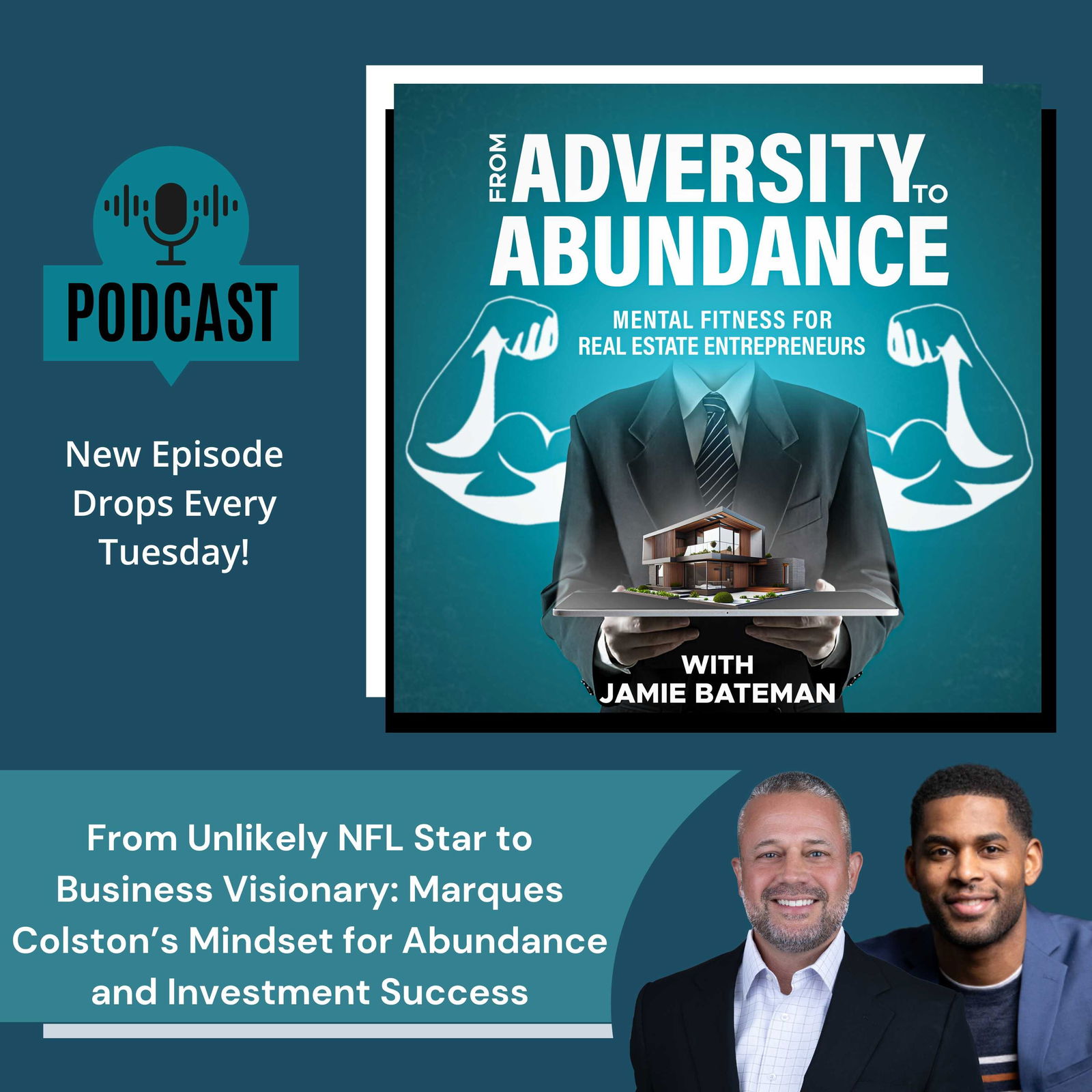
From Unlikely NFL Star to Business Visionary: Marques Colston’s Mindset for Abundance and Investment Success

 Apple Podcasts

 Spotify

 Amazon Music

 iHeartRadio

 RSS Feed
In this special episode of From Adversity to Abundance , host Jamie Bateman sits down with Marques Colston, a former NFL wide receiver and Super Bowl champion with the New Orleans Saints. With the Super Bowl coming to New Orleans on February 9th, this episode celebrates Marques’ 10-year career with the Saints and his inspiring transition to entrepreneurship.
Marques was drafted late in the 2006 NFL Draft but went on to become one of Drew Brees' most trusted receivers. While we don’t dive deep into his football career, Marques opens up about the lessons he learned through adversity—like overcoming a career-changing injury in college—and how he applied those lessons from team sports to business.
In this conversation, Marques shares the mindset principles he’s used in both sports and business. He discusses his work at Champion Venture Partners, a company dedicated to giving more people access to alternative investments. Marques also reveals how he focuses on amplifying his blessings and helping others succeed. Toward the end of the episode, he shares insights on how our view of competition can limit us and how we can shift our perspective for greater success. He also talks about the role of financial abundance in his life and recommends two impactful books.
Guest Introduction: Marques Colston
Marques Colston is a former NFL wide receiver who played 10 seasons for the New Orleans Saints, winning a Super Bowl and becoming a top target for quarterback Drew Brees. After retiring from football, Marques transitioned into business, co-founding Champion Venture Partners to provide access to alternative investments. He focuses on using his platform to share his knowledge and create opportunities for others to build wealth and success.
Episode Highlights:
- From Underdog to NFL Star : Marques shares his journey of being drafted late and working hard to become one of Drew Brees’ most trusted targets.
- Adversity in College : How an injury in college reshaped Marques’s approach to sports and business.
- Applying Team Sports Principles to Business : How Marques uses lessons from the field to succeed in the world of entrepreneurship.
- Champion Venture Partners : Marques discusses how his company is giving more people access to alternative investments and wealth-building opportunities.
Key Takeaways:
- Adversity—whether physical or emotional—can lead to greater opportunities if we shift our mindset.
- Principles from team sports, such as discipline and collaboration, can be key to success in business.
- Viewing competition differently can unlock new potential and opportunities for growth.
- Financial abundance isn’t just about money—it’s about using what you have to help others and make a positive impact.
Connect with Marques:
Website: https://www.championpartners.co/
Twitter: https://x.com/MarquesColston
Instagram: https://www.instagram.com/marquescolston/?hl=bg
Facebook: https://www.facebook.com/profile.php?id=61563798286730
LinkedIn: https://www.linkedin.com/in/marques-colston/
Integrity Income Fund:
https://labradorlending.com/investors/passive-investors/
Labrador Mentorship:
labradorlending.com/investors/active-investors/
—
Haven Financial Services:
Learn more: jamie.myfinancialhaven.com/
—
Purchase Jamie’s Book: www.amazon.com/dp/B0CGTWJY1D?ref_=pe_3052080_397514860
—
Leave us a REVIEW: podcasts.apple.com/us/podcast/from-adversity-to-abundance/id1618672867?mt=2&ls=1
www.adversity2abundance.com/reviews/new/
Connect with us
Website: www.adversity2abundance.com
Facebook: https://www.facebook.com/labradorlending/
Instagram: https://www.instagram.com/labradorlendingllc/
LinkedIn: https://www.linkedin.com/company/labrador-lending/?viewAsMember=true
Youtube: https://www.youtube.com/channel/UChYrpCUlqFYLy4HngRrmU9Q
Connect with Jamie
LinkedIn: www.linkedin.com/in/jamie-bateman-5359a811/
Twitter: twitter.com/batemanjames
0:00 Speaker 0: Alright, guys. Speaker 0: You're gonna enjoy this one. Speaker 0: This is a a special treat. Speaker 0: Today, we hear from Marques Colston. Speaker 0: I got the chance to chat with him. Speaker 0: Marques is a former NFL wide receiver who Speaker 0: played for the New Orleans Saints for many years and was absolutely phenomenal. Speaker 0: He almost didn't make it into the NFL, was drafted very, very late in Speaker 0: the draft in two thousand six, and played for ten years, Speaker 0: was Drew Brees's favorite receiver for most of those ten years, if Speaker 0: not all of them. Speaker 0: We don't spend a ton of time talking about, you know, all of that Speaker 0: because you can find that online. Speaker 0: Marque is famous, really. Speaker 0: And, Speaker 0: but what we do talk about is or or some of the lessons that Speaker 0: he learned through adversity in his college career with a with a particular Speaker 0: injury and, and then also how just a lot of the principles Speaker 0: that he's taken from team sports and how he's been able to apply those Speaker 0: to business.
0:53 Speaker 0: We talk about investing, Speaker 0: what, Champion Venture Partners is up to, the the company that Marques Speaker 0: is running, how he's trying to give access to alternative investments Speaker 0: to everyone, really. Speaker 0: Marques talks about how he's a lifelong learner and how he just Speaker 0: tries to take the blessings that he's received and amplify those Speaker 0: and share those with others. Speaker 0: Really get into a lot of the mindset stuff here which applies to all Speaker 0: of us and just not letting your circumstances define you. Speaker 0: You know, Speaker 0: one of the things I loved about this episode too is is really toward Speaker 0: the very end.
1:34 Speaker 0: I'm not gonna give it away. Speaker 0: You gotta listen. Speaker 0: But he talks about how we tend to view our competition and how it's Speaker 0: really that view of the competition ends up holding us back and kinda Speaker 0: gives a little secret at the end about how he thinks we should view Speaker 0: competition. Speaker 0: Also toward the end, Marques talks about how financial abundance has benefited Speaker 0: him, and he recommends two really high quality books Speaker 0: as well. Speaker 0: I think you're really gonna enjoy this episode. Speaker 0: I know I did. Speaker 1: From adversity to abundance, hosted by entrepreneur Speaker 1: and seasoned real estate investor, Jamie Bateman, is the ultimate guide Speaker 1: for active and passive investors seeking clarity, mental fitness, and Speaker 1: the confidence to make inspired decisions in the world of real estate.
2:20 Speaker 1: With a decade plus of investing experience across various niches and Speaker 1: a background as a combat veteran, former army officer, and Speaker 1: multimillion dollar mortgage note company owner, Jamie brings a wealth Speaker 1: of knowledge and inspiring stories to each episode. Speaker 1: Through weekly episodes featuring insightful interviews with industry leaders Speaker 1: and solo explorations of mindset and strategy, listeners Speaker 1: will uncover actionable advice and tips to overcome challenges Speaker 1: and build lasting financial success. Speaker 1: Whether you're a seasoned investor or just starting, from adversity Speaker 1: to abundance is your road map to turning obstacles into opportunities Speaker 1: and achieving financial freedom.
3:04 Speaker 0: Welcome, everybody, to another episode of the From Adversity to Abundance podcast. Speaker 0: I am your host, Jamie Bateman, and I'm thrilled today to have with us Speaker 0: Marques Colston. Speaker 0: Marques is a, former standout wide receiver Speaker 0: with the New Orleans Saints, in the NFL and as Speaker 0: a current business leader, we're gonna get into a lot more of the specifics Speaker 0: there. Speaker 0: Marques, how are you doing today? Speaker 2: I'm doing well, man. Speaker 2: How about yourself? Speaker 0: I'm doing great. Speaker 0: The sun is shining. Speaker 0: You know? Speaker 0: I'm Speaker 0: vertical. Speaker 0: There's a lot to be thankful for. Speaker 0: So, I interviewed your, one of your business partners, Nick Speaker 0: Edwards, recently, and he said that although you were a phenomenal Speaker 0: receiver in the NFL, that you're ten times that as a as a person.
3:50 Speaker 0: So, that's that's high praise. Speaker 0: And, I can tell you that I personally I I mentioned to you before Speaker 0: we hit record my several of my fantasy teams over the years benefited from Speaker 0: your NFL performance. Speaker 0: So I've been looking forward to this this episode. Speaker 0: This is gonna be a fun one. Speaker 0: I could tell just I don't know you well, of course, but, just from Speaker 0: observing that you have a a humble confidence about you. Speaker 0: So I'm I'm excited to dive into some of the mindset stuff here. Speaker 0: For those listeners who may not be familiar with you, Marques, who are you Speaker 0: and what are you up to today? Speaker 2: Yeah. Speaker 2: That's that's a that's a loaded question. Speaker 2: I'm I'm somebody I consider myself a lifelong learner. Speaker 2: I have obviously, my my professional background as Speaker 2: as a as a player, kinda precedes everything.
4:36 Speaker 2: But, you know, in in the in the transition out of football, I've I've Speaker 2: been I just kind of immersed myself in a lot of different places, lot Speaker 2: of different roles from, adjunct professor to financial adviser, Speaker 2: team owner, investor, consultant. Speaker 2: And, you know, that's really a function of that lifelong learning piece. Speaker 2: You know, I see something that that's interesting. Speaker 2: I I explore it and, you know, kind of let the curiosity lead me Speaker 2: into my version and my way of doing things. Speaker 2: So, it's led me down a down a pretty diverse path and and, you Speaker 2: know, still learning and still building as I go. Speaker 0: I love that. Speaker 0: Yeah. Speaker 0: Lifelong learner. Speaker 0: Before we get too far ahead, this is for a friend of mine. Speaker 0: What's the most you ever bench pressed?
5:20 Speaker 2: Man, that's going all the way back to my college days. Speaker 2: I probably put put up three thirty or three forty. Speaker 2: I got I got long arms, man. Speaker 2: So it's Yeah. Speaker 0: It's a tough one. Speaker 0: Alright. Speaker 0: We got that one out of the way. Speaker 0: That was a that was a fun one, though. Speaker 0: But, so, Marques, I mean, I like I said, I've followed your career Speaker 0: fairly closely over the years, and I know you were a seventh round pick, Speaker 0: which for those who don't know is is pretty late in the in the Speaker 0: NFL draft. Speaker 0: So what heading we're we're gonna jump back even further than that, but, Speaker 0: I mean, just the fact that you were able to do so well in Speaker 0: your NFL career is just it obviously speaks to your mindset and your, Speaker 0: like you said, lifelong learning approach to things. Speaker 0: We're not gonna cover a lot of the stuff that people can Google and Speaker 0: and read on Wikipedia, Speaker 0: but it's just an impressive, you know, it's just so impressive to observe Speaker 0: what you've done.
6:09 Speaker 0: So jump back before before the draft. Speaker 0: You you before we hit record, you mentioned something about, your your college Speaker 0: career and some adversity you faced there. Speaker 0: Let's dive in there. Speaker 0: What happened to you? Speaker 0: And talk to us about your college career. Speaker 2: Yeah. Speaker 2: So I'm I'm one of those people that, you know, a lot of athletes Speaker 2: end up redshirting, but most most often, it kinda happens in the beginning of Speaker 2: your career. Speaker 2: Most people redshirt as a freshman, and that's kind of their developmental year. Speaker 2: For me, I I finished up a really good junior campaign. Speaker 2: Last game of the season, I broke the all time, single game record for Speaker 2: my school. Speaker 2: But I played most of that year with a with a messed up shoulder Speaker 2: and, you know, went and had surgery in the off season, came back, wasn't Speaker 2: quite ready, in in spring and, got to training camp Speaker 2: of my senior year, and it just didn't feel right.
6:59 Speaker 2: And at that point, I knew something was up, and I kinda had to Speaker 2: make a decision. Speaker 2: Do I try to play this senior season with a bum shoulder, or do Speaker 2: I, you know, have this surgery and and sit down and and sit out Speaker 2: my senior year red shirt and then come back the following year? Speaker 2: And I chose the latter. Speaker 2: And, you know, for me, it was that was the first time in my Speaker 2: life from from age seven, that I that I had to go without Speaker 2: playing football. Speaker 2: And, you know, to do it in a senior year where I I was Speaker 2: teed up, I was, you know, a preseason all American, Speaker 2: ready to go out and have a great campaign, ready to go out and Speaker 2: and get ready for the draft and all those things. Speaker 2: For that for that to happen at that moment, was probably one of Speaker 2: the tougher things that I had to deal with at that point to that Speaker 2: point in my life.
7:44 Speaker 2: Sure. Speaker 2: And it it kinda reset a lot of things for me mentally. Speaker 2: You know, a lot of things that, you know, I just kinda took for Speaker 2: granted. Speaker 2: Sure. Speaker 0: Yeah. Speaker 2: That the ball would be there. Speaker 2: The fact that, you know, I'd be able to go to practice and be Speaker 2: around my teammates, be around my colleagues, all those things. Speaker 2: Yep. Speaker 2: It was a it was a really hard reset, that year sitting out and Speaker 2: watching watching my guys play and watching the class that I came in, watching Speaker 2: them graduate, walk the stage, and I stayed behind. Speaker 2: Yeah. Speaker 2: Yeah. Speaker 2: Yeah. Speaker 2: So it was a kind of a a delineation point in my in my Speaker 2: life and career that I didn't know at the time. Speaker 0: Sure. Speaker 0: No. Speaker 0: And, I I was a collegiate athlete as well and also redshirted Speaker 0: a year and also dealt with some injuries. Speaker 0: Not not a season ending injury like that or the decision to sit out Speaker 0: for a whole year.
8:26 Speaker 0: And and, certainly, I didn't make it to the pros or anything like that. Speaker 0: So not saying we're on the same level there, but I I know what Speaker 0: it's like to take a lot of those those blessings for granted. Speaker 0: And, and and just it starts to kinda shake Speaker 0: your identity a little bit at that point. Speaker 0: It's deeper than just a, you know, shoulder pain or something like that. Speaker 0: So, speak to, like, what what's going through your mind at that point as Speaker 0: far as deciding whether to sit out and then, and then when you did Speaker 0: come back, talk to us about your your senior year campaign. Speaker 2: Yeah. Speaker 2: I mean, it it was like I said, up up until that point in Speaker 2: my life is one of the tougher things that I that I had to Speaker 2: deal with. Speaker 2: You know, I I was I was teed up.
9:07 Speaker 2: You know? Speaker 2: The the the dream was right at the doorstep. Speaker 2: Mhmm. Speaker 2: Right? Speaker 2: All I literally, all I had to do was go out and and, you Speaker 2: know, compete at the same level as a senior. Speaker 0: You'd already done before. Speaker 0: Right? Speaker 2: Yeah. Speaker 2: Exactly. Speaker 2: Exactly. Speaker 2: So so the it kinda felt like that rug pull and that rug pull Speaker 2: moment, and you just as a twenty year old, you just don't know what Speaker 2: to do with that. Speaker 2: You know, that kinda loss, like you like you mentioned, it's an identity loss. Speaker 0: Mhmm. Speaker 2: So that that kinda got the clock started for me in just realizing that Speaker 2: you have to be somebody outside of just the athlete because it can be Speaker 2: long and fast. Speaker 0: That's so true. Speaker 2: And, you know, that that kinda started started that thought process for me, and Speaker 2: it and it made me you know, that whole season, I kinda had to Speaker 2: sit.
9:51 Speaker 2: I couldn't travel to away games. Speaker 2: We had some weird policies and stuff, so I couldn't be on the sideline Speaker 2: during during the games. Speaker 2: Mhmm. Speaker 2: So I was just kinda in this this state of isolation, and I had Speaker 2: to really figure out who I was in a lot of ways. Speaker 0: Mhmm. Speaker 0: Gotcha. Speaker 2: You know, to to have that happen at at twenty years old, you know, Speaker 2: it was it was a blessing in disguise just because it got a clock Speaker 2: started, and I had to start thinking outside of how I typically thought. Speaker 2: Mhmm. Speaker 2: In a lot of ways, that kinda laid the groundwork for, just the mindset Speaker 2: and the the the ability to not let this situation define Speaker 2: who I was in any given time. Speaker 0: Mhmm. Speaker 0: I love that. Speaker 0: That's really, really good. Speaker 0: So like I said, we're not gonna dive into all of the, all your, Speaker 0: you know, accolades and everything during your NFL career, but Speaker 0: talk to us briefly about sort of your heading into the the the your Speaker 0: the draft and what your mindset was, and then kind of walk us Speaker 0: through your career as a whole.
10:50 Speaker 2: Yeah. Speaker 2: I mean, I like like you mentioned, I was I was seventh round pick, Speaker 2: fourth to the last pick in the draft. Speaker 2: And, again, just kinda back to that. Speaker 2: The the situation is is one thing, but I can't let it define me. Speaker 2: Right? Speaker 2: So in my mind, I wasn't walking into training camp. Speaker 2: I wasn't walking into mini camp as a seventh round pick. Speaker 0: Mhmm. Speaker 0: I Speaker 2: was walking into somebody that was just there to compete for for a starting Speaker 2: job Speaker 0: Mhmm. Speaker 2: Compete for an opportunity. Speaker 2: Mhmm. Speaker 2: You know, had to wait a little bit longer than I than I wanted Speaker 2: to be. Speaker 0: During the draft. Speaker 0: Yeah. Speaker 2: But at the end of the day, it's it's all perspective. Speaker 2: It's it's you know, a lot of people put stock in that number. Speaker 2: I was picked two fifty two. Speaker 2: And if you're only looking at two fifty two out of two fifty five, Speaker 2: it it doesn't sound very, very, very appealing.
11:33 Speaker 0: Mhmm. Speaker 2: But when you when you're able to zoom out and see this is two Speaker 2: hundred fifty two out of, you know, ten thousands Speaker 0: Right. Speaker 0: So then then it's That's pretty impressive. Speaker 0: Yeah. Speaker 2: So, Speaker 2: you know, that that entering the league in that way, my mindset Speaker 2: was one that I I just I'm gonna compete. Speaker 2: I'm gonna compete. Speaker 2: I'm gonna do, you know, what I need to do. Speaker 2: I'm gonna figure out how I can, you know, get better at any given Speaker 2: point. Speaker 2: Mhmm. Speaker 2: And that that was the mindset that I went in with. Speaker 2: And, you know, from the jump, from from day one, I I ended up Speaker 2: playing, playing in a position that I'd never played in before. Speaker 2: Mhmm. Speaker 2: You know? Speaker 2: So it's it's Speaker 0: You were a you were a tight end before that? Speaker 2: I I played I played receiver in college, but we had this this pretty Speaker 2: I'll I'll call it a static offense where Uh-huh.
12:20 Speaker 2: For four years in college, I played the left wide out. Speaker 2: Okay. Speaker 2: Never played in the slot. Speaker 2: I never played on the right side of the field. Speaker 0: Gotcha. Speaker 0: Okay. Speaker 2: So I played in one static position for four years Speaker 0: Mhmm. Speaker 0: And I Speaker 2: to did the highest level, and now I'm moving all over the field, and, Speaker 2: you know, I have to learn these different nuances. Speaker 2: And Speaker 0: Mhmm. Speaker 2: Again, it it's it's the mindset. Speaker 2: You know, for a lot of people, they saw that as as a knock. Speaker 2: Mhmm. Speaker 0: But for Speaker 2: me, I saw it differently. Speaker 2: It was I didn't have a lot of bad habits that I had to Speaker 2: unlearn before I could learn the real ones. Speaker 0: Sure. Speaker 0: Yeah. Speaker 2: So it was an opportunity. Speaker 2: It was a blank slate in a lot of ways, and and I just Speaker 2: I went in with the mindset that I'm gonna compete. Speaker 2: I'm gonna learn. Speaker 2: I'm gonna help the people around me be a good teammate and, Speaker 2: you know, see where it lands me.
13:02 Speaker 2: And it Speaker 0: Yeah. Speaker 2: Ended up in a pretty good spot. Speaker 0: Yeah. Speaker 0: For sure. Speaker 0: I mean, you were Drew Brees' favorite target for many years. Speaker 0: You know, that's it it was really, really impressive to watch. Speaker 0: And I know again, I'm I'm, you know, I don't I don't know I'm Speaker 0: not plugged into the NFL or anything like that, but just from the outside, Speaker 0: a lot of the wide receivers in particular tend to be pretty flashy, Speaker 0: you know, pretty, we'll say divas. Speaker 0: But, you just always seem to carry yourself in such a humble yet confident Speaker 0: way. Speaker 0: Clearly, you're confident to make to to have create such an impact. Speaker 0: And and, so talk to us about humility Speaker 0: and what that was you know, how that played into your approach.
13:43 Speaker 2: Yeah. Speaker 2: It it was huge for me. Speaker 2: I mean, I it it it was a little bit easier in that, in Speaker 2: every kinda in every stage and in every transition in my life. Speaker 2: But, like, I I was never the the most heralded, you know, opportunity. Speaker 2: I wasn't I wasn't the top prospect coming out of high school. Speaker 2: That's how you end up at Hofstra. Speaker 2: Clearly wasn't a top draft pick. Speaker 2: That's how you become a seventh round pick. Speaker 2: So so for me, it it was never about the flash. Speaker 2: It was always about I have to I have to put in this work, Speaker 2: and I have to prepare at a level, Speaker 2: at such a high level that I get an opportunity to overcome my situation. Speaker 0: Mhmm. Speaker 2: That was always my mentality. Speaker 2: So it was never really about flash. Speaker 2: It was always about production.
14:24 Speaker 2: And Mhmm. Speaker 2: If you can produce at at a high level and figure out how to Speaker 2: produce again at a high level even when circumstances change Yeah. Speaker 2: How you can sustain success. Speaker 0: Oh, I love that. Speaker 2: With my mentality. Speaker 2: You can't you can't take again, you can't take the next rep for granted. Speaker 2: You can't take the next year for granted. Speaker 0: Mhmm. Speaker 2: Because I'd already been through that. Speaker 0: Right. Speaker 0: Right. Speaker 2: So it it was always about being in the moment, staying in the moment. Speaker 2: What is what is the win that I can extract from this moment? Speaker 2: Whether it's a play, it's a quarter, it's a season, a game, what's the Speaker 2: win I can extract from this moment? Speaker 2: Wonderful. Speaker 2: Take the insights. Speaker 2: Figure out the next moment. Speaker 2: How do I win this next moment? Speaker 2: That was always my mentality. Speaker 2: And that's kinda how I put together ten years Speaker 0: Mhmm.
15:05 Speaker 2: Of football that maybe looked different from age twenty two to age thirty two, Speaker 2: but the production thing. Speaker 0: Right. Speaker 0: Right. Speaker 0: Yeah. Speaker 0: And then you develop a a trust from one of the best quarterbacks ever. Speaker 0: And I remembered him, Drew Brees, talking about just not always focusing Speaker 0: on the outcome, but focusing on the process and the moment and just Speaker 0: doing the right thing in the moment, and the the the rest will take Speaker 0: care of itself. Speaker 0: Briefly, what was it like playing with Drew Brees? Speaker 2: Man, it it was it was a partnership. Speaker 2: That's the that's the best way to explain it. Speaker 2: It it's we we had so much so many, just Speaker 2: so much time on task with he he was a perfectionist. Speaker 0: Yeah. Speaker 0: Yeah. Speaker 2: I was a perfectionist.
15:45 Speaker 2: And Mhmm. Speaker 2: You know, we would we would go through practice. Speaker 2: We would go through film, go through processes, and it it wasn't it wasn't Speaker 2: it wasn't a good rep until we saw it the same. Speaker 2: Like, I can see the game through his eyes, and he had to know Speaker 2: exactly what I was seeing and read my body language. Speaker 2: So it was a true partnership for ten years. Speaker 2: And, you know, you just don't get many opportunities to work Speaker 2: at with somebody that plays at such a high level that thinks and sees Speaker 2: the game at such a high level, and they they've just kinda become a Speaker 2: thinking partner. Speaker 2: So it was it was an amazing ten years. Speaker 0: Yeah. Speaker 0: I mean, just, again, from the outside, the synergy and the chemistry you guys Speaker 0: displayed was were phenomenal. Speaker 0: And so talk to us about so, I guess, age thirty two Speaker 0: is is when you ended up, you know, ending your NFL career.
16:32 Speaker 0: What was that like? Speaker 0: How did that happen? Speaker 0: How did you were you in control of that, or what what was the, Speaker 0: decision making process there? Speaker 2: No. Speaker 2: You you're never in control of that. Speaker 2: But, But, no, I I I finished my tenth year, and that was the Speaker 2: first year that I that I ended the season feeling like I Speaker 2: can't play at the level that I wanna play at. Speaker 2: Like, you as a competitor, you have this vision. Speaker 2: And that was the first year that I just I couldn't I couldn't get Speaker 2: to my own vision for myself. Speaker 2: Mhmm. Speaker 2: That's kinda when I knew I I'd always told myself when I can't play Speaker 2: at the level of of of excellence that I wanna play at, then I Speaker 2: need to walk away. Speaker 0: Yeah. Speaker 2: So I kinda came out of my tenth year knowing that that it was Speaker 2: it for me.
17:13 Speaker 2: And then I got a call. Speaker 2: I'm literally laying in the bed right right around the combine time in February. Speaker 2: Mhmm. Speaker 2: I got a call that that confirmed it. Speaker 0: Okay. Speaker 0: Said the Speaker 2: Saints were gonna go in a different direction, and, you know, I appreciate them Speaker 2: for, thank them for the opportunity and Mhmm. Speaker 2: You know, kept it moving and went on with my day because I I Speaker 0: kinda coming. Speaker 0: You knew it was coming. Speaker 0: But, I mean, you probably could have, you know, tried to play for another Speaker 0: team, get signed elsewhere. Speaker 0: Right? Speaker 2: Yeah. Speaker 2: So so interestingly enough, so I got I got released by the Saints. Speaker 2: Mhmm. Speaker 0: But a Speaker 2: day or two later, my agent calls me. Speaker 2: He's got a couple of teams that had called him that were interested. Speaker 2: And, you know, I've started listening to the offers for a minute, and I Speaker 2: just I I I quickly just told him, look.
17:57 Speaker 2: I I'm done. Speaker 2: Like, I don't get to talk with Speaker 0: you. Speaker 0: When you know, you know. Speaker 0: Right? Speaker 2: Yeah. Speaker 2: I'm not gonna pick up my family and go to another city and, like, Speaker 2: I'm done. Speaker 2: I'm I'm it's time to turn the page. Speaker 2: So I I I don't know who I don't know who was interested after Speaker 2: I told them don't call me. Speaker 0: Right. Speaker 0: Gotcha. Speaker 0: So okay. Speaker 0: So during that the ten years that you were playing in the NFL, did Speaker 0: you were you working on the next phase of your life, or, Speaker 0: what what were your thoughts as to your post NFL career? Speaker 2: Yeah. Speaker 2: I was I was I was actively building it as I was playing. Speaker 2: Mhmm. Speaker 2: I started maybe my fourth year, angel investing, Speaker 2: And I I was really, really quickly, I was able to kinda kinda draw Speaker 2: a parallel between my life as an athlete and the the life Speaker 2: of a of a startup entrepreneur.
18:46 Speaker 0: Okay. Speaker 2: It was very, very much the same journey. Speaker 2: You had this vision. Speaker 2: The odds are stacked against you, and you have to bet on you, and Speaker 2: you have to believe in you before anyone else will. Speaker 0: Mhmm. Speaker 0: Sure. Speaker 2: When I was able to connect those dots, it it opened up entrepreneurship and Speaker 2: venture capital to me mentally in a way that, it just felt Speaker 2: very it just felt very like I was at home. Speaker 2: And from that moment moment on, I knew I was an entrepreneur, and and Speaker 2: I just kinda continued to experiment and and almost, like, prototype my way Speaker 2: through, Speaker 2: figuring out what it is that that that I was good at, what it Speaker 2: is that I was interested in. Speaker 0: Mhmm. Speaker 2: As they like as they say, I kissed a lot of frogs Speaker 0: Okay.
19:27 Speaker 2: Early days, but you you kinda have to figure out Speaker 0: the Speaker 2: things you don't wanna do and the things that you're not passionate about Speaker 0: Right. Speaker 2: Really hone in and focus on the things that that, you know, should be Speaker 2: time and attention. Speaker 2: Yeah. Speaker 0: And that's you're you're speaking about during your NFL career, you're you were testing Speaker 0: different things. Speaker 0: Right? Speaker 0: So you didn't wait till you were done. Speaker 0: Hey. Speaker 0: I should probably test some things and see what what I like or what Speaker 0: I'm good at. Speaker 0: I love that. Speaker 0: There's you're planning ahead. Speaker 0: You're thinking long term, but then you're still coming back to the moment and Speaker 0: the present when you're playing football and training for football. Speaker 0: It's not like you were, you know, not present, but you're also planning ahead Speaker 0: and thinking, you know, this is I'm not gonna be playing football forever. Speaker 0: So and, like, you you mentioned what you're good at.
20:07 Speaker 0: Just we're all unique, and we all have the, you know, individual talent, and Speaker 0: nobody is is like you or me and or the listener. Speaker 0: And so I think that's critical to to, you know, be introspective and figure Speaker 0: out what drives you, what are you passionate about, what are you good at, Speaker 0: how can you serve others. Speaker 0: But, also, like you you mentioned, it's trial and error. Speaker 0: You know, you gotta test things and try things. Speaker 0: So what were some of the things that you tried during your NFL career Speaker 0: that maybe didn't pan out? Speaker 2: Man, there were so many of them. Speaker 0: Gotcha. Speaker 2: No. Speaker 2: So so investments are easy one. Speaker 2: Yeah. Speaker 2: I mean, you're if if you're hitting on half of your investments, especially, like, Speaker 2: in the private and the venture space. Speaker 2: Mhmm. Speaker 2: Mhmm. Speaker 2: Right? Speaker 2: So we get into know that that game and you expect to fail, but Speaker 2: you expect the wins to kinda overtake the failures.
20:52 Speaker 0: Right. Speaker 2: But for me, it it was really the the one thing that the one Speaker 2: opportunity that changed everything for me was, I ended up in a position Speaker 2: where I was owning and operating a an indoor football team. Speaker 0: Okay. Speaker 0: Nice. Speaker 0: I did What team was that? Speaker 2: It was it was a lower level team. Speaker 2: It was in my hometown called the Harrisburg Stampede. Speaker 0: Okay. Speaker 0: So I think This is Harrisburg, Pennsylvania? Speaker 0: Harrisburg, Pennsylvania. Speaker 0: Gotcha. Speaker 0: Yeah. Speaker 0: I'm in, the Baltimore area and, Speaker 2: you know, familiar with. Speaker 2: Harrisburg team, the the Baltimore Mariners we played down around here. Speaker 0: Okay. Speaker 2: Yeah. Speaker 2: Yeah. Speaker 0: Nice. Speaker 0: Mariner. Speaker 0: Yeah. Speaker 2: I I got got into that business. Speaker 2: I knew obviously, knew the sports the sports angle, wanted to figure out the Speaker 2: the the front office and and figure out the operations of the business.
21:34 Speaker 2: So Mhmm. Speaker 2: I got in there, and I ran I ran that team for for three Speaker 2: years. Speaker 2: Okay. Speaker 2: Soup to nuts, general manager. Speaker 2: I I intentionally did everything except the roster decisions. Speaker 2: You know, so business ops, game operations, marketing, Speaker 2: media, all every everything except pick the Speaker 2: team and coach the team. Speaker 2: That that was kinda what I what I intentionally, took Speaker 0: And why why do you avoid doing that? Speaker 2: Because I I had a I had a coach that I knew that I Speaker 2: knew he was he would do a good job. Speaker 2: He had Gotcha. Speaker 2: Half. Speaker 2: He he was he was a successful coach Mhmm. Speaker 2: Already. Speaker 0: Mhmm. Speaker 2: And I wanted them I wanted him to know that he had autonomy to Speaker 2: do what he needed to do without this this shadow kinda just over Speaker 2: over Right.
22:22 Speaker 0: Understood. Speaker 0: That makes sense. Speaker 2: You know? Speaker 2: And for me, it was I needed I needed the focus to figure out Speaker 2: the things the the unknown unknowns that I was walking. Speaker 0: Yeah. Speaker 0: And what what years, was that? Speaker 2: So this was this was twenty eleven through Speaker 2: twenty twelve through twenty fourteen. Speaker 0: Gotcha. Speaker 0: And what what was your what were one or two takeaways from that experience? Speaker 2: Man, for me, it it was it was my first real Speaker 2: experience in business leadership. Speaker 2: K. Speaker 0: Yep. Speaker 2: Drastically different than sports leadership. Speaker 2: And and for for me, I'm I'm somebody that I'm I'm kind of the Speaker 2: lead by example type of person.
23:03 Speaker 2: I'm not I'm not a suit I'm not a really, vocal leader. Speaker 2: I'm not a really high strum leader. Speaker 0: Right. Speaker 2: So to be in that position where I had to be vocal, I had Speaker 2: to be upfront. Speaker 2: I couldn't just hide behind production. Speaker 2: I had to show up and and lead people. Speaker 0: Yeah. Speaker 2: It was a really good at that point in my life, I'm, like, twenty Speaker 2: six, twenty seven. Speaker 2: That was just really good lesson for me to learn and a really good Speaker 2: experience that that I I kinda put in my back pocket and and carried Speaker 2: with me. Speaker 0: Mhmm. Speaker 2: And that I started to learn how I could lead in a way that Speaker 2: was authentic to who I was. Speaker 0: Mhmm. Speaker 2: But it also gave the team members what they needed so that Speaker 2: they could be successful. Speaker 2: So it would you know, it's different than, you know, preparing and going out Speaker 2: and running the route and winning the route.
23:48 Speaker 2: You can still lead all day, but Yeah. Speaker 2: Using a team kind of requires requires different muscles and and to get and Speaker 2: to start building those muscles. Speaker 0: That makes sense. Speaker 0: And I've in certain points, I've, like, I was I was in the military. Speaker 0: I was kinda pushed into certain positions where I'm like you. Speaker 0: I'm not I'm not, you know, super necessarily comfortable. Speaker 0: Maybe you are now, but, you know, I'm not that rah rah guy that's Speaker 0: it's cheering, you know, in front of thousands of people, pumping everybody up. Speaker 0: I I'm more of a lead by example kinda person, but got pushed into Speaker 0: certain positions that were outside of my comfort zone. Speaker 0: But I think that builds trust that your the people you're leading tend to, Speaker 0: you know, see, like, you know, maybe you're learning as well, like you said, Speaker 0: a lifelong learner, and you're you're comfortable pushing yourself and stepping outside of your Speaker 0: comfort zone.
24:32 Speaker 0: And and maybe you don't do that same position forever, but, Speaker 0: there's a lot of there's a growth opportunity there. Speaker 0: So but I do think, you know, yeah, it's different in business versus Speaker 0: sports, but there are so many principles from team sports in particular Speaker 0: that lead that that apply in business and entrepreneurship. Speaker 0: Can you can you mention just kind of one or two that you think Speaker 0: are are, kinda cross over well? Speaker 2: Yeah. Speaker 2: I mean, the the one the one that I have really hung my hat Speaker 2: on that most people don't connect to strategy. Speaker 0: Okay. Speaker 0: How so? Speaker 2: We'll get into the soft skills and the leadership and and team building and Speaker 2: all of those things, and they're important.
25:12 Speaker 0: Mhmm. Speaker 2: Me, it's it's been strategy. Speaker 0: Okay. Speaker 2: Particularly the position that I played, it was one that Speaker 2: you literally had to take the best you, Speaker 2: the best abilities of your yourself and your your offensive unit. Speaker 0: Mhmm. Speaker 2: You know, compare and contrast against the the the the best of the defensive Speaker 2: unit and put together a game plan to go out and execute it. Speaker 2: And that game plan had the same core principles every Speaker 2: week, but the execution of it was different based on on the matchup. Speaker 2: Right? Speaker 2: Got it. Speaker 2: Yeah. Speaker 2: That's at macro level. Speaker 2: At a micro level, I'm doing the same exact thing in my position. Speaker 2: Right? Speaker 2: I know who I am as a as a six foot four, two hundred Speaker 2: twenty five pound receiver.
25:54 Speaker 0: Mhmm. Speaker 2: I know what my skill set is. Speaker 2: I gotta figure out who is who is the defender that I'm going against Speaker 2: and what is the scheme that he's playing within. Speaker 0: Mhmm. Speaker 2: And starting to figure out how to how to win, not just Speaker 2: against that opponent, but against that defense, and then again against Speaker 2: that defense in certain situations. Speaker 2: Just figuring out how to think strategically and and that that game theory Speaker 0: Mhmm. Speaker 2: Is something that I've taken literally, transferred wholesale Speaker 2: into the way that I think about the way that I build and the Speaker 2: way that I operate businesses. Speaker 0: Love that. Speaker 0: So is there more, you know, kind of a tactical example Speaker 0: you can give of that in recent years where you've where that's Speaker 0: the the strategy approach has really applied to your business operations?
26:41 Speaker 2: Yeah. Speaker 2: I mean, it's it's, let me let me let me think through one. Speaker 2: So so, ultimately, like, brand positioning and strategic positioning Speaker 2: at the end of the day is Mhmm. Speaker 2: You get into an industry. Speaker 2: So we're we're and we'll probably touch on on this later. Speaker 2: The the current firm that that I'm running, Champion Venture Partners Speaker 0: Mhmm. Speaker 2: For a sports private equity firm. Speaker 2: Mhmm. Speaker 2: But knowing who our play who our team is, knowing the skill sets of Speaker 2: our team, we are we're more operators than investors, Speaker 2: knowing the access that we have. Speaker 2: Our version of of private equity looks different than traditional private equity Speaker 2: firms. Speaker 2: Okay. Speaker 2: Of of being strategic and leading with leading with our strengths intentionally Speaker 2: so that we can leverage our operational capacity in the way that we bring Speaker 2: value.
27:28 Speaker 2: It's not our value is not just opening a Rolodex and connecting you with Speaker 2: advisers. Speaker 0: Mhmm. Speaker 0: Our Speaker 2: value add is we literally have operators that can come into your business and Speaker 2: integrate into your business either as contractors or as, you know, fractional Speaker 2: C suite representatives. Speaker 0: Okay. Speaker 0: That's pretty cool. Speaker 0: So Speaker 2: so kinda going back to understanding who you are, Speaker 2: what you do well, and how to deliver that to the target audience. Speaker 0: Yeah. Speaker 2: That's that's one tactical example of just how to Yeah. Speaker 2: Firm. Speaker 0: So was that something where you built your team and then you said, hey. Speaker 0: What are we good at? Speaker 0: Or was it, like, what how do we wanna be different from the competition? Speaker 0: Let's go build the team or a mix of both? Speaker 2: It it's kind of kind of a mix of both.
28:09 Speaker 2: You know, like, you you build out the vision. Speaker 2: You build out, you build out the the kind of the end game or Speaker 2: the North Star Yeah. Speaker 2: And you find the people that that can help you that can help you Speaker 2: get there. Speaker 0: Yeah. Speaker 2: You know, it's it's it's it's no different than building a roster. Speaker 2: It's no different than draft day. Speaker 2: You you got certain holes that you wanna fill. Speaker 0: Right. Speaker 2: Term, and then you got certain certain picks that you wanna, you know, you Speaker 2: wanna get out you wanna develop over time. Speaker 2: So Sure. Speaker 0: Yeah. Speaker 0: You're gonna need to know where you're going, but then as time goes on, Speaker 0: you can adjust that a little bit. Speaker 0: You don't know how you're gonna get there, of course. Speaker 0: But also you can, at times, pivot and maybe change the Speaker 0: North Star a little bit.
28:50 Speaker 0: So talk to us in more detail about, Champion Speaker 0: Venture Partners and what you all are up to. Speaker 2: Yeah. Speaker 2: So so Champion Venture Partners, like I mentioned, we we're a private equity firm. Speaker 2: We focus on what we call the the value chain of sports. Speaker 2: So most of the conversations around sports investment now are teams. Speaker 2: You know, NFL, n NFL, NBA, MLB, Speaker 2: MLS, the the the big five leagues. Speaker 0: Okay. Speaker 0: Yep. Speaker 2: What we know is that there is a there is a value chain Speaker 2: that kinda makes even those teams and those leagues operate. Speaker 2: It makes them tick. Speaker 2: Right? Speaker 2: So so we wanted to build a a firm that really looked at Speaker 2: the the the components and the the picks and shovels of the sports business Speaker 2: and put them all into a portfolio alongside teams and clubs.
29:42 Speaker 2: So everything from sports tech to real estate and hospitality Speaker 2: to sports medicine, Speaker 2: to media, you know, all of the picks and shovels that make sports what Speaker 2: it is. Speaker 0: Mhmm. Speaker 2: So that's that's really our our investment thesis. Speaker 2: That's what we invest in. Speaker 0: Okay. Speaker 0: So Speaker 0: for the, you know, layperson who may not be totally familiar with what what Speaker 0: that all means, it it is there a particular example, either a Speaker 0: true case study or even a sort of fake case study going forward where Speaker 0: you can say this is how we've helped a a business, a sports team, Speaker 0: or something like that? Speaker 2: Yeah. Speaker 2: So so I'll give I'll give you a live example. Speaker 2: So we are in con we've had several conversations with with sports clubs Speaker 0: Mhmm.
30:23 Speaker 2: That are, Speaker 2: obviously, open to investment in the club and ownership at the club level. Speaker 0: Mhmm. Speaker 0: But they Speaker 2: also have real estate projects. Speaker 2: They they have stadium projects, stadium upgrades that they wanna that they wanna get Speaker 2: into. Speaker 0: Okay. Speaker 2: So that's that's where our our entire, you know, ecosystem play. Speaker 2: We can come in and invest in the team, but we can also bring Speaker 2: some some different technology integrations and technology platforms that they Speaker 2: can integrate into their stadium upgrades. Speaker 0: Okay. Speaker 2: Around ticketing. Speaker 2: Maybe it's around fan engagement. Speaker 2: There might be a sports medicine, technology or sports medicine, Speaker 2: partnership or opportunity that we can bring into the club. Speaker 2: Mhmm.
31:04 Speaker 2: Most clubs at at at this day and age are looking beyond just just Speaker 2: the the team in the stadium. Speaker 2: You're seeing a lot of real estate plays, lot of hospitality plays. Speaker 0: Mhmm. Speaker 2: You know, one one kinda North Star that we always point to is is Speaker 2: the battery, down in down in Atlanta. Speaker 0: Okay. Speaker 2: Right? Speaker 2: So you got the Braves organization. Speaker 0: Yeah. Speaker 0: You know, you got the the Speaker 2: whole sporting aspect, but you've got this whole, basically, this whole smart city that's Speaker 2: that's owned by the Braves organization. Speaker 0: Okay. Speaker 2: Yep. Speaker 2: All of the the retail there, all of the hospitality there, all of the Speaker 2: data that's generated there, the parking, all of that becomes part Speaker 2: of this this this club operation in this club, Speaker 2: this club portfolio.
31:47 Speaker 0: Okay. Speaker 2: Yeah. Speaker 2: So that that is is a is a live example of how we Speaker 2: wanna structure our portfolio. Speaker 0: Nice. Speaker 0: And what does your team look like right now? Speaker 2: So so our team our team is is pretty like I said, it's a Speaker 2: pretty diverse group. Speaker 2: Mhmm. Speaker 2: The operators. Speaker 2: Yeah. Speaker 2: We are about I'm I'm counting real real time in my head. Speaker 2: We are Yeah. Speaker 0: No worries. Speaker 0: Just approximate. Speaker 2: Yeah. Speaker 2: We're about twelve deep. Speaker 2: Gotcha. Speaker 2: We've got folks that that have, worked in the front offices at Speaker 2: the league level, at the at the team level. Speaker 2: We've got folks that have been life, that that have been professional investors Speaker 0: Mhmm.
32:28 Speaker 2: In the real estate game. Speaker 2: We have have been, practitioners, within the sports Speaker 2: medicine world. Speaker 0: Yeah. Speaker 2: Myself as a as a team owner, a former financial adviser. Speaker 2: Mhmm. Speaker 2: We put together a team that that we we feel like are, one, Speaker 2: high level people. Speaker 0: Sure. Speaker 2: High performance people. Speaker 2: Yep. Speaker 2: Two, just very diverse skill sets and operated within sports that you Yeah. Speaker 0: Yeah. Speaker 0: So you all are bringing both capital as well as operational expertise Speaker 0: to a particular sports organization or Speaker 0: related organization to add value to that organization. Speaker 0: And then is there, like, an, I guess, an exit point on each deal Speaker 0: where you hopefully exit for a profit, or how does that work?
33:13 Speaker 2: So that's that's the beautiful part about about our strategy. Speaker 2: We're not we're not a traditional firm with a with a, kind of Speaker 2: a cap in in a in a timeline on us. Speaker 0: Like, we're Speaker 2: not ten year, fund. Speaker 0: Okay. Speaker 0: Yeah. Speaker 2: We need to produce returns in a in a finite time. Speaker 2: We're more of a permanent capital structure that allows us to come in and Speaker 2: literally build companies that have long term sustainability, Speaker 2: and help to build the sustainability within the companies. Speaker 2: So they're naturally gonna be exit points with some of the portfolio companies that Speaker 2: we get into. Speaker 2: Yep. Speaker 2: But it's not our mandate. Speaker 2: And and that that provides us a level of flexibility to be able to, Speaker 2: you know, create long term value and set up long term partnerships Yeah.
33:54 Speaker 2: In a way that's a little bit different. Speaker 0: Yeah. Speaker 0: And it doesn't put pressure on you to maybe rush and make poor decisions, Speaker 0: in the moment. Speaker 0: So for for the everyday person at home who is Speaker 0: maybe a real estate investor or an entrepreneur, either active or passive Speaker 0: investor, how can they get involved with what you're doing? Speaker 2: Yeah. Speaker 2: So so we are actually, within the next within Speaker 2: q one of this year, we Speaker 0: will Speaker 2: be live on on our evergreen fund Speaker 0: K. Speaker 2: Which is exciting for us because it's it's an opportunity to make sports investment, Speaker 2: accessible to every investor. Speaker 2: Like I mentioned before, typically, the conversations are, you know, Speaker 2: eight, nine figure checks into Mhmm.
34:40 Speaker 2: Clubs and Yeah. Speaker 2: Handful of people on earth with Right. Speaker 0: Yeah. Speaker 2: But this evergreen fund that that we're launching, in in q one or q Speaker 2: two of this year, takes those same assets, and it gives Speaker 2: every investor an opportunity to to get engaged. Speaker 2: Nice. Speaker 2: But it's it's a it's a blind pool investment. Speaker 2: It's it's more of a passive play. Speaker 0: Yeah. Speaker 0: Yeah. Speaker 2: But the portfolio construction is one that you'll get access to, Speaker 2: you know, teams and clubs all the way down through, you know, early stage Speaker 2: technology to where you can get a you can get a pretty pretty, pretty Speaker 2: pretty wide breadth of of exposure into the sports sports world. Speaker 0: So the blind pool fund really means Speaker 0: the the limited partner, the passive investor doesn't have a ton of Speaker 0: control over what the investments, you know, are in in the fund.
35:30 Speaker 0: Yeah. Speaker 0: But sounds like you're intentionally creating a lot of diversification within the fund Speaker 0: across different asset types, different, you know, sports teams and different, Speaker 0: like you mentioned, real estate technology, a lot of different, different things within Speaker 0: the fund. Speaker 2: The just just to to double click on that, your thousand right with with Speaker 2: you don't get you you don't have a lot of say into what gets Speaker 2: invested in. Speaker 0: Yeah. Speaker 2: The thing that's different about our fund is you do have you do have Speaker 2: access to, Speaker 2: the the opportunity to liquidate, at two different parts Speaker 2: during the year Okay. Speaker 2: Semiannually. Speaker 2: Okay. Speaker 2: Most funds most funds, if it's a ten year lockup, it's a ten year Speaker 2: lockup.
36:10 Speaker 2: It's Right. Speaker 0: Yeah. Speaker 0: Yeah. Speaker 0: No. Speaker 0: For sure. Speaker 0: I run a Speaker 2: The liquid assets, but there is, you know, there are liquidity options with Speaker 0: it. Speaker 0: Sure. Speaker 0: I run a mortgage note fund, and it's that's one of the highlights that Speaker 0: we, like to talk about in the in our little niche in Speaker 0: the real estate space. Speaker 0: You know, oftentimes, three or four years is kind of the minimum is your Speaker 0: commitment period as a as a passive investor. Speaker 0: Yep. Speaker 0: Ours is one year, you know, which is relatively liquid, you know, Speaker 0: compared to some other funds. Speaker 0: And it does force us to, in some ways, purchase smaller Speaker 0: dollar assets and make sure we have the liquidity within the fund to be Speaker 0: able to sell things off and provide that you know, execute on that Speaker 0: redemption request for each investor.
36:53 Speaker 0: But but, yeah, oftentimes, these alternative investments are Speaker 0: five, ten years, and it's like, you don't know what your life you know, Speaker 0: you don't know what needs maybe your kids are gonna have or, you know, Speaker 0: you go through life events and all of a sudden you need your your Speaker 0: money back. Speaker 0: Sounds like you all with, six months is the is the actual commitment Speaker 0: period. Speaker 0: Is that what you're saying? Speaker 2: Yeah. Speaker 2: So so yes. Speaker 2: With the with like I said, every it's it's semiannual. Speaker 2: Those Speaker 0: Gotcha. Speaker 0: Got it. Speaker 2: So, yeah. Speaker 2: You get in there. Speaker 2: There's two there's two opportunities a year to liquidate. Speaker 0: Awesome. Speaker 0: So within that, the what you might you all might invest in, you mentioned Speaker 0: the Atlanta piece. Speaker 0: Is there something that you personally are super interested in as far as the, Speaker 0: business, sports franchise or something like that?
37:40 Speaker 2: Yeah. Speaker 2: I'm I'm I've got my eye on, a lot of these, Speaker 2: a lot of these, teams and clubs in emerging leagues. Speaker 0: Okay. Speaker 2: You know, if you look at the big five and what's happening there with Speaker 2: the valuations, a lot of those are just driven by off of media Speaker 2: rights. Speaker 0: Okay. Speaker 0: Yep. Speaker 2: As we're seeing the linear players get more and more competition, the the CBSs Speaker 2: and the Foxes and the ESPNs of the world, they're getting more competition from Speaker 2: the Amazons and the Netflixes of the world. Speaker 0: Okay. Speaker 2: Yeah. Speaker 2: There's bound to be other emerging leagues that that benefit from Speaker 2: the you know, you're you're playing you're playing a game of musical chairs. Speaker 2: Whoever gets left out, they gotta spend those dollars and allocate those dollars somewhere.
38:20 Speaker 0: Okay. Speaker 0: Yeah. Speaker 2: And, you know, I think that some of these emerging leagues that are getting Speaker 2: into these niche audiences, they have the same operational overhead as Speaker 2: as some of the bigger, you know, legacy leagues. Speaker 2: I think there's gonna be some really good opportunities there. Speaker 0: And when you say emerging leagues, is that the same sports major sports we're Speaker 0: talking about or different sports? Speaker 2: Could could be different sports, could be could be similar sports. Speaker 2: Gotcha. Speaker 2: There there's one there's one that that there's one live example, Speaker 2: the the women's, three on three basketball league unrivaled. Speaker 0: Okay. Speaker 0: Uh-huh. Speaker 2: Not an opportunity that we we got, a chance to to get into, but Speaker 2: just looking and and at what they're doing and seeing, you know, their their Speaker 2: launch has been why widely successful.
39:01 Speaker 0: Nice. Speaker 2: You know, I think those types of opportunities are coming. Speaker 2: Those type of opportunities are in the pipeline Speaker 0: Nice. Speaker 2: That we're looking for. Speaker 0: How about, lacrosse or pickleball? Speaker 0: Lacrosse, pickleball, Speaker 2: cricket cricket is up and coming. Speaker 2: Okay. Speaker 2: I read an article today about, the cornhole. Speaker 2: Like Speaker 0: Oh, nice. Speaker 0: A lot of sports Speaker 2: are are gaining traction. Speaker 0: Yeah. Speaker 0: Yeah. Speaker 0: Alright. Speaker 0: I got a bunch of rapid fire questions here as we start Speaker 0: to wrap up here, Marques. Speaker 0: This has been this has been great. Speaker 0: You ready for some rapid fire questions? Speaker 2: We're gonna find out. Speaker 0: Can you share a moment in your career when you felt completely defeated and Speaker 0: how you overcame that experience?
39:42 Speaker 0: I don't know when Speaker 2: I felt completely defeated. Speaker 2: Man, I was just talking about this the other day. Speaker 2: So there there was a there's a playoff game in two thousand fourteen. Speaker 2: We're out in Seattle playing the Seahawks. Speaker 2: Down early in the game and figured out a way to mount a comeback Speaker 2: and got to got literally down to the last drive of the game. Speaker 2: We're down by about a touchdown, and we drew up this play, this crazy Speaker 2: play where I ran I ran a route on the sideline. Speaker 2: I caught the ball, and we had a running back that was supposed to Speaker 2: be leaking out up the sideline all the way across the field. Speaker 0: Okay. Speaker 2: Mhmm. Speaker 2: Ball, make sure my feet weren't balanced, and throw a backward lateral all the Speaker 2: way across the field.
40:24 Speaker 2: We practice that in our indoor facility. Speaker 2: No wind. Speaker 2: No condition. Speaker 2: The thing we out for was it's probably twenty twenty, thirty degree Speaker 0: wind. Speaker 0: Right. Speaker 2: So I catch the ball down, make sure my feet are in balance. Speaker 2: Mhmm. Speaker 2: I run the wind up, throw it across field. Speaker 2: That sucker goes seven yards forward. Speaker 2: Oh, jinx. Speaker 2: Game is over. Speaker 2: Wow. Speaker 2: That sucks. Speaker 2: So yeah. Speaker 2: Yeah. Speaker 2: For me, we we weren't as heavy into the meme culture as we are Speaker 2: now. Speaker 0: Right. Speaker 0: Right. Speaker 0: Yeah. Speaker 0: For sure. Speaker 0: Okay. Speaker 0: So those for those who are unfamiliar, you can't have two forward passes on Speaker 0: one play is is basically. Speaker 0: And then so it's a, you know, incomplete. Speaker 0: The play's over and the game's over.
41:06 Speaker 2: Yep. Speaker 0: And sounds like was that the end of the season too? Speaker 2: That was the end of the season. Speaker 0: Oh, jeez. Speaker 2: Long flight from Seattle back home to New Orleans. Speaker 0: Oh, man. Speaker 0: A lot of time to think about that one. Speaker 0: Yep. Speaker 0: That that sucks. Speaker 0: Which running back was it? Speaker 0: Do you remember? Speaker 2: Tavares Cadet. Speaker 0: Okay. Speaker 0: I do. Speaker 0: I remember him. Speaker 2: Yep. Speaker 2: I can still Speaker 0: see him Speaker 2: in my head, unfortunately. Speaker 2: What's that? Speaker 2: I can still see the play in my Oh, yeah. Speaker 0: He's he sends you memes now? Speaker 0: No. Speaker 0: I'm just kidding. Speaker 0: What's something that's controversial or unconventional? Speaker 0: You mean you mentioned your your fund is unconventional. Speaker 0: Anything controversial, unconventional that you can highlight in in your Speaker 0: in the industry that you run-in?
41:51 Speaker 2: I wouldn't call it controversial. Speaker 2: It it's it's something that I'm that that I'm is actively, on my Speaker 2: on my brain just because I I was in the finance world as an Speaker 2: adviser. Speaker 2: Mhmm. Speaker 2: And there just doesn't seem to be with within the athlete and entertainer Speaker 2: world. Speaker 2: Mhmm. Speaker 2: It just doesn't seem to be a lot of alignment, Speaker 2: with how, you know, the the the typical financial adviser Speaker 2: gets paid off, fees under management. Speaker 2: They get paid off. Speaker 2: But they're typically in, you know, traditional stocks and bonds. Speaker 0: Sure. Speaker 2: And, you know, as as a younger athlete, younger entertainer, Speaker 2: you should be in more alternative assets, but it kinda puts Speaker 2: the adviser in a conflict in that.
42:34 Speaker 2: Yep. Speaker 2: If you invest in those alternative assets, it takes away assets Speaker 2: under management, which kinda reduces my fee. Speaker 0: So there's really Speaker 2: not a lot of motivation to build the truly fiduciary relationship Speaker 2: with a truly diverse portfolio. Speaker 0: Right. Speaker 2: And one of the things that we're we're kinda trying to fill that fill Speaker 2: that void in Speaker 0: Yeah. Speaker 0: Yeah. Speaker 2: Other ways. Speaker 0: Right. Speaker 0: Who's whose interest do they really have in mind? Speaker 0: Right? Speaker 0: That's not to say all financial advisers are are thieves or anything like that, Speaker 0: but it's like yeah. Speaker 0: I mean, is it really based on the performance of the portfolio or or Speaker 0: the diversification or or getting into alternative assets? Speaker 2: Yeah. Speaker 0: That makes sense. Speaker 0: What's what's one of the biggest psychological barriers you think entrepreneurs Speaker 0: face today?
43:20 Speaker 2: One of the biggest psychological barriers. Speaker 2: The Speaker 2: perception of competition. Speaker 0: Okay. Speaker 2: I think it's I think it's very easy as an entrepreneur to look out Speaker 2: and see how most how a lot of businesses are being marketed Speaker 2: on on these online social media Speaker 0: platforms. Speaker 0: Mhmm. Speaker 2: And I think it is very easy as an entrepreneur, an early entrepreneur to Speaker 2: look out at everyone's highlight reels and Yeah. Speaker 2: Kinda defeat yourself because you're not at the stage that they look Speaker 2: like they're at when they might not even Speaker 0: They might not actually be there. Speaker 2: I think the perception of competition is one that keeps that keeps entrepreneurs Speaker 2: on the sidelines for a little bit.
44:03 Speaker 0: That's a great answer. Speaker 0: I've never heard that one. Speaker 0: So back to you personally. Speaker 0: What how has financial abundance I'm sure you made some money in the NFL. Speaker 0: How has financial abundance made your life better? Speaker 2: It's, it's been a blessing that's that's given me the opportunity Speaker 2: to create blessings. Speaker 2: Mhmm. Speaker 2: You know, the ability to be able to navigate even the world that we're Speaker 2: in now launching CBP. Speaker 2: Mhmm. Speaker 2: And the access to this world is is really a launchpad to Speaker 2: create access for others. Speaker 2: And On that. Speaker 2: That that to me is is is true abundance. Speaker 2: When you can take a take a gift or take a blessing and multiply Speaker 2: it and offer it as an opportunity for others, that's that's Speaker 2: the win for me at this point.
44:49 Speaker 0: So good. Speaker 0: What is a book or two that you could recommend for our listeners? Speaker 2: Man, Speaker 2: one one I just finished reading is, Hidden Potential. Speaker 2: I think it's by Adam Grant. Speaker 0: Okay. Speaker 0: Mhmm. Speaker 0: So case. Speaker 2: The effective executive is another one that that just kinda changed my my thought Speaker 2: process on you know, most people are are trying to get as efficient Speaker 2: as possible Speaker 0: Mhmm. Speaker 2: As many things into a day as possible. Speaker 2: Yeah. Speaker 2: That one helped me zoom out and just figure out on, you know, how Speaker 2: do you be effective. Speaker 2: Like, what what how do you prioritize effectiveness and then build Speaker 2: efficiency into that?
45:30 Speaker 2: So those are those are two that I kinda think through and and kind Speaker 2: of have kind of integrated into my personal operating system. Speaker 0: Yeah. Speaker 0: Yeah. Speaker 0: Well, maybe the the sales of those two will take off, like, the, the Speaker 0: the book that AJ Brown, was reading. Speaker 0: I don't know. Speaker 0: Did you see any of that? Speaker 2: I I did, man. Speaker 2: I did. Speaker 2: And Speaker 0: I hope, Speaker 2: yeah, partnership in the work somewhere. Speaker 2: So Speaker 0: it's I know several people who have purchased that book just just because of Speaker 0: that. Speaker 0: But, Speaker 0: I know we can't cover every way that you already mentioned, you know, taking Speaker 0: your blessings and then blessing others. Speaker 0: What are one or two ways that you like to serve others? Speaker 2: I think, for me, it's it's it's being being a resource.
46:14 Speaker 2: Like, I know that that the experience that I that I've had Speaker 2: are not they're they're not supposed to be for somebody that comes from my Speaker 2: background. Speaker 2: Mhmm. Speaker 2: And in a lot of ways, the work that I'm doing and the work Speaker 2: that I've I've I've been doing and will continue to do Mhmm. Speaker 2: Is trying to figure out how how to make that pathway from where I Speaker 2: came from easier for other people to to navigate. Speaker 0: Love that. Speaker 0: Marques Colston, what's one question that you wish I'd asked that I haven't? Speaker 0: Think I think I think Speaker 2: you knocked out the part, my man. Speaker 0: Awesome.
46:55 Speaker 0: So you're gonna be heading to the Super Bowl here. Speaker 0: And Speaker 0: anything else you wanna touch on as far as, your visit to new to Speaker 0: New Orleans coming up? Speaker 2: No. Speaker 2: I'm I'm I'm excited to get back down. Speaker 2: The Super Bowl hasn't been there for a while. Speaker 2: Yeah. Speaker 2: I'm excited to get back down kind of in a in a in a Speaker 2: business capacity. Speaker 0: Mhmm. Speaker 2: We've been there as as the former athlete. Speaker 0: Right. Speaker 2: But it's it's it's gonna be fun to get back down to that city Speaker 2: in particular, Speaker 2: with a business that that we feel really good about and, you know, with Speaker 2: the opportunity to to to create Speaker 2: opportunities for other people. Speaker 2: So it's gonna be really, really cool to just to be back in the Speaker 2: city kind of in a different capacity.
47:38 Speaker 0: Yeah. Speaker 0: I'm guessing you you have a couple of contacts there, and you got Speaker 0: a a place to stay. Speaker 0: Nice. Speaker 0: Well, this has been really good, Marques. Speaker 0: Thanks thanks so much for your time. Speaker 0: Where can our listeners find you online? Speaker 2: Yeah. Speaker 2: Sure. Speaker 2: You can you can you can find, Champion Venture Partners at, champion venture Speaker 2: partners dot com. Speaker 2: We're also on LinkedIn and and Instagram. Speaker 2: And then me personally, my personal website is is marques colson dot x Speaker 2: y z. Speaker 2: And I'm also on, I wanna call it Twitter, but it's x. Speaker 0: Yeah. Speaker 2: Instagram and LinkedIn. Speaker 2: Feel free to reach out and and, you know, hopefully, it's a way we Speaker 2: can, we can work together and create some value. Speaker 0: Awesome.
48:18 Speaker 0: You're not you're not hard to find online at least, but, Speaker 0: this has been great. Speaker 0: I I just, you know, the lifelong learner aspect and then just, Speaker 0: you know, taking the blessings and and blessing others and just, Speaker 0: being in the present, I think, was a big takeaway for me. Speaker 0: Having a long term approach, but then being in the present moment and doing Speaker 0: your best, you know, right now, right here, where your feet are, so Speaker 0: to speak. Speaker 0: I think those were some of my big takeaways from this. Speaker 0: And like I said, I was a big fan of yours over the years. Speaker 0: So appreciate you joining us, and, yeah, best Speaker 0: of luck to you with with your business ventures. Speaker 2: I really appreciate you having me, man. Speaker 0: Absolutely. Speaker 0: And to the listener out there, thank you so much for lending us your Speaker 0: most valuable resource, and that is your time.
49:04 Speaker 0: Thanks, everyone. Speaker 0: Take care. Speaker 1: Thank you for joining us on from adversity to abundance. Speaker 1: We hope today's episode has equipped you with valuable insights and practical advice Speaker 1: to elevate your real estate journey. Speaker 1: For more inspiring stories and resources, visit us at w w w Speaker 1: dot adversity to abundance dot com. Speaker 1: If this episode has inspired you, please share it with a friend who could Speaker 1: also benefit from our conversation. Speaker 1: Together, let's turn adversity into abundance. Speaker 1: Until next time, keep building your mental fitness and your real estate empire.